
On July 24, 2026, the Japanese government approved the “FY2026 Basic Plan for the Development of Specified Port Facilities Project” targeting 73 ports nationwide. This plan aims to strengthen port infrastructure by investing a total of approximately 76.2 billion yen to address a wide range of challenges, including logistics issues in 2024, addressing carbon neutrality, and ensuring economic security.
- Overview and Key Figures of the FY2026 Plan
- Legal Framework Supporting Specified Port Facility Development Projects
- Addressing the 2024 Problem and Implementing AI Terminals
- Accelerating the formation of carbon-neutral ports
- Disaster-Resilient Port Development and Aging Measures
- Cybersecurity measures as core infrastructure
- Regional Revitalization through Direct Producer Ports and ‘Minato Oasis’
- Medium- to Long-Term Outlook and Key Points Toward 2030
Overview and Key Figures of the FY2026 Plan
The Basic Plan for Specified Port Facility Development for FY2026 has been decided to be implemented targeting 73 ports nationwide. This plan allocations a total project cost of approximately 76.2 billion yen, aiming to maintain, renew, and upgrade the port infrastructure that supports Japan’s trade and logistics infrastructure.
The breakdown of the specific facility-specific development plans is as follows.
-
Warehouse: 83 buildings are planned for maintenance and improvement across 20 ports nationwide, with a project cost of approximately 2,691 million yen.
-
Cargo handling machinery: Cargo handling machinery such as gantry cranes will be newly introduced or extended in 58 units at 25 ports, with an investment of approximately 8.934 billion yen.
-
Wharf land: The largest budget allocated is for the development and improvement of wharf land, with 1,616,000 square meters of development progressing across 63 ports, and the project cost reaching approximately 34,991 million yen.
-
Coastal land development: Port-related land is planned to be developed at 13 ports totaling 432,000 square meters (approximately 25,637 million yen), and industrial land at 6 ports totaling 193,000 square meters (approximately 3,989 million yen).
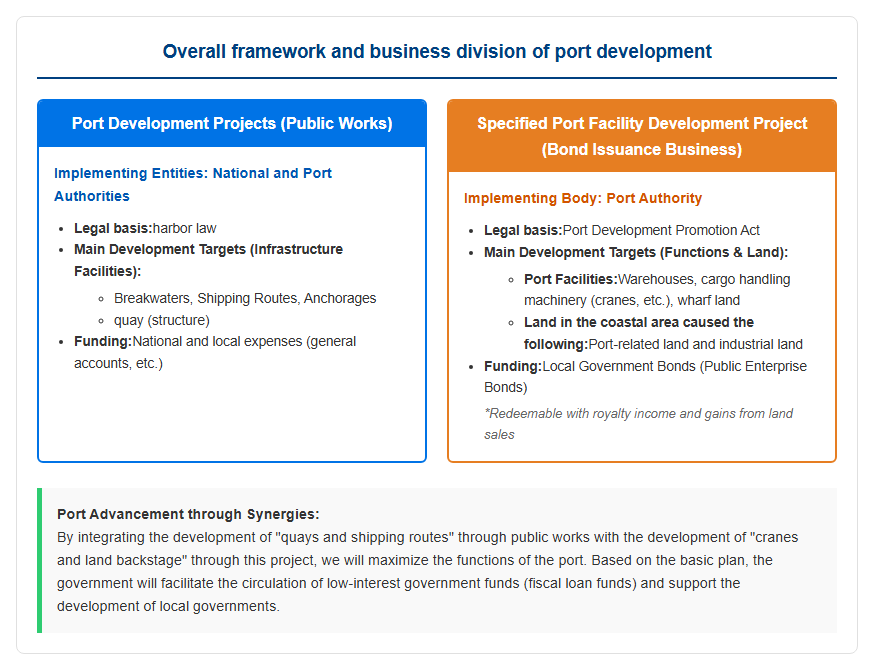
These projects consist of two pillars: the ‘Port Function Facility Development Project’ to maximize port functions, and the ‘Coastal Land Development Project’ that contributes to industrial development. The specific plans for each port are carefully selected, taking into account the status of the front-line quay development, consistency with land use plans, and coordination with local stakeholders. The diagram below shows the overall framework of port development.
Legal Framework Supporting Specified Port Facility Development Projects
The Specified Port Facility Development Project is a system implemented under the Port Development Promotion Act. The biggest feature of this project is that the port administrator directly raises funds through municipal bonds (public enterprise bonds), which are then redeemed through income from facility usage fees and gains from land sales.
The role of the national government (Ministry of Land, Infrastructure, Transport and Tourism) is to formulate basic plans after deliberations by the Transport Policy Council each fiscal year and obtain Cabinet approval, so that port operators can smoothly raise funds. Based on the basic plan approved by the Cabinet, the Minister of Land, Infrastructure, Transport and Tourism will mediate the provision of fiscal loan funds to the Ministry of Finance and others. In response, the government has a legal obligation to ensure the necessary funding is available.
The need for this system is because it must align with the development of quays and breakwaters as public works, and that the development of ‘tops’ such as shelters, cranes, and wharf sites must be carried out through creativity by private and local governments. The target ports include 5 international strategic ports, 18 international hub ports, 102 important ports, and 81 local ports designated by government ordinance, totaling 206 ports. The FY2026 plan was approved by the Cabinet to select projects from these ports that are highly urgent and highly effective for investment.
Logistics crisis and strategic investments in decarbonization
Addressing the 2024 Problem and Implementing AI Terminals
The “2024 Problem” facing the logistics industry is a serious challenge with concerns about insufficient transport capacity due to restrictions on truck drivers working overtime. Ports are expected to play an important role in solving this problem by serving as carriers for the modal shift to maritime transport and as hubs for improving overall logistics productivity through streamlined cargo handling operations.
The FY2026 plan strongly includes the promotion of an “AI terminal supporting humans” to address labor shortages and improve the working environment. Specifically, the following initiatives are being carried out.
-
Support for the introduction of remotely operated gantry cranes: By remoteizing crane operations, we promote the liberation from harsh high-altitude work and create environments where women and the elderly can also work.
-
Horizontal deployment of CONPAS (New Port Information System): By eliminating congestion at container terminals and reducing truck wait times, we aim to improve the efficiency of land transportation.
-
Digitization of port logistics procedures: By utilizing CyberPort, port logistics procedures between private operators can be digitized and visualized, dramatically boosting productivity in administrative tasks.
These measures are being developed and implemented in society ahead of the curve, especially at Keihin Port and Hanshin Port, which are strategic international container ports. For example, at Yokohama Port’s Honmoku BC Terminal, remotely operated RTGs (Tire Portal Cranes) have already begun, contributing to the maintenance and expansion of the number of port calls.
Accelerating the formation of carbon-neutral ports
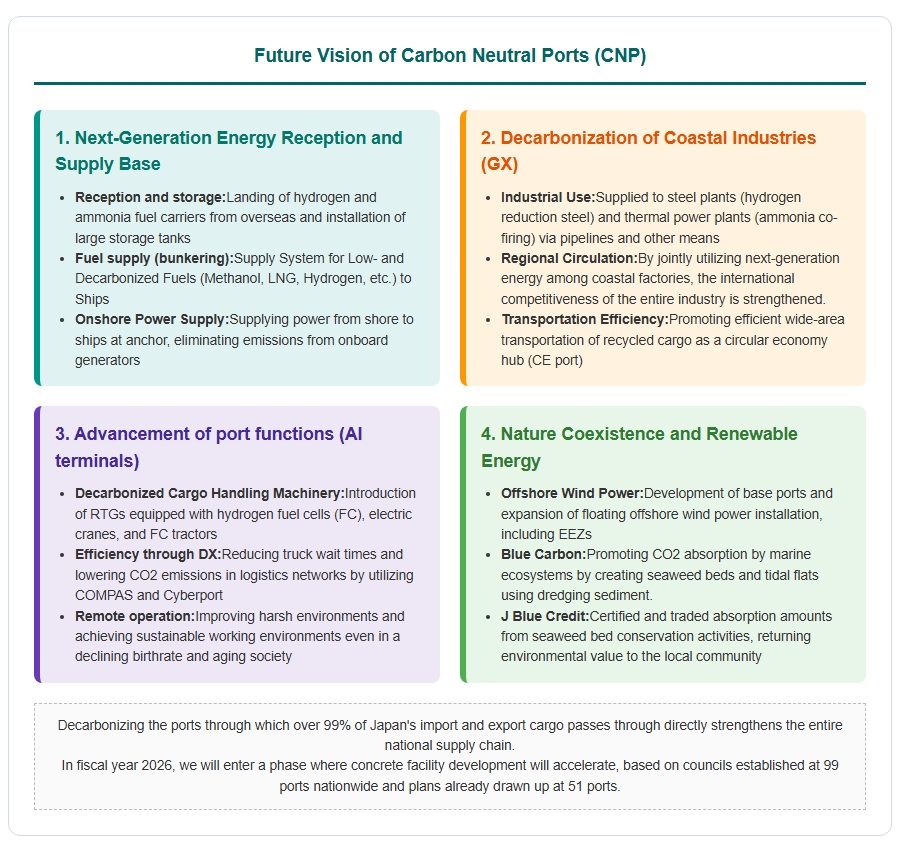
Amid the global trend toward decarbonization, achieving carbon neutrality at ports through which over 99% of import and export cargo passes through (CNP: Carbon Neutral Port) is a critical issue that determines the international competitiveness of our country’s industry. Shippers and shipping companies are demanding decarbonization across the entire supply chain, and ports that delay in responding to decarbonization risk being excluded from port calls.
The basic plan for fiscal year 2026 includes the development of advanced port functions aimed at forming a CNP.
-
Establishment of next-generation fuel reception environments: To establish systems for accepting, storing, and supplying next-generation fuels such as hydrogen, ammonia, and methanol, existing port facilities will be upgraded.
-
Decarbonizing cargo handling machinery: Promote the introduction of hybrid, electric, and even hydrogen-powered cargo handling machinery.
-
Shore power supply to ships: Equip facilities to supply power from shore so that ships at rest can stop engines and generate electricity, thereby reducing CO2 emissions.
As of the end of July 2025, the creation of the “Port Decarbonization Promotion Plan” has already been completed at 51 ports nationwide, with councils established at 99 ports. Fiscal Year 2026 will be a year when concrete facility developments based on these plans will become full-scale across the country. The following figure illustrates the future formation image of CNP.
Ensuring Economic Security and National Resilience
Disaster-Resilient Port Development and Aging Measures
Japan constantly faces risks of large-scale earthquakes and increasingly severe storms and floods, so strengthening ports to support the transport of relief supplies and the early reopening of industry during disasters is extremely important. In the FY2026 plan, strategic infrastructure maintenance will be promoted as the first year of the First Medium-Term Plan for National Resilience (FY2026–FY2000).
One particularly noteworthy aspect is the concept of “collaborative protection.” Ports are densely packed not only with public facilities but also with private factories and embankments, and if even a part of the area is not sufficiently raised, it can cause widespread flooding damage. Therefore, the framework for public and private sectors to collaborate on climate change adaptation goals and to advance protective measures through integrated hardware and software efforts will be strengthened.
Additionally, the aging of port facilities, which were intensively developed during the period of rapid economic growth, is also serious.
-
Shift to preventive maintenance: We are shifting from the traditional ‘repair after breaking’ post-maintenance to preventive maintenance that utilizes new technologies for planned repairs, aiming to reduce future maintenance costs.
-
Response to rising sea levels: Based on forecasts of future average sea level increases caused by climate change, the system will be expanded to reflect planned increases in coastal conservation facilities in long-life plans.
-
Early Restoration of Affected Ports: Based on lessons learned from the Noto Peninsula Earthquake, we will carry out intensive restoration work at affected ports from the end of fiscal year 2025 to fiscal year 2026 to support the resumption of regional economic activities.
Cybersecurity measures as core infrastructure
While the digitalization and automation of port logistics are advancing, the risk of logistics disruptions due to cyberattacks is increasing. Learning from lessons such as the system failure incident at Nagoya Port in 2023, the government has designated ports as “critical infrastructure” and has implemented legal and institutional protective measures.
Due to amendments to the Economic Security Promotion Act, from April 2025, general port transportation businesses have been added to the scope of “core infrastructure services.” Accordingly, from November 2025, the government will begin preliminary reviews by the government for major operators handling cargo at ports with an annual container handling volume of 800,000 TEU or more when outsourcing terminal operation systems (TOS) for the introduction and maintenance of their terminals.
The FY2026 plan also strengthens support to support the operation of these systems.
-
TOS vulnerability assessment: Diagnoses vulnerabilities in systems used by port carriers, and experts advise on appropriate countermeasures.
-
Cyberattack Scenario Training: Drills are conducted across both public and private sectors to confirm preparedness in case system failures occur.
-
BCP (Business Continuity Planning) Evaluation: We assist businesses in evaluating and creating BCPs and guidelines to promptly resume logistics even after a cyberattack.
Thus, not only physical resilience but also ensuring safety in the digital space is an essential element of modern port policy.
Regional Revitalization and Future Port Policy Focus
Regional Revitalization through Direct Producer Ports and ‘Minato Oasis’
Ports serve not only as hubs for international logistics but also as the “core of regional revitalization,” supporting regional industries and promoting resident exchanges. The government is strongly supporting the development of ‘direct production ports’ where producers and port stakeholders collaborate, aiming for a 5 trillion yen export value of agricultural, forestry, and fishery products and food products by 2030.
So far, at six ports in Hokkaido, as well as at Shimizu Port and Shibushi Port, we have developed cargo handling facilities capable of advanced hygiene management, as well as power supply equipment for reefer containers that support the cold chain. In fiscal year 2026, facility improvements will continue to be carried out to efficiently export local agricultural and marine products to the world.
Additionally, efforts to revitalize the flow of people and tourism on the soft side are also active.
-
Minato Oasis: As of July 2025, 168 locations nationwide have been registered as hubs for interaction among local residents and tourism promotion. Through events such as the National Sea-Class Gourmet Competition, we promote the appeal of the region.
-
Minato Green Space PPP: In 2022, a system was established in 2022 to allow private businesses to develop and operate profit-generating facilities such as cafes, and return those profits to the maintenance and management of green spaces, replacing port operators facing financial difficulties. The first project has been certified at places like Kobe Port, and the creation of high-quality, lively spaces is progressing.
-
Expansion of cruise ship acceptance: Aiming for a full-scale recovery in inbound cruise passengers, the reception environment is being advanced through renovations of passenger shelters and the development of covered passageways.
Medium- to Long-Term Outlook and Key Points Toward 2030
The Cabinet-approved FY2026 Plan marks an important step toward the grand design of Japan’s ports toward 2030. The following three key points are particularly noteworthy in future port policy.
First, further “selection and concentration” of international container strategic ports. In response to the rise of Asian ports, Keihin Port and Hanshin Port are accelerating the development of deep-water container terminals to accommodate larger vessels, maintaining and expanding calls on key international routes, and clearly demonstrating a commitment to safeguarding Japan’s supply chain.
Second, the conservation and utilization of designated remote islands. On designated remote islands such as Okinotorishima and Minamitorishima, the government will directly lead the development of port facilities that serve as bases for marine resource development and research. This is a challenge directly linked to the national strategy of securing maritime rights and interests.
Third, it is to contribute to new regional revitalization (Regional Revitalization 2.0). By developing a wide-area transportation network and linking ports, we aim to build seamless logistics and human flow networks even in rural areas.
Ports are transforming from mere “transshipment points” into hubs of the energy revolution, digital frontiers, and spaces that serve as regional pride. The development projects in fiscal year 2026 will serve as an important opportunity to concretize this transformation.
Reference Page
-
[Cabinet Approval of the ‘FY2026 Basic Plan for Specified Port Facility Development Projects’ ~ Approximately 76.2 billion yen of specified port facility development projects to be implemented at 73 ports nationwide ~] https://www.mlit.go.jp/report/press/port04_hh_000567.html
-
[FY2026 Port Bureau Budget Preliminary Request Summary – Ministry of Land, Infrastructure, Transport and Tourism] https://www.mlit.go.jp/page/kanbo01_hy_002651.html
[#閣議決定 #港湾整備 #物流2024年問題 #DX #カーボンニュートラル #国土強靱化 #経済安全保障 #地方創生]


コメント