From the end of July through August 2026, the Japanese government and the Bank of Japan conducted a record-breaking JPY 15 trillion-scale yen-buying foreign exchange intervention. Behind the joint yen-buying intervention by Japan and the U.S.—the first of its kind in about 28 years—was the alignment of both nations’ intentions to curb the rapid depreciation of the yen while also working to stabilize the U.S. Treasury market.
- The Full Picture of the Massive Live-Fire Market Intervention Exceeding 15 Trillion Yen
- The First Japan-US Joint Intervention in 28 Years and Its Background
- US Realism and the Utilization of FIMA Repo
- Chair Warsh’s Remarks and the Reversion to the “160-Yen Range”
- Interest Rate Differentials as a Structural Factor and Their Impact on Businesses and Households
- Future Outlook and Key Points for the September US and Japanese Central Bank Meetings
- Status of Foreign Exchange Intervention by the Ministry of Finance
- Official Systems of the Bank of Japan and the US Central Bank
- Institute for International Monetary Affairs Report
- Teikoku Databank Research Report
The Full Picture of the Massive Live-Fire Market Intervention Exceeding 15 Trillion Yen
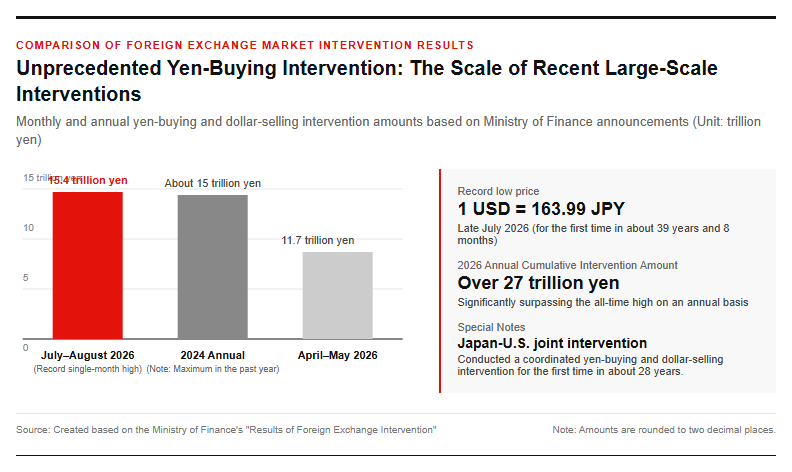
According to the implementation status of foreign exchange intervention released by the Ministry of Finance on August 28, 2026, the amount of foreign exchange intervention from July 30 to August 26, 2026, reached 15.3993 trillion yen. This is the largest-ever single-month amount for yen-buying, dollar-selling intervention. Surpassing the 11.7349 trillion yen intervention conducted between April and May 2026, the cumulative total for 2026 has exceeded 27 trillion yen. This is an unprecedented scale, vastly exceeding the approximately 15 trillion yen in 2024, which was the previous annual record. In late July 2026, the yen briefly depreciated to 163.99 yen per dollar, marking its lowest level in about 39 years and 8 months. To cope with this rapid fluctuation, the government and the Bank of Japan carried out a large-scale unilateral intervention on the night of July 30, pumping funds into the market for consecutive days through July 31. Please refer to the following chart summarizing the trends in foreign exchange intervention to date.
. As a result, the exchange rate temporarily surged to the 155-yen range, leading to volatile price movements. The sudden appreciation of the yen on the night of July 30 is estimated, based on the movement of the Bank of Japan’s current account deposits, to have involved a solo intervention by the Japanese government of up to approximately 9.3 trillion yen. This was followed by consecutive interventions starting the next day. Compared to past historical foreign exchange interventions—such as approximately $20 billion during the Asian financial crisis from 1997 to 1998, or approximately $35 billion at the time of the 2011 Great East Japan Earthquake—the scale of actual funds deployed over these few days is extremely large, reflecting the strong determination of the government and the BOJ to thoroughly curb speculative market movements.
The First Japan-US Joint Intervention in 28 Years and Its Background
What is particularly noteworthy about this intervention is that a joint intervention to buy yen was conducted by the Japanese and U.S. governments on July 31, 2026. A joint U.S.-Japan intervention to buy the yen was an extremely rare event, occurring for the first time in about 28 years since June 1998. In recent years, monetary authorities in Europe and the United States have taken the position that exchange rates should be determined by market fundamentals, and interventions have been carried out only in extremely limited circumstances. However, amidst the progression of a historic depreciation of the yen approaching 164 yen to the dollar, leaving further depreciation unchecked risked making it impossible to stop a self-fulfilling currency decline. This is an exceptionally unusual response, not seen since the Asian financial crisis in 1998 or the Great East Japan Earthquake in 2011. Please refer to the figure below for a summary of the history and effects of past joint interventions.
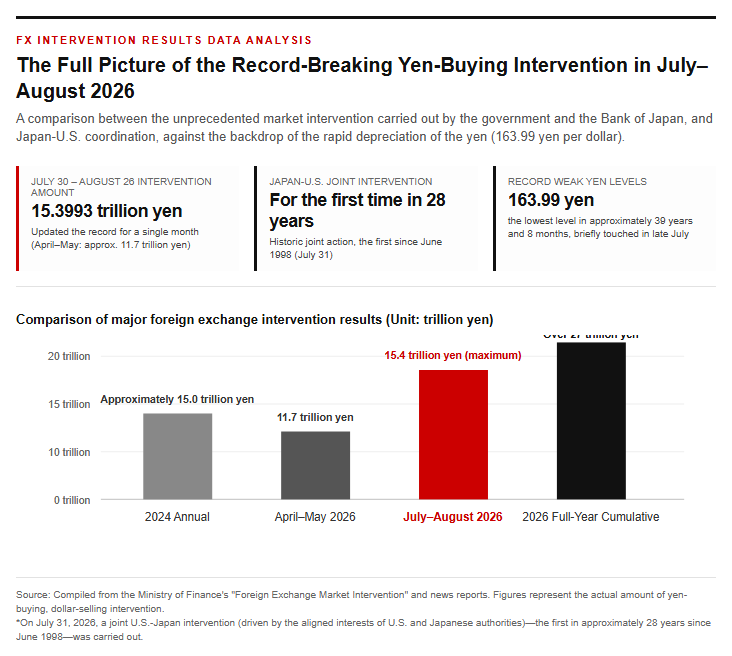
. Behind the United States’ decision to undertake joint intervention is the concern that the depreciation of the yen would drive up U.S. long-term interest rates. If Japan were to sell off massive amounts of its holdings of U.S. Treasuries on the market to secure funds for yen-buying intervention, U.S. Treasury prices would plummet and U.S. long-term interest rates would rise. To prevent this and avoid the risks of cascading depreciation of other currencies in the Asian region and financial instability such as an Asian currency crisis, the U.S. Department of the Treasury executed a joint intervention of selling euros and buying yen through the Federal Reserve Bank of New York.
US Realism and the Utilization of FIMA Repo
Behind the coordinated intervention lies a meticulous cooperative framework between Japan and the United States, as well as calculated self-interest on the U.S. side. In a statement released on August 3, 2026, Finance Minister Katayama explicitly stated that the U.S. Federal Reserve’s Repo Facility for Foreign and International Monetary Authorities (FIMA Repo Facility) is planned to be utilized in the future. This mechanism allows foreign central banks to temporarily procure dollar liquidity using U.S. Treasuries they hold as collateral, without having to sell those U.S. Treasuries on the market. When Japan conducts additional yen-buying interventions, it avoids having to sell U.S. Treasuries directly in the market, which offers a tremendous benefit to the U.S. side by controlling potential upward pressure on long-term interest rates. In addition to this, to avoid a decline in confidence caused by a weak dollar, the U.S. conducted the coordinated intervention not through dollar-selling, but through euro-selling and yen-buying. Vice Minister of Finance Mimura described this series of mechanisms as the completed form of the Japan-U.S. currency alliance, symbolizing a pragmatic realism between the two nations aimed at curbing the depreciation of the yen while protecting the U.S. Treasury market. It can be said that the cooperation between Japan and the U.S. goes beyond merely showing off an alliance; it was an extremely practical choice to ensure the stability of both countries’ financial markets.
Market Reversal and Future Economic Impact
Chair Warsh’s Remarks and the Reversion to the “160-Yen Range”
Despite the implementation of a record-breaking intervention exceeding 15 trillion yen, its effects remained only temporary. On August 28, 2026, the yen briefly plummeted to the lower 160 yen range against the U.S. dollar in the New York foreign exchange market, reversing back to the level seen before the joint intervention. The catalyst for this trend reversal was a speech delivered by Federal Reserve (FRB) Chair Warsh at Jackson Hole, Wyoming. In his speech, Chair Warsh expressed a hawkish stance, stating that he would not hesitate to take additional tightening measures, including interest rate hikes, unless there is clear confidence that the inflation rate is heading toward the 2% target. As a result, market expectations for an interest rate hike at the September Federal Open Market Committee (FOMC) meeting temporarily surged to over 60%, and the yield on 2-year U.S. Treasury bonds jumped to the 4.3% range. Just weeks earlier, expectations for rate cuts had emerged following the slowdown in the July U.S. employment report, but Chair Warsh’s remarks overturned that premise, reigniting dollar-buying and yen-selling driven by expectations of a widening interest rate differential between Japan and the U.S. The effects of the massive live intervention were thus washed away in a mere four weeks or so.
Interest Rate Differentials as a Structural Factor and Their Impact on Businesses and Households
What determines exchange rates over the medium to long term is not temporary currency intervention, but the structural issue of the interest rate differential between Japan and the United States. While the U.S. policy rate is in the 3.50% to 3.75% range, Japan’s policy rate remains at 1.00%, and unless this nominal interest rate differential narrows, the pressure from the yen carry trade—borrowing low-interest yen to invest in high-yield assets—will remain stubbornly persistent.
According to a corporate survey conducted by Teikoku Databank in May 2024, 63.9% of companies reported that the ongoing depreciation of the yen has a negative impact on their profits, with half holding the view that the appropriate exchange rate is in the 110 to 120 yen range per US dollar.
In a world where the 160-yen-to-the-dollar range becomes the norm, import costs for energy and raw materials will continue to rise, relentlessly squeezing the profits of domestic-demand-oriented companies and small and medium-sized enterprises (SMEs). Furthermore, price increases driven by the weak yen will weigh on household budgets through essential infrastructure such as electricity and gas, serving as a factor that dampens consumer sentiment. Meanwhile, economic polarization will advance further, as the situation proves beneficial for exporters with high overseas sales ratios and the inbound tourism industry, among others.
Future Outlook and Key Points for the September US and Japanese Central Bank Meetings
The decisive watershed for the future exchange rate will be the central bank meetings of Japan and the United States, held just days apart in mid-September 2026. The focal points will be whether the Fed makes a move toward an additional rate hike at the FOMC meeting from September 15 to 16, and whether the BOJ implements a 0.25% rate hike at its meeting from September 18 to 19. In the market, expectations are also emerging that the BOJ will implement further rate hikes within the year and that the terminal rate will climb to around 2.25%. Considering the real interest rate differential between Japan and the US, it is difficult to fundamentally correct the downward pressure on the yen unless the BOJ accelerates its pace of rate hikes. However, rate hikes entail serious side effects, such as rising mortgage rates and ballooning government bond interest payments. Within the Japanese government, Prime Minister Takaichi has shown a stance toward fiscal expansion, such as outlining a policy to cut the food consumption tax from 8% to 1%, but this could exert upward pressure on long-term interest rates and lead to further policy misalignment. As the actual ammunition of market intervention reaches its limits, the utmost point of attention is how rapidly the BOJ can construct a world with interest rates.
Primary Source for This News
Status of Foreign Exchange Intervention by the Ministry of Finance
Japan’s monetary authority, the Ministry of Finance (MOF), publishes the results of its foreign exchange market interventions on a monthly and quarterly basis. The figure of 15.3993 trillion yen announced as the intervention results for the period from July 30 to August 26, 2026, is primary information based on official Ministry of Finance data. Detailed daily data on the interventions is structured to be released several months later, which will clarify the precise timeline of actual funds deployed. In addition, the accompanying increases or decreases in foreign exchange reserves—particularly fluctuations in holdings of U.S. Treasuries and deposits—can be confirmed through the data on foreign exchange reserves and other related information published by the Ministry of Finance.
Japan’s Ministry of Finance discloses detailed trends in foreign exchange intervention amounts on its official website, making it possible to compare and verify them with past intervention cases. For example, the intervention results of 11.7349 trillion yen conducted from April to May 2026, as well as comparisons with the annual results for 2024, can all be verified through the Ministry of Finance’s statistical data. Regarding this historic Japan-U.S. joint intervention as well, official statements and reports record the process through which the Japanese government procured funds and reached an agreement with the U.S. Department of the Treasury. These data are published for the purpose of the sound operation of the foreign exchange market and ensuring transparency, and also play an important role in aiming for an announcement effect against speculative trading.
Official Systems of the Bank of Japan and the US Central Bank
The monetary policies and official frameworks of the Japanese and U.S. central banks that back up foreign exchange interventions are also extremely important as primary sources. From the official announcements of the Bank of Japan, it is possible to verify the past trajectory of policy interest rate hikes (the process of raising rates up to 1.00%) and the summary of Governor Ueda’s press conference at the Monetary Policy Meeting. Additionally, the FIMA Repo Facility, which was integrated into this intervention as a U.S. central bank mechanism, is an official liquidity-providing facility permanently established by the Federal Reserve Bank of New York and the Federal Reserve Board (FRB). The details, eligibility criteria, and maximum limits (currently $60 billion per institution) of these mechanisms are all defined in the central banks’ public documents. Accurately grasping these financial systems and interest rate trends is the key to unraveling the structural impact that this largest-ever coordinated intervention had on the market. Furthermore, the U.S. Department of the Treasury’s semi-annual foreign exchange policy reports submitted to Congress disclose the criteria for continuing to place Japan on the monitoring list and the background behind statements noting that excessive fluctuations in the yen are undesirable. These reports serve as premier documents for ensuring transparency in the currency policies of both Japan and the United States.
Reference Page
Institute for International Monetary Affairs Report
For the preparation of this article, we referred to a report published on August 12, 2026, by Masashi Hashimoto, Senior Research Fellow at the Institute for International Monetary Affairs, as a primary information source. The report provides an extremely detailed analysis of the background behind the first joint US-Japan yen-buying intervention in 28 years and the historical effects of past joint interventions. In particular, it cites four cases of joint intervention conducted since 1995 (dollar-buying in 1995, yen-buying in 1998, euro-buying in 2000, and yen-selling in 2011), explaining the mechanism by which, although the effects temporarily dissipate immediately after the intervention, they have served in the long term as precursors to market trend reversals. Additionally, it discusses the significance of the future utilization of the FIMA Repo Facility introduced in this intervention and how it functions as a mechanism to prevent a rapid sell-off of U.S. Treasuries, offering an important perspective for understanding the structure of financial markets.
– 【Public Interest Incorporated Foundation, Institute for International Monetary Affairs, “Background and Impact of the First Joint US-Japan Yen-Buying Intervention in 28 Years”】https://www.iima.or.jp
Teikoku Databank Research Report
The analysis on the impact on businesses presented in this article is based on a fact-finding survey released by Teikoku Databank, Ltd. on May 17, 2024. Conducted via the internet between May 10 and 15, 2024, targeting 1,046 companies, this survey highlights the specific impacts that the rapid depreciation of the yen is having on corporate activities within Japan. According to the survey results, 63.9% of responding companies reported that the ongoing depreciation of the yen has a negative impact on their profits, and more than half of the companies consider the appropriate exchange rate level for their business to be in the 110 to 120 yen per US dollar range. It records vivid voices from the front lines—such as the hardships faced by companies unable to fully pass on soaring imported raw material costs to their own products and services, and the cooling of personal consumption due to rising prices—making it an extremely reliable primary source for examining the damage that the structural depreciation of the yen inflicts on domestic-demand-driven industries and small and medium-sized enterprises.
– 【Teikoku Databank, Ltd. “Corporate Survey on the Impact of the Weak Yen (May 2024)”】https://www.tdb.co.jp/
[#ForeignExchangeIntervention #JointIntervention #DollarYen #JapaneseEconomy #MonetaryPolicy #FRB #BOJ #FIMARepo]


コメント