Japan’s long-term interest rates temporarily surged to 2.950%, hitting their highest level in approximately 30 years. This was driven by a resurgence of expectations for interest rate hikes in the U.S., expectations for additional domestic rate hikes, and concerns over increased government bond issuance associated with aggressive fiscal policies by the Takaichi administration.
- The Historic Surge in Interest Rates and the Core of the Events
- The Chain Reaction Triggered by US and Japanese Monetary Policy
- Increase in Risk Premium Caused by Expansionary Fiscal Policy
- Impact on Corporate Activities and the Issue of Refinancing Interest-Bearing Debt
- Mortgage Interest Rate Trends Directly Hitting Household Budgets
- Future Outlook and Key Points to Watch
The Historic Surge in Interest Rates and the Core of the Events
In the Tokyo bond market on August 31, 2026, the yield on newly issued 10-year government bonds—the benchmark for long-term interest rates—temporarily rose to 2.950%, causing bond prices to fall. This interest rate level marks a historic high, reaching levels not seen in approximately 30 years since October 1996. On the same day, the 2-year bond yield also reached 1.725%, a level unseen since 1995, resulting in a market-wide sell-off of bonds. Behind this rapid rise in interest rates are hawkish remarks by Federal Reserve (FRB) Chair Warsh at the Jackson Hole Symposium held in Wyoming, USA, on August 28 of the same year. By hinting at additional rate hikes amid vigilance over persistent inflation, U.S. Treasury yields rose, which directly spilled over to the Tokyo market at the start of the week. Moreover, compounding caution in Japan regarding an early additional rate hike by the Bank of Japan (BOJ) and concerns over increased government bond issuance stemming from the government’s expansionary fiscal policy, it is now being whispered that breaking the psychological milestone of 3% is only a matter of time.
The Chain Reaction Triggered by US and Japanese Monetary Policy
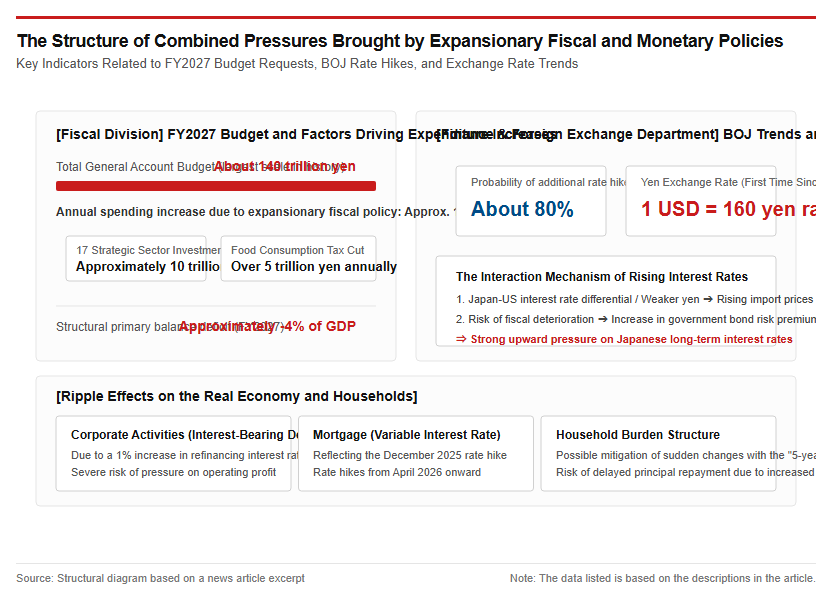
Expectations surrounding monetary policy both at home and abroad are linked, intensifying upward pressure on interest rates. The Bank of Japan raised its policy interest rate to 0.75% in December 2025, and further to around 1% in June 2026. In the market, the probability that the BOJ will implement another rate hike at the Monetary Policy Meeting to be held from September 17 to 18 has reached approximately 80%. Amid these circumstances, U.S. Treasury Secretary Scott Bessent showed a stance of de facto approval toward BOJ Governor Kazuo Ueda’s decision to raise interest rates. With the interest rate differential between Japan and the U.S. coming into focus, selling of the yen and buying of the dollar became dominant in the foreign exchange market, causing the yen exchange rate to temporarily drop to the 160 yen range per dollar. This is the first level of depreciation for the yen since the large-scale foreign exchange intervention conducted at the end of July, and it will further increase domestic inflationary pressure through rising import prices. As rising interest rates in Japan and the U.S. and the depreciation of the yen stimulate each other, strong upward pressure continues to be exerted on Japan’s long-term interest rates.
Increase in Risk Premium Caused by Expansionary Fiscal Policy
The responsible proactive fiscal policy promoted by the Sanae Takaichi administration is also a contributing factor to the rise in interest rates. Budget requests submitted by various ministries and agencies for the FY2027 budget compilation are expected to reach a record-high general account total of approximately 140 trillion yen, following the removal of spending caps for areas such as economic growth and crisis response. This includes proactive fiscal measures such as investments in 17 strategic fields expected to total around 10 trillion yen annually and a reduction in the consumption tax on food items projected to require over 5 trillion yen annually, with a combined expenditure increase expected to reach about 15 trillion yen per year. Such expansive fiscal policies raise concerns that the central government’s structural primary balance deficit will widen to approximately -4% of nominal GDP in FY2027. Investors concerned about the worsening state of public finances are accelerating their sell-off while factoring in the risk premium associated with holding Japanese Government Bonds, which is strongly fueling the surge in interest rates.
Broad Impact on the Real Economy and Life Planning
Impact on Corporate Activities and the Issue of Refinancing Interest-Bearing Debt
The rise in long-term interest rates significantly pressures the financing costs of corporate activities in the real economy. Across various sectors, including the information and communication industry, many companies carry interest-bearing debt through borrowings from financial institutions and the issuance of corporate bonds for the purpose of business expansion, such as opening AI data centers, making DX (Digital Transformation) investments, and conducting M&As. When estimating the profit impact on these companies assuming a 1-percentage-point increase in refinancing rates for interest-bearing debt coming due for repayment or redemption within the next two years, there are numerous cases where the average operating profit of the most recent three fiscal periods would be heavily squeezed. Companies with approaching repayment and redemption schedules will be forced to refinance at higher interest rates, thereby taking a direct hit from the rising interest rates. In the stock market, complex effects are emerging: while the banking sector and other industries benefiting from higher interest rates are being bought, driving consecutive gains in the Tokyo Stock Price Index (TOPIX), downward pressure is being applied to growth stocks burdened with heavy debt.
Mortgage Interest Rate Trends Directly Hitting Household Budgets
The surge in long-term interest rates is also bringing about significant changes to the mortgage environment, which is directly tied to household finances. Fixed mortgage rates (such as Flat 35), which are determined in conjunction with newly issued 10-year government bond yields, are already showing a gradual upward trend, and further hikes are considered inevitable if inflation continues. In response to this, momentum is growing to consider early borrowing, with the sentiment that “if you’re going to borrow, do it soon.” Meanwhile, regarding variable interest rates—used by over 70% of mortgage holders—the Bank of Japan’s interest rate hike in December 2025 is expected to impact the short-term prime rate, and the increase in the benchmark rate is projected to be reflected in the applied interest rates from April 2026 onward. Although variable rates are subject to the “5-year rule” and the “125% rule,” which curb sudden surges in payment amounts, the interest burden itself will increase, creating a risk that the pace of principal repayment will slow down. Please refer to the figure below.
Future Outlook and Key Points to Watch
The future focus will be on the final destination level of Japanese interest rates and the resilience of the market and the national finances against them. According to expert forecasts, the Bank of Japan’s policy interest rate is expected to be raised to around 2% by the end of fiscal 2027, with long-term interest rates rising to around 3.6% and moving into a phase that keeps entering the 4% range in sight. As the Bank of Japan proceeds with quantitative tightening (QT) by gradually reducing its purchases of government bonds, the stock effect that had been depressing interest rates will steadily diminish, placing further upward pressure on government bond yields. Along with this, the government’s interest payment costs—burdened by a massive outstanding balance of government bonds exceeding 1,000 trillion yen—will rapidly increase. Interest payment costs in the general account are projected to reach more than four times the fiscal 2025 level by fiscal 2040, bringing fiscal sustainability into even sharper focus. How the political and monetary policy authorities of Japan and the United States will control the “negative spiral,” in which concerns over fiscal deterioration trigger further sudden spikes in interest rates, will be the center of attention in predicting future economic trends.
Reference Page
- [Cabinet Secretariat: “Basic Policy for Introducing the Refundable Tax Credit System” (Cabinet Decision of August 5, 2026)] https://www.cas.go.jp/jp/seisaku/kokuminkaigi/contents/20260805/01_siryou1.pdf
- [U.S. Congressional Budget Office “The Budget and Economic Outlook: 2026 to 2036”] https://www.cbo.gov/publication/61882
【#Economy #LongTermInterestRates #MonetaryPolicy #BankOfJapan #FiscalIssues #Inflation #HomeLoans】

コメント