Kawasaki Heavy Industries has announced that it will establish one of the largest testing facilities for liquefied hydrogen-related equipment in Japan at its Harima plant in Hyogo Prefecture, aiming to begin operations within fiscal year 2027. This move aims to accelerate technological demonstrations toward commercializing the hydrogen supply chain by 2030 and secure leadership in the international decarbonization market.
- One of Japan’s largest hydrogen technology development bases to be established at the Harima Plant
- Advanced Technology Demonstration Required in an Ultra-Low Temperature Environment of Minus 253 Degrees Degrees
- A commercialization demonstration project worth 300 billion yen and its economic feasibility
- The battle for the leadership of next-generation fuels between “liquefied hydrogen” and “ammonia”
- Learning from the History of Hydrogen Accidents: The Importance of Demonstration Testing
- The world’s first commercial-scale terminal began operations in the Kawasaki waterfront area
- Building an international hydrogen logistics network involving Canada and Australia
One of Japan’s largest hydrogen technology development bases to be established at the Harima Plant
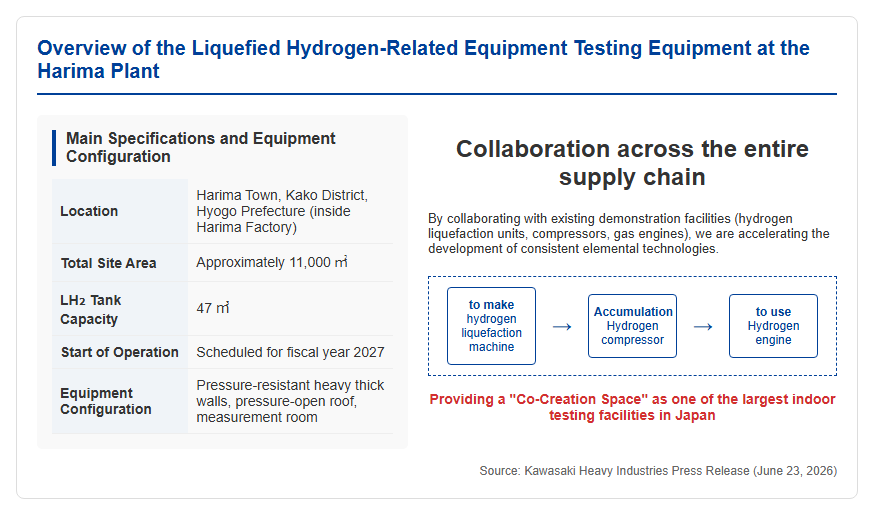
Kawasaki Heavy Industries has decided to establish a new testing facility for liquefied hydrogen-related equipment at its hydrogen technology development base at its Harima plant (Harima Town, Kako District, Hyogo Prefecture). This facility covers a vast site of approximately 11,000 square meters and will be one of the largest indoor testing facilities in Japan, capable of handling and testing liquefied hydrogen liquids at practical capacity. The equipment configuration will include heavy pressure-resistant walls, pressure-open roofs, a liquefied hydrogen tank with a capacity of 47 cubic meters, and a measurement room.
Notably, this facility is positioned as a co-creation space that goes beyond its own exclusive boundaries, opening up to universities, research institutions, and even partner companies. We aim to start operations within fiscal year 2027, covering a wide range of development targets, from functional demonstrations at the equipment and device level to part-level operation verification and material-level property evaluation. Within this site, demonstration facilities for centrifugal hydrogen compressors, hydrogen gas engines, and hydrogen liquefaction machines are already installed. By collaborating with these, a system is established to simultaneously develop core technologies across the entire hydrogen supply chain—including production, extraction, storage, and use—in a short period. Please refer to the diagram below.
Advanced Technology Demonstration Required in an Ultra-Low Temperature Environment of Minus 253 Degrees Degrees
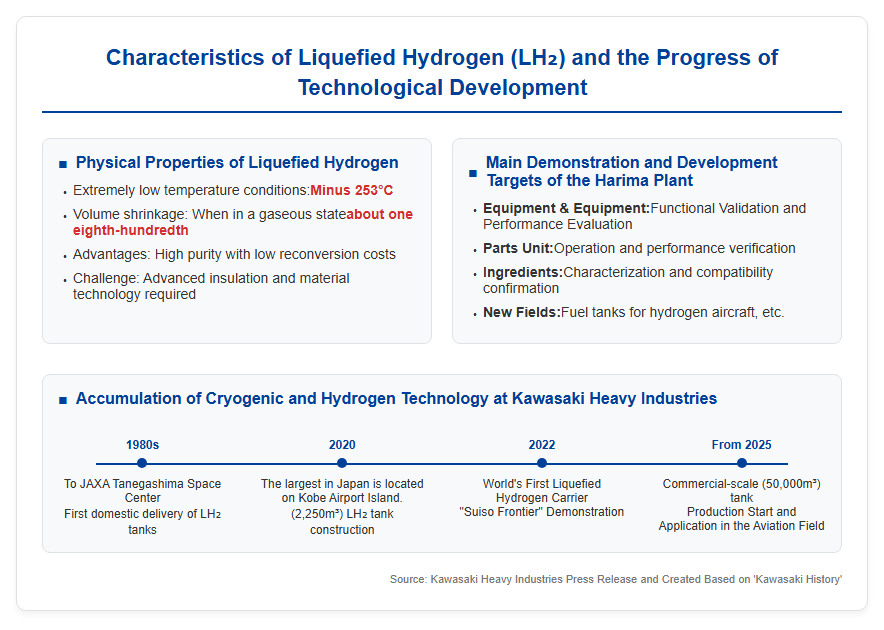
Handling liquefied hydrogen presents extremely high physical hurdles. To convert hydrogen from gas into liquid, it must be cooled to an extremely low temperature close to absolute zero, at minus 253 degrees, during which its volume shrinks to one-eighth-hundredth of its original volume. Selecting materials that can withstand this extremely low temperature, establishing insulation structures that minimize heat intrusion, and ensuring precise operation of pumps and valves under ultra-low temperatures are essential steps toward commercialization. Kawasaki Heavy Industries has accumulated cryogenic technology through deliveries of tanks to JAXA’s Tanegashima Space Center in the 1980s and the successful transport between Japan and Australia using the world’s first liquefied hydrogen carrier, the Suiso Frontia.
With this new facility development, it will be possible to repeatedly validate these cultivated technologies on an even larger and practical scale. Especially in the current situation where the application of technology has expanded into the aviation field, such as successful filling tests of fuel tanks for hydrogen aircraft, building reliable quality using real liquid solutions forms a solid technical foundation supporting the safety and security of the hydrogen society. This enables the acquisition of knowledge and technical refinement unique to full-scale scale, which cannot be achieved through conventional computational simulations alone. Please refer to the diagram below.
Management Strategies Aiming for Dominance in a Hydrogen Society
A commercialization demonstration project worth 300 billion yen and its economic feasibility
This test facility development is positioned as part of the “Commercialization Demonstration of the Liquefied Hydrogen Supply Chain,” selected as a Green Innovation Fund project of NEDO (New Energy and Industrial Technology Development Organization). This project is a large-scale national initiative with a scale of about 300 billion yen, of which about 220 billion yen will be supported by the government. Through this demonstration, Kawasaki Heavy Industries aims to establish a hydrogen supply system of several tens of thousands of tons annually by 2030, and over 200,000 tons in the future, aiming to achieve a target price of 30 yen per standard cubic meter for onboard delivery costs.
On the management side, in the “Group Vision 2030,” we have set energy and environmental solutions as key focus areas, setting ambitious targets of over 10% business profit margin and 3 trillion yen in sales revenue for fiscal 2030. Early monetization of the hydrogen business is considered the top priority, and strategic cash allocation is being implemented for research and development and capital investment. Despite the increasing trend of interest-bearing debt, the company’s commitment to developing hydrogen-related infrastructure as an investment for future growth reflects the company’s strong determination.
The battle for the leadership of next-generation fuels between “liquefied hydrogen” and “ammonia”
In the transportation of next-generation energy, there is an intense battle for control between ‘liquefied hydrogen,’ promoted by Kawasaki Heavy Industries, and ‘ammonia,’ which is easy to repurpose with existing infrastructure. The greatest advantage of liquefied hydrogen lies in its high purity. The great appeal is that it can be immediately deployed in high-precision applications such as fuel cells and semiconductor manufacturing, without the hassle of reconversion. Meanwhile, ammonia is expected to act as a step-by-step relay for decarbonizing coal-fired power plants, such as co-firing at power plants, with major power companies like JERA and IHI accelerating demonstrations.
In response to this discussion, Kawasaki Heavy Industries asserts that direct use of hydrogen is essential for the ultimate clean energy society, and is adopting a strategy of fully dedicating itself to liquefied hydrogen technology. While ammonia requires enormous energy consumption and impurity removal costs to convert back to hydrogen, liquefied hydrogen can be positioned as a “core infrastructure” that minimizes conversion losses once infrastructure is established. The equipment setup at the Harima plant can be seen as a stepping stone to further raise technical entry barriers and demonstrate technological superiority to the ammonia camp.
Safety technologies and infrastructure supporting social implementation
Learning from the History of Hydrogen Accidents: The Importance of Demonstration Testing
Ensuring safety is an unavoidable aspect of realizing a hydrogen society. Analysis of past hydrogen gas accidents shows that among the 172 valid domestic accidents between 1949 and 2002, most were caused by “human factors” such as poor tightening of piping flanges or valve misoperation, as well as inspection failures and design and structural defects. Hydrogen, in particular, is prone to explosions and ruptures, and once an accident occurs, it can lead to enormous human casualties.
Precisely because of this background, it is extremely important to develop new facilities with harsh testing environments at a practical scale. With the new facility, multiple laboratories allow for a wide range of tests tailored to different products in parallel, thoroughly verifying everything from part-level operation verification to overall system reliability evaluation. The challenge is how to eliminate past accident factors such as impurity accumulation and cracks caused by aging deterioration, and repeated verification using real liquids is the only way to increase public acceptance of a hydrogen society.
The world’s first commercial-scale terminal began operations in the Kawasaki waterfront area
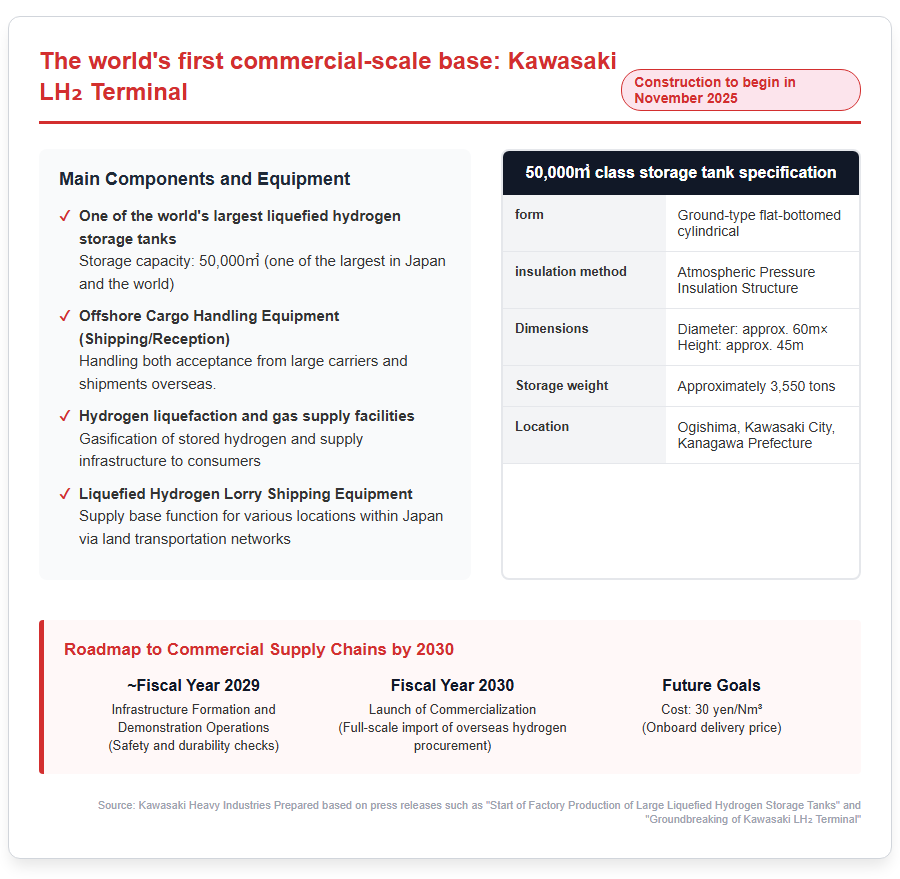
Alongside technological development at the Harima plant, the infrastructure that will serve as an actual supply base is also steadily progressing. In November 2025, Kawasaki Heavy Industries held a groundbreaking ceremony for the liquefied hydrogen terminal “Kawasaki LH₂ Terminal” on the JFE Steel site in Ogishima, Kawasaki City. This facility will be the world’s first commercial-scale facility, equipped with one of the world’s largest liquefied hydrogen storage tanks with a storage capacity of 50,000 cubic meters, and will cover offshore cargo handling and hydrogen liquefaction facilities.
The 50,000-cubic-meter above-ground flat-bottom cylindrical tank, which forms the heart of this terminal, was developed in-house by combining Kawasaki Heavy Industries’ long-cultivated expertise in LNG tank manufacturing with cryogenic technology for JAXA. Compared to conventional spherical tanks, it enables larger storage capacities and greatly contributes to cost reduction through economies of scale. By supporting the actual operation of such massive infrastructure with equipment polished at Harima’s testing facility, the puzzle of “making, extracting, storing, and using” toward commercialization by 2030 is coming together as one. Please refer to the diagram below.
Future Outlook and Global Competition
Building an international hydrogen logistics network involving Canada and Australia
Kawasaki Heavy Industries’ focus extends beyond Japan, focusing on securing supply sources on a global scale. In April 2026, we signed a memorandum of understanding (MOU) with an organization in Alberta, Canada, for a feasibility study to build a liquefied hydrogen supply chain. By considering routes to export inexpensive, low-carbon Canadian hydrogen to Japan, the aim is to diversify sourcing sources from the perspective of energy security.
In addition to the brown coal-derived hydrogen project in Australia, the development of the North American route will greatly contribute to diversifying geopolitical risks within Japan’s basic hydrogen strategy. In January 2026, we signed a shipbuilding contract for the world’s largest 40,000-cubic-meter liquefied hydrogen carrier, and laying solid groundwork both in terms of hardware and software toward commercialization by fiscal year 2030. In the future, as global hydrogen trade intensifies, whether Japan’s liquefied hydrogen technology becomes the de facto standard (de facto standard) or the start of trial equipment operation at the Harima plant will be a crucial milestone that determines the success or failure of that event.
[#川崎重工業 #液化水素 #水素サプライチェーン #カーボンニュートラル #グリーンイノベーション基金 #エネルギー安全保障 #クリーンエネルギー #2030年目標]


コメント