The Nikkei Stock Average extended its decline during the morning session on September 10, dropping over 950 yen at one point before closing the morning down 545 yen. The sell-off was driven by growing caution over surging crude oil prices amid escalating Middle East tensions and rising US long-term interest rates.
- Behind the Sudden Drop: Nikkei Plunges Over 950 Yen at One Point
- TSE Prime Market Sees Widespread Declines as Declining Stocks Surge
- Escalating Middle East Tensions and Oil Price Spikes Fuel Inflation Fears
- Rising US Long-Term Yields and Capital Inflows into Domestic Financials
- Sector Rotation: Capital Shifts from Semiconductors to Power Infrastructure and Energy
- Key Focus Points: Major SQ Settlement and Central Bank Meetings
Behind the Sudden Drop: Nikkei Plunges Over 950 Yen at One Point
During the morning session on the Tokyo Stock Exchange on September 10, 2026, the Nikkei Stock Average faced a sharp continuation of its recent decline. Opening lower than the previous day’s close, the market struggled to mount a recovery, with the benchmark index pushed down by over 950 yen at its trough into the mid-64,000 yen range. The morning session ended at 64,597.46 yen, down 545.32 yen (-0.84%) from the previous day, marking three consecutive days of losses. Following a weak session on Wall Street—where the Dow Jones Industrial Average dropped 405.41 points to 52,380.66 and the Nasdaq Composite fell 168.07 points to 26,253.34—selling pressure dominated from the opening bell across a broad spectrum of issues. The following chart illustrates the stock price trajectory and index performance during the morning session on the 10th.
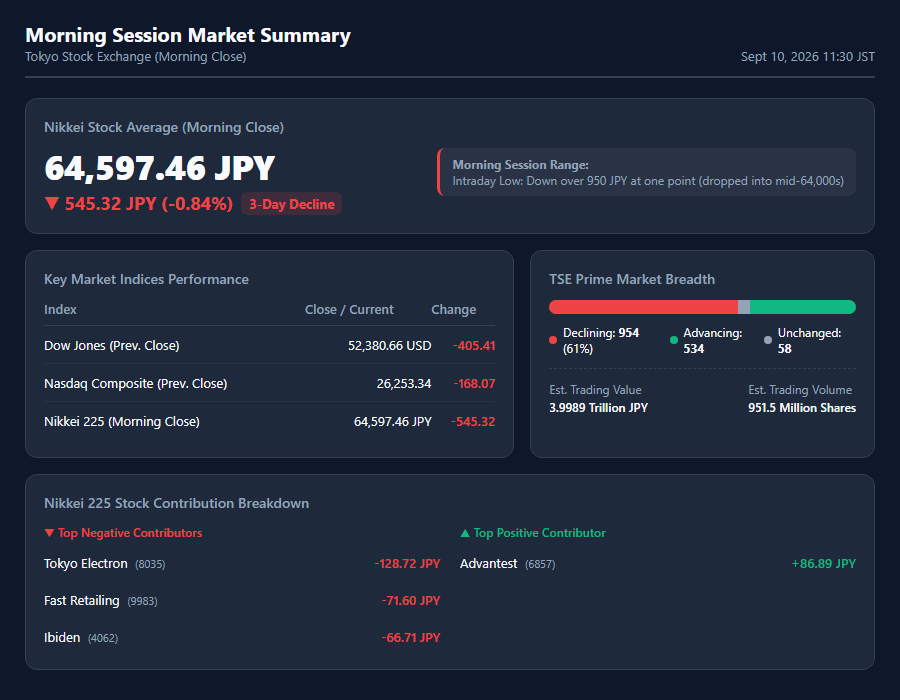
Looking at individual stock contributions, major high-priced blue chips heavily weighed on the index. Tokyo Electron (8035) single-handedly dragged the Nikkei down by 128.72 yen, while Fast Retailing (9983) subtracted 71.60 yen and Ibiden (4062) cut 66.71 yen, demonstrating how declines in specific heavyweights drove the overall benchmark lower.
TSE Prime Market Sees Widespread Declines as Declining Stocks Surge
On the TSE Prime Market during the morning session, risk-averse sentiment was starkly visible, with 954 issues—representing over 60% of all listed stocks—falling. Only 534 stocks advanced, while 58 remained unchanged. Estimated trading volume reached 951.5 million shares, with trading value hitting an estimated 3.9989 trillion yen, underscoring heavy trading activity dominated by persistent selling pressure. Looking at the TSE’s 33 industry sectors, Nonferrous Metals, Other Products, and Glass & Ceramics Products ranked among the top decliners, as profit-taking spread across raw materials and core manufacturing stocks that had recently enjoyed gains. Gaming and entertainment names also retreated across the board, including Nintendo (7974), Konami Group (9766), and Bandai Namco Holdings (7832). In contrast, Advantest (6857) bucked the broader market downturn, lifting the Nikkei by 86.89 yen and highlighting a stark divergence in performance among individual stocks.
External Drivers: Tensions, Interest Rates, and Crude Oil Dynamics
Escalating Middle East Tensions and Oil Price Spikes Fuel Inflation Fears
The primary catalyst behind the market downturn was a sharp rise in geopolitical risk in the Middle East, which triggered a sudden spike in crude oil prices. Reports of escalating hostilities and expanding military strikes between Israel and Iran sparked immediate global energy supply concerns. Brent crude futures broke above \$101 per barrel, reaching their highest level since July 2026. The rapid surge in oil prices reignited fears of renewed global inflation and margin compression for businesses, dealing a heavy blow to investor sentiment. Concerns escalated that rising energy costs would be passed on to product prices and logistics, slowing global economic growth and triggering a chain reaction of risk-off selling from Wall Street to Tokyo. While higher oil prices spurred buying in the Oil & Coal Products sector (such as ENEOS Holdings) and the Mining sector (such as INPEX), it was insufficient to offset the overarching inflation anxiety hanging over the broader market.
Rising US Long-Term Yields and Capital Inflows into Domestic Financials
Compounding geopolitical risks, upward pressure on long-term interest rates in both the US and Japan weighed heavily on equities. After the US Department of the Treasury announced an expansion of its bond buyback program (a threefold increase) that fell short of market expectations, selling in the US Treasury market pushed long-term yields higher. This rise in US yields transmitted upward pressure to Japanese long-term rates, prompting equity selling among investors sensitive to higher borrowing costs. In foreign exchange markets, the US dollar traded in the mid-153 yen range against the Japanese yen, where caution over potential yen appreciation further capped any rebound in Japanese shares. Conversely, financial sectors expected to benefit from improving net interest margins during rate-hike environments attracted robust capital inflows. Banking, Securities, and Commodities Futures ranked among the top sector gainers, with Mitsubishi UFJ Financial Group (8306) and Shizuoka Financial Group (5831) trading firmly to lend underlying support to the market.
Sector-Level Capital Shifts and Mid-to-Long-Term Outlook
Sector Rotation: Capital Shifts from Semiconductors to Power Infrastructure and Energy
Beneath the surface of the Nikkei’s headline drop, a dynamic capital rotation across market themes is underway. While profit-taking has begun to emerge in generative AI and semiconductor-related stocks that previously powered the market rally, substantial capital is being reallocated into power infrastructure and electrical wire sectors, where demand is surging due to rapid data center expansion. The diagram below illustrates the capital flow between sectors and the correlation among key stocks.
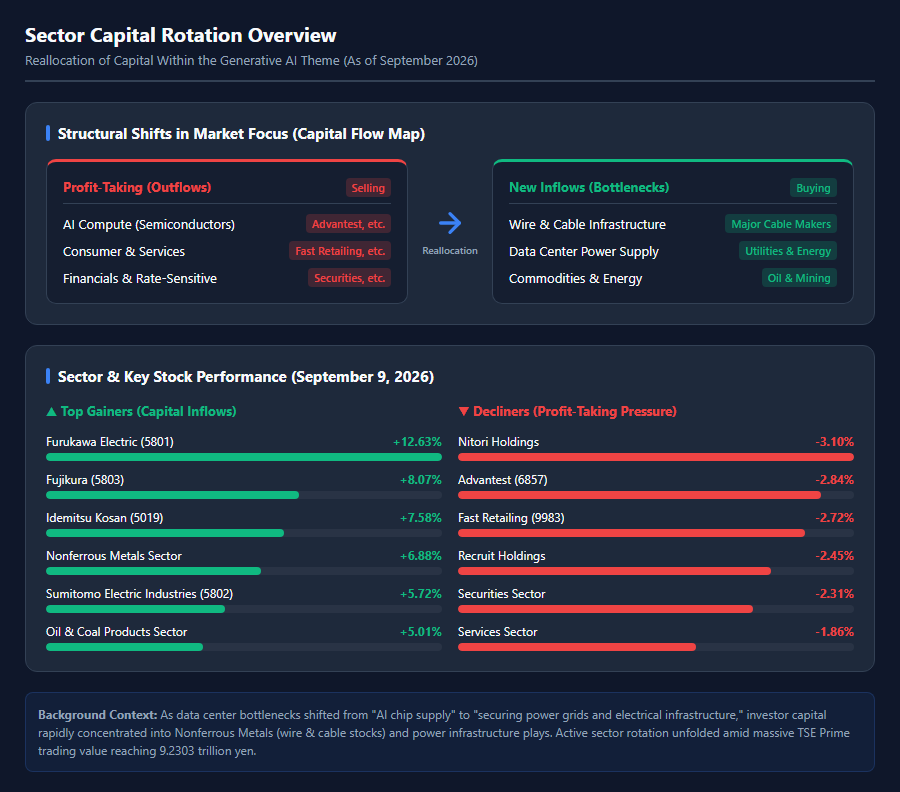
On September 9, 2026, the Nonferrous Metals sector jumped 6.88%, led by sharp gains in Furukawa Electric (5801) (+12.63%), Fujikura (5803) (+8.07%), and Sumitomo Electric Industries (5802) (+5.72%). Although these wire and cable stocks experienced a temporary pullback in the morning session on the 10th, capital inflows targeting long-term structural shifts—such as skyrocketing electricity demand and infrastructure investment—remain intact, driving greater diversification in market focus.
Key Focus Points: Major SQ Settlement and Central Bank Meetings
Looking ahead, short-term supply-demand dynamics and upcoming central bank monetary policy decisions will be critical market determinants. On Friday, September 11, 2026, the TSE faces its major Special Quotation (SQ) settlement, intensifying positioning battles among institutional investors in Nikkei 225 futures and options. Derivatives analysis indicates that the 65,000 yen level serves as a solid support floor, while the 65,500 to 66,000 yen range acts as overhead resistance, suggesting volatile, range-bound trading. Furthermore, next week features back-to-back monetary policy meetings: the US Federal Open Market Committee (FOMC) on September 15–16, followed by the Bank of Japan (BOJ) on September 17–18. Rate cut decisions under newly appointed Fed Chair Warsh and the hawkish stance of BOJ Policy Board member Masu will significantly influence market volatility, requiring investors to carefully monitor both monetary policy trajectories and Middle East developments.
References
- 【Analysis of Rapid Market Fluctuations in the Japanese Stock Market in Early August 2024】https://www.fsa.go.jp/common/about/kaikaku/fsaanalyticalnotes/20250108/02.pdf
【#Nikkei225 #StockMarket #JapaneseStocks #OilPrices #Forex #Inflation】


コメント