
Japan’s Corporate Goods Price Index (CGPI) rose 7.6% year-on-year in August 2026, according to preliminary data released by the Bank of Japan on September 11, maintaining a near-high level driven by market expectations. Prolonged energy costs linked to US-Iran tensions and a persistent weak yen continue to fuel cost pressures, raising concerns about spillover into consumer inflation.
- Overview of August 2026 CGPI and Market Reaction
- Item-by-Item Price Fluctuations and Import Cost Transmission Channels
- Current State and Challenges of Price Pass-Through in Supply Chains
- Commercial Practice Reforms and Regulatory Adjustments in Logistics
- Consumer Price Index (CPI) Transmission and Household Burdens
- Bank of Japan Monetary Policy Decisions and Key Points Ahead
Overview of August 2026 CGPI and Market Reaction
The preliminary Corporate Goods Price Index (CGPI, 2020 average = 100) released by the Bank of Japan on September 11, 2026, stood at 136.1, up 7.6% year-on-year. Although the growth rate narrowed slightly by 0.1 percentage points from July’s 7.7% increase, it exceeded the median forecast of 7.4% among private market research institutions. On a month-on-month basis, the index declined by 0.2%, yet overall corporate prices continue to hover near their highest levels in roughly three and a half years. Even after adjusting for summer electricity tariff surcharges, the index rose 7.7% year-on-year and fell 0.1% month-on-month, signaling that price pressures in inter-firm transactions remain persistently strong. Key catalysts include rising resource prices—such as crude oil and natural gas driven by prolonged military conflicts between the United States and Iran—alongside a structurally weak yen in foreign exchange markets. The yen-based import price index climbed 24.8% year-on-year, and although this marks a deceleration from July’s 29.3% surge, import costs remain exceptionally elevated. Refer to the figure below.
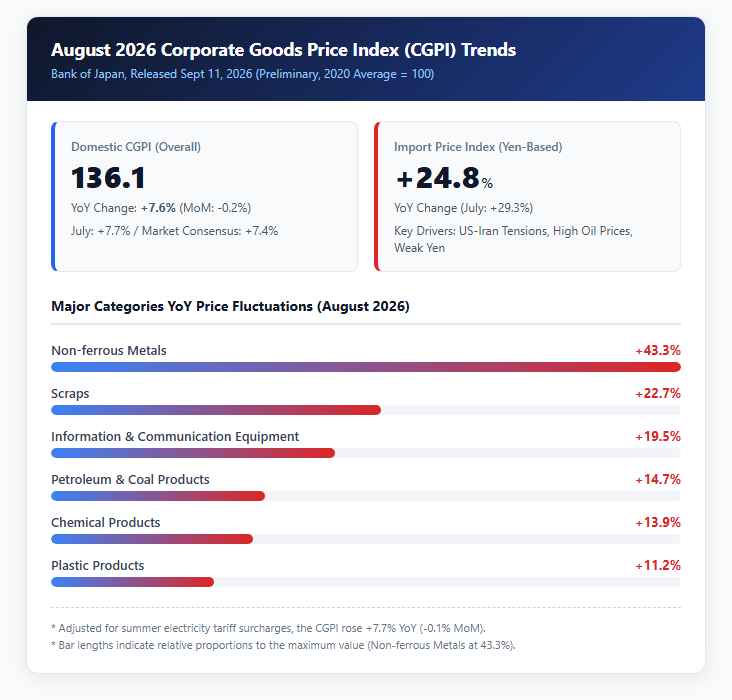
This sustained high cost of imported raw materials and fuel forms the primary structural force driving up domestic corporate prices across the board.
Item-by-Item Price Fluctuations and Import Cost Transmission Channels
A granular analysis of the August 2026 CGPI by category reveals significant increases in raw material items directly exposed to import costs. Non-ferrous metals recorded the highest year-on-year surge at 43.3%, reflecting gains in international market prices for copper and aluminum. Scraps followed with a 22.7% increase, information and communication equipment (including personal computers) rose 19.5%, petroleum and coal products gained 14.7%, chemical products increased 13.9%, and plastic products climbed 11.2%. On a month-on-month contribution basis, electric power, city gas, and water (-0.14%), agriculture, forestry, and fishery products (-0.12%), and petroleum and coal products (-0.12%) exerted downward pressure. Conversely, positive monthly contributions came from non-ferrous metals (+0.10%), foods and beverages (+0.04%), and plastic products (+0.04%), indicating an ongoing pass-through of raw material costs across various manufacturing sectors. This pattern underscores how cost increases cascade from upstream raw materials down to intermediate goods, establishing sustained cost-push pressure throughout the production chain.
Industry Responses and the Business Environment for Fair Cost Pass-Through
Current State and Challenges of Price Pass-Through in Supply Chains
As high raw material and energy costs persist, establishing proper price pass-through mechanisms across corporate transactions has become a critical economic objective. Historically, Japanese commercial practices between large corporations and small-to-medium enterprises (SMEs) made it difficult for suppliers to fully reflect rising input costs in selling or delivery prices. However, amidst recent inflation and rising labor costs, momentum toward price negotiations has gained traction. A report by the Business Transaction Study Group, organized jointly by the Fair Trade Commission and the Small and Medium Enterprise Agency, clarified that refusing to negotiate price increases when input costs rise constitutes a typical form of abuse of superior bargaining position under the Antimonopoly Act. Refer to the figure below.
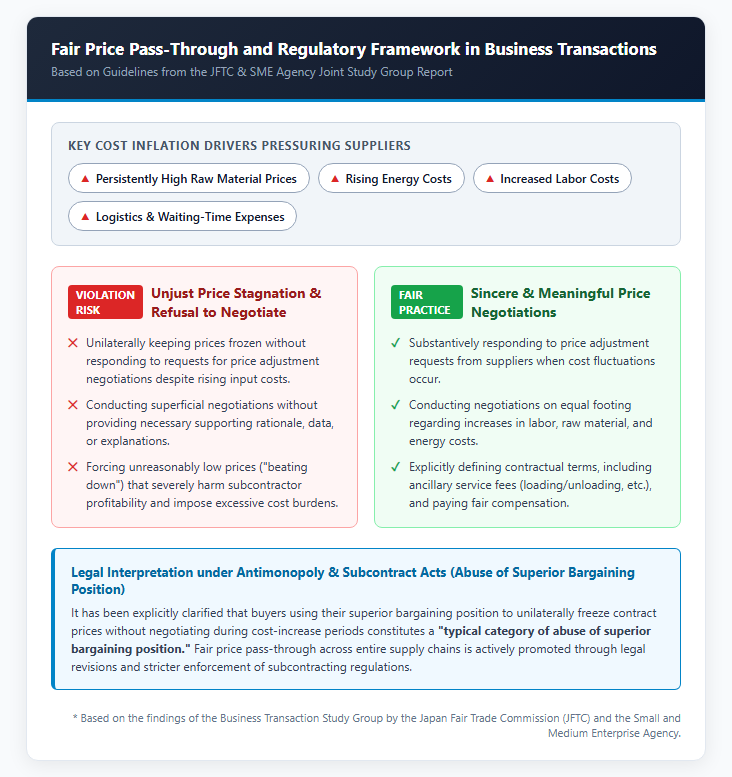
Authorities are increasingly strengthening regulatory oversight and enforcement under both the Subcontract Act and the Antimonopoly Act against buyers that impose contract terms without meaningful dialogue regarding increases in labor, raw material, or energy expenses.
Commercial Practice Reforms and Regulatory Adjustments in Logistics
Surging corporate prices are affecting not only raw material costs but also corporate bottom lines through mounting logistics expenses. In the trucking industry, operators face severe pressures from soaring fuel costs, wage hikes, and long waiting times at loading sites. Transactions between shippers and transport operators traditionally suffered from a lack of transparent fee structures for freight and cargo handling, leaving prices stagnant. In response, government agencies are preparing legislative revisions to bring freight transport transactions directly under the scope of the Subcontract Act. These reforms aim to mandate clear contractual terms for incidental tasks like loading and unloading, as well as waiting-time charges, rectifying structures where excessive cost burdens fall disproportionately on service providers. Embedding fair price pass-through as a standard commercial practice across supply chains is vital for stabilizing enterprise management and realizing a virtuous economic cycle.
Broader Economic Impact and Financial Policy Outlook
Consumer Price Index (CPI) Transmission and Household Burdens
The CGPI, which measures price movements of goods traded among businesses, serves as a crucial leading indicator for the Consumer Price Index (CPI). As upstream and midstream wholesale prices remain elevated, concerns are growing over a “second wave” of retail price hikes as cost pressures gradually pass downstream to consumers. Although July 2026 core CPI (excluding fresh food) rose 1.8% year-on-year—kept below 2% due to government energy subsidies—many companies have yet to fully pass on accumulated corporate cost increases. This raises the risk of accelerated price hikes in processed foods, daily necessities, and consumer durables from autumn onward. While spring wage negotiations (Shunto) yielded notable pay increases, rising prices for essential goods and utilities continue to squeeze real disposable income. As companies are forced to adjust sales prices upward, diminishing consumer purchasing power highlights the compounding drawbacks of cost-push inflation.
Bank of Japan Monetary Policy Decisions and Key Points Ahead
With corporate prices staying high and spilling over into retail prices, market attention is focused squarely on the Bank of Japan’s monetary policy stance. The BOJ is expected to debate an additional interest rate hike at its upcoming policy meetings in September or October 2026. Policymakers face growing pressure to tighten monetary policy to curb inflationary upside risks and prevent further yen weakness. However, because the current surge in corporate prices is driven by imported resource inflation and currency depreciation rather than overheating domestic demand (demand-pull inflation), critics point out that rate hikes alone may not fully tame cost-push forces. Moving forward, the key economic focus will be whether a virtuous cycle of sustainable wage growth and price stability can be achieved, while closely monitoring commodity market trends, exchange rate swings, corporate price pass-through velocity, and the impact of government relief measures and tax adjustments.
Reference Pages
- 【Bank of Japan Time-Series Data Search Portal】https://www.stat-search.boj.or.jp/index.html
- 【Japan Institute for Labour Policy and Training (JILPT)】https://www.jil.go.jp/english/index.html
- 【IMF – World Economic Outlook Databases】https://data.imf.org/en/datasets/IMF.RES:WEO
【#Economy #CGPI #BankOfJapan #Inflation #CostPushInflation #WeakYen #PricePassThrough #MonetaryPolicy】

コメント