On September 17, 2026, Japan’s Ministry of Land, Infrastructure, Transport and Tourism (MLIT) convened the inaugural meeting of its Enterprise Evaluation Working Group under the Study Panel on the Future of Construction as a Sustainable Growth Industry. The ministry aims to review current evaluation frameworks, including the Management Score Evaluation System, to ensure that construction companies actively improving worker compensation and productivity are fairly selected in project procurement and recruitment, with new policy guidelines set to be finalized within fiscal 2026.
- Inaugural Working Group Meeting and Review of Current Evaluation Systems
- The Three Existing Evaluation Frameworks Under Review and Their Key Challenges
- Incentivizing Companies Investing in Worker Compensation and Productivity
- Key Proposals and Insights Presented by Working Group Members
- Stakeholder Hearings and Finalizing Policy Directions by Fiscal 2026
- Enhancing Corporate Visibility and Market Expectations in Procurement and Hiring
Inaugural Working Group Meeting and Review of Current Evaluation Systems
On September 17, 2026, the Ministry of Land, Infrastructure, Transport and Tourism (MLIT) convened the first meeting of the Enterprise Evaluation Working Group (WG) at the Central Government Building No. 2 in Kasumigaseki, Tokyo. Operating as a specialized subcommittee under the Study Panel on the Future of Construction as a Sustainable Growth Industry, the working group appointed Professor Hirotake Kanisawa of the Department of Architecture at Shibaura Institute of Technology as chair, officially launching a comprehensive review of corporate evaluation standards.
This panel was established in July 2026 as a major milestone approaching the 10-year mark of the “Construction Industry Policy 2017+10,” originally formulated in 2017. At the opening session, Naofumi Ise, Director of the Construction Industry Division at MLIT’s Real Estate and Construction Economy Bureau, emphasized that these discussions would serve as a vital platform to elevate the sustainability and competitiveness of Japan’s construction sector.
The initiative expands beyond traditional public works procurement to encompass private sector projects, subcontractors, labor markets, and educational institutions. Chair Kanisawa underscored the long-standing challenge of creating a market where ethical, forward-looking companies are properly recognized and not disadvantaged by cost-centric competition, expressing strong determination to address this deep-rooted industry issue.
The Three Existing Evaluation Frameworks Under Review and Their Key Challenges
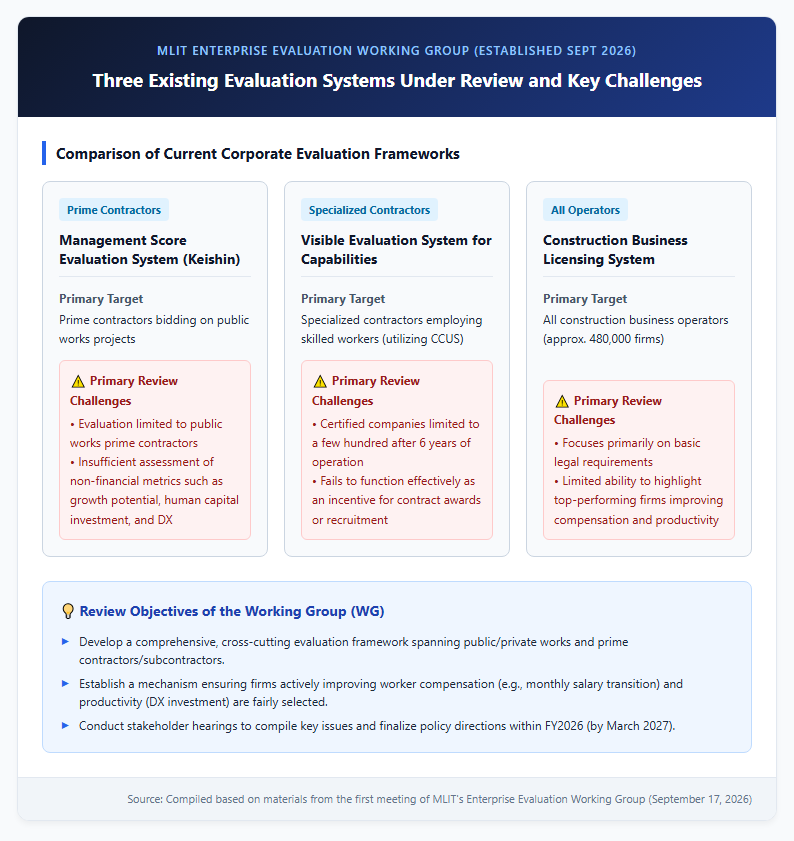
The working group has targeted three primary existing evaluation frameworks for review: the Management Score Evaluation System (Keishin), which assesses general contractors bidding on public works; the Visible Evaluation System for Specialized Construction Companies’ Construction Capabilities, which utilizes the Construction Carrier Upgrade System (CCUS); and the Construction Business Licensing System.
Current evaluation mechanisms face significant criticism for failing to adequately capture essential operational metrics, such as corporate growth potential, management capabilities, human capital investment, and productivity enhancements. For instance, because Keishin primarily evaluates main contractors directly executing public projects, the practical application of its scores remains overly restricted in scope.
Similarly, the Visible Evaluation System for specialized contractors directly employing skilled workers has seen limited adoption since its launch in 2020, with only a few hundred certified companies over six years. As a result, it has failed to function effectively as an incentive for client selection or recruitment. The working group will rigorously examine these operational gaps to determine necessary improvements and explore potential new framework structures.
Driving Factors Behind Reform and Expert Policy Recommendations
Incentivizing Companies Investing in Worker Compensation and Productivity
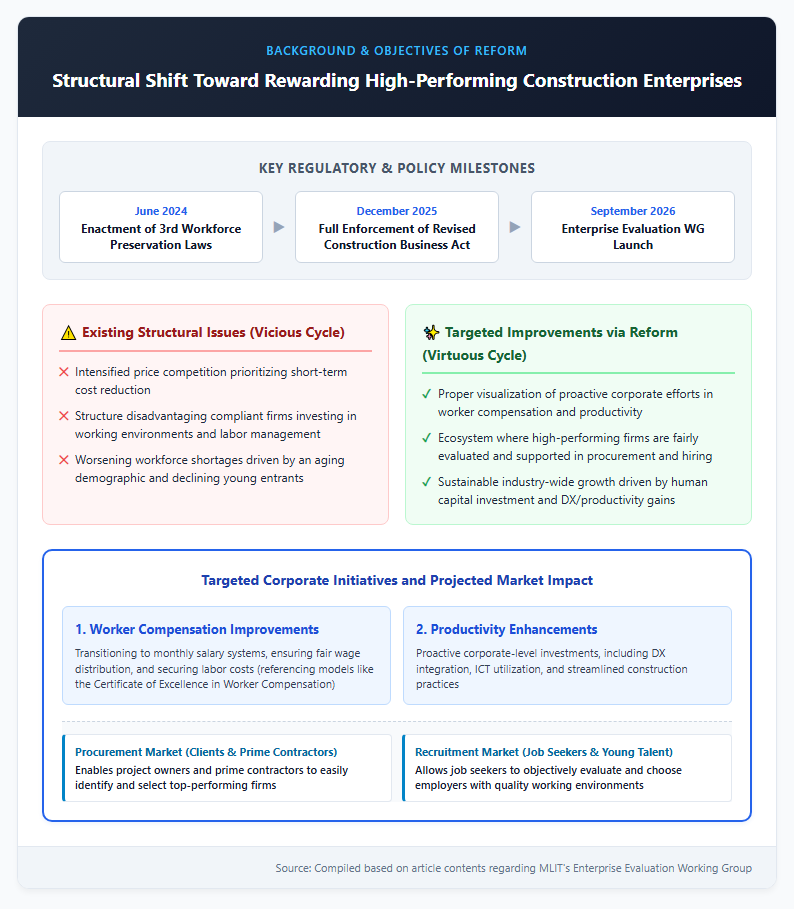
The Japanese construction industry faces severe long-term workforce shortages driven by a rapidly aging demographic and a sharp decline in young entrants. To address these structural headwinds, the government enacted the Third Workforce Preservation Laws in June 2024 and fully implemented the revised Construction Business Act in December 2025, mandating fair labor cost allocation, improved compensation, and work-style reform.
The current overhaul of corporate evaluation frameworks seeks to ensure that proactive construction firms—those transitioning to monthly salary systems, guaranteeing fair wages, and making strategic DX investments—are actively supported in project procurement and talent recruitment. Specifically, policymakers are examining models like the “Certificate of Excellence in Worker Compensation,” which certifies businesses demonstrating verified, competitive wage structures.
Historically, severe price competition led the industry to prioritize cost reduction over labor environment investments, frequently placing compliant, worker-focused firms at a competitive disadvantage. By establishing transparent corporate evaluation standards, the government aims to enable project owners and job seekers to easily identify high-quality contractors, establishing a virtuous cycle for industry-wide sustainable growth.
Key Proposals and Insights Presented by Working Group Members
During the inaugural meeting, panel members from diverse professional backgrounds offered strategic insights regarding current systemic limitations and future reform directions. Akihiro Suzuki, Head of the Urban Development Department at the Development Bank of Japan, advocated for a standardized, cross-cutting evaluation framework capable of assessing both main contractors and specialized subcontractors under a single, unified benchmark.
Associate Professor Hiroyuki Fukuchi from the Graduate School of Business Administration at Hitotsubashi University suggested leveraging the widely adopted Keishin framework to evaluate general contractors on their management capability to oversee and guide their entire supply chains. Meanwhile, Certified Public Accountant Masato Nakagawa proposed unbundling non-financial metrics—such as workforce cultivation—from Keishin so that private project owners could independently utilize them when vetting contractors.
In addition, attorney Shohei Sugita, an expert on foreign labor employment, emphasized that attracting international talent and establishing credibility in global labor markets requires organizing evaluation frameworks tailored to these specialized hiring dynamics. Collectively, these expert proposals highlight a definitive shift from traditional, purely financial evaluations toward a framework emphasizing non-financial capital and human resource development.
Implementation Roadmap and Projected Industry Impact
Stakeholder Hearings and Finalizing Policy Directions by Fiscal 2026
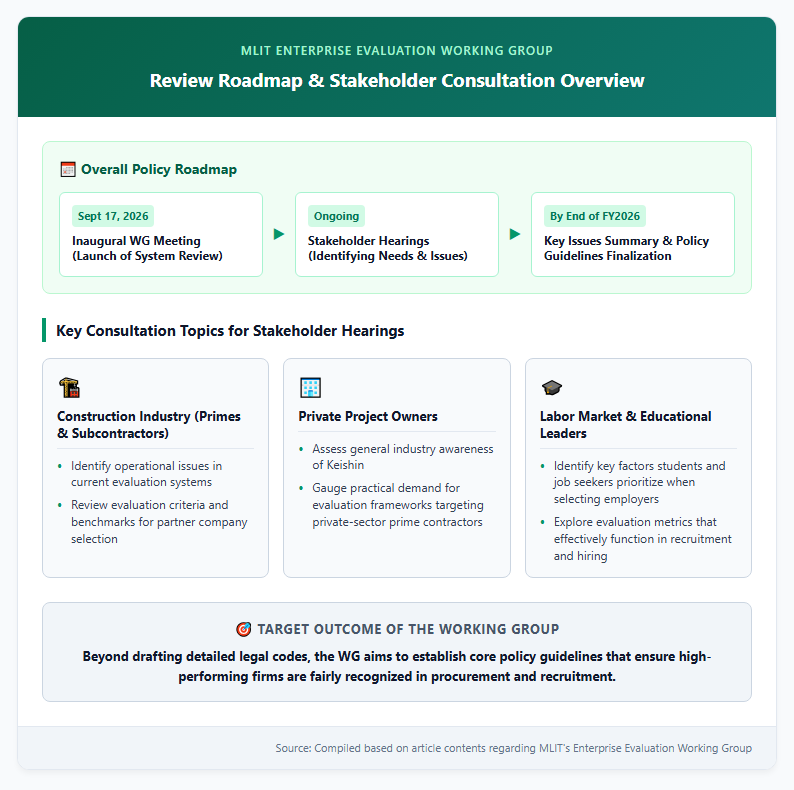
MLIT plans to conduct a comprehensive series of stakeholder hearings to identify operational challenges within existing systems and gauge emerging evaluation needs. These consultations will engage major construction associations, individual general contractors and subcontractors, private project developers, labor market analysts, and academic institutions.
For private project owners, MLIT will assess general awareness of Keishin and determine industry demand for new evaluation systems tailored to private-sector prime contractors. Simultaneously, interviews with educational leaders and career counselors will explore key factors students and job seekers prioritize when evaluating potential employers, ensuring new business metrics resonate effectively during hiring processes.
Rather than drafting granular legal codes immediately, the working group will organize its findings into a comprehensive white paper outlining core policy objectives. MLIT intends to compile these overarching guidelines by the end of fiscal 2026 (March 2027), laying the foundation for concrete regulatory and legislative reforms.
Enhancing Corporate Visibility and Market Expectations in Procurement and Hiring
Once fully operational, reformed corporate evaluation frameworks are expected to transform commercial practices and recruitment dynamics across the construction sector. By making evaluation metrics public and widely accessible, firms that invest heavily in wage improvements, environmental compliance, and human capital will gain a distinct competitive edge when bidding for private construction contracts and acquiring top-tier talent.
This visibility offers immense value to high-performing specialized contractors and small-to-medium enterprises (SMEs) that have traditionally struggled to showcase their technical prowess and superior working conditions. Clearer benchmarks will provide project owners and prime contractors with reliable criteria for selecting sub-tier partners, promoting supply-chain integrity throughout the sector.
For construction to evolve into an industry that respects workers, demonstrates genuine managerial strength, and sustains future growth, robust policy backing is essential. The deliberations initiated by MLIT’s Enterprise Evaluation Working Group mark a critical first step toward building an economic ecosystem where sound corporate governance and fair labor practices are genuinely rewarded.
References
- [Press Release: Inaugural Meeting of the Enterprise Evaluation Working Group] https://www.mlit.go.jp/report/press/tochi_fudousan_kensetsugyo13_hh_000001_00357.html
- [Study Panel on the Future of Construction as a Sustainable Growth Industry] https://www.mlit.go.jp/tochi_fudousan_kensetsugyo/const/tochi_fudousan_kensetsugyo_const_tk1_000001_00068.html
- [Voluntary Declaration System for Companies Valuing Construction Skilled Workers] https://www.mlit.go.jp/tochi_fudousan_kensetsugyo/tochi_fudousan_kensetsugyo_const_tk2_000001_00045.html
【#MLIT #ConstructionIndustry #CorporateEvaluation #Keishin #CompensationImprovement #WorkStyleReform #HumanCapital】
コメント