
Takashimaya Co., Ltd. and Bunkyo Gakuin University have announced the release of new Edo Komon stenciled kimono patterns created using generative AI technology, with sales scheduled to begin in October 2026. This initiative addresses critical challenges facing traditional crafts, particularly a severe shortage of pattern designers caused by a shrinking kimono market and an aging workforce.
- Key Event Details: Takashimaya and Bunkyo Gakuin University Launch New Edo Komon Line
- Structural Challenges and Artisan Shortages Facing Traditional Edo Komon
- Data Science and AI Algorithms Decoding Artisan Tacit Knowledge
- Collaborative Process: AI Automated Layout and Handcrafted Finishing
- Retail Expansion in Department Stores and Reaching New Customer Segments
- Future Prospects: The Outlook for AI and Traditional Craft Coexistence Models
Key Event Details: Takashimaya and Bunkyo Gakuin University Launch New Edo Komon Line
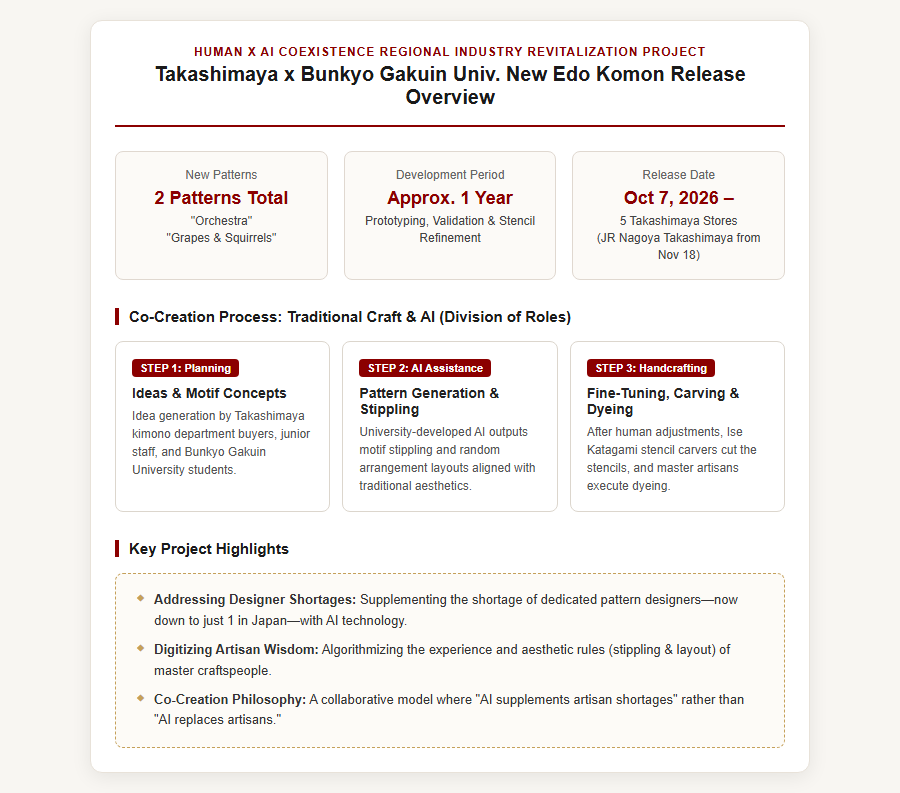
As an outcome of the joint industry-academia “Human x AI Coexistence Regional Industry Revitalization Project” (commonly known as the Reiwa Komon Project), Takashimaya Co., Ltd. and Bunkyo Gakuin University announced two new patterns for Edo Komon, a traditional Japanese dyeing craft. The newly commercialized patterns are titled “Orchestra” and “Grapes and Squirrels” (Budou to Risu). These items will go on sale sequentially starting Wednesday, October 7, 2026, across five Takashimaya department store locations, starting with the Nihombashi store, as well as at JR Nagoya Takashimaya. At JR Nagoya Takashimaya, the collection will be presented on the 11th-floor Kimono Department from Wednesday, November 18 to Tuesday, November 24, 2026.
Key highlights of this initiative include:
– Utilizing university-developed AI technology to assist the traditional pattern design process
– Originating design ideas from Takashimaya kimono department buyers, junior employees, and university students
– Assigning final supervision and production to traditional master artisans specializing in stencil carving and dyeing
Developed through approximately a year of prototyping and testing, these pieces have drawn significant attention as a model of co-creation combining traditional craftsmanship with cutting-edge technology. Please refer to the diagram below.
Structural Challenges and Artisan Shortages Facing Traditional Edo Komon
Edo Komon is a traditional craft originating in the Edo period, characterized by extremely intricate dyed patterns created using Ise paper stencils (Ise Katagami). In particular, a design style known as keren-mono—which features playfulness and high artistic value through the random arrangement of multiple motifs—has long been cherished. However, due to the shrinkage of the kimono market, a lack of successors, and an aging artisan population in recent years, the production ecosystem for Edo Komon has been severely impacted.
The main challenges facing the industry can be summarized as follows:
– A severe shortage of skilled pattern designers (zuanka), with only one dedicated master designer remaining in all of Japan
– Increasing difficulty in maintaining the traditional division of labor across pattern design, stencil carving, and dyeing
– A near-complete absence of new keren-mono patterns in the market, leading to a fading kimono culture as a modern fashion statement
Because the craft relied heavily on tacit knowledge, such as artisans’ intuition and long-accumulated experience, there was a pressing risk that the techniques would be lost. To prevent this extinction, the project was launched as a solution to bridge the missing links in the division of labor through technological support.
Modeling “Artisan Wisdom”: AI Integration and Production Process
Data Science and AI Algorithms Decoding Artisan Tacit Knowledge
Starting in 2021, Professor Akie Kawagoe’s research seminar in the Faculty of Business Administration at Bunkyo Gakuin University analyzed historic Edo Komon works and stencils, systematizing five core design theories behind traditional layout and aesthetics in April 2022. Subsequently, in April 2025, a data science research seminar led by Assistant Professor Keisuke Yoshida initiated the development of the “Edo Komon Design Support Application” using generative AI.
The specific technical approaches and empirical validations in AI development include:
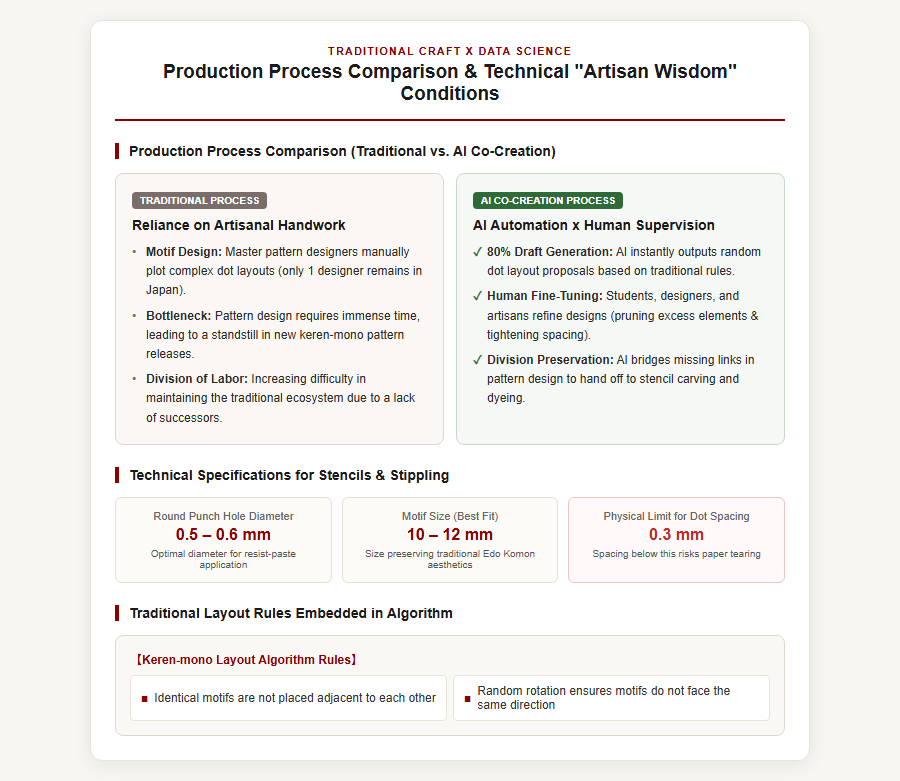
– Conducting carving experiments using round punches on treated paper (shibugami) to identify optimal hole diameters (0.5 mm to 0.6 mm) and motif sizes (10 mm to 12 mm)
– Determining physical constraints, such as paper tearing at 0.3 mm intervals, and programming conditional formulas to ensure smooth resist-paste application
– Incorporating traditional arrangement rules into algorithms, such as ensuring identical motifs are not adjacent and do not face the same direction
What AI inherits is not the physical manual labor of the artisan, but the “artisan wisdom” cultivated through years of experience. This has dramatically streamlined the complex, time-consuming task of manually positioning dot data that previously required immense effort from master artisans.
Collaborative Process: AI Automated Layout and Handcrafted Finishing
This project adheres strictly to the philosophy that “AI does not replace artisans, but supplements artisan shortages.” Rather than generating a 100% finished product directly, the AI rapidly generates an automated arrangement proposal at an 80% completion level, leaving the final supervision and adjustment to human hands.
The actual production process follows these steps:
– Takashimaya buyers, junior staff, and university students plan motif concepts and themes
– The AI application automatically converts motifs into stippled dots and outputs random arrangement layouts
– Students, designers, and artisans fine-tune the design (pruning excess elements and tightening spacing) to refine it into stencil data
– Ise Katagami stencil carvers cut out the paper stencils, and master craftsmen at dyeworks such as Sootome Dyeing Works execute the dyeing process
Following the “Sweets-Filled Komon” released in 2024, the newly introduced “Orchestra” and “Grapes and Squirrels” patterns achieve a remarkable finish that fuses handcrafted aesthetics with digital efficiency. Please refer to the diagram below for a comparison of the production process.
Economic and Social Impact on Regional Industry Revitalization and Heritage Preservation
Retail Expansion in Department Stores and Reaching New Customer Segments
In September 2025, Takashimaya Co., Ltd. and Bunkyo Gakuin University entered into a comprehensive industry-academia partnership agreement to accelerate commercialization. The retail rollout starting at the Nihombashi store goes beyond merely exhibiting traditional crafts; it is positioned as a strategic merchandising effort to engage new and younger customer segments.
The expected economic and commercial benefits include:
– Unlocking new demand among younger generations with fresh pattern aesthetics while serving existing kimono enthusiasts
– Establishing a sustainable business model to regularly introduce new keren-mono designs into a market where they had virtually vanished
– Providing Gen Z university students with practical marketing opportunities and traditional cultural education through industry-academia collaboration
As demonstrated by the instant sell-out of the “Sweets-Filled Komon” upon its release, products combining traditional dye techniques with contemporary motifs have proven high market value. This upcoming retail tour across Takashimaya stores is expected to further enhance the value added to traditional craft products.
Future Prospects: The Outlook for AI and Traditional Craft Coexistence Models
The collaborative effort between Takashimaya and Bunkyo Gakuin University extends beyond Edo Komon, exerting a significant influence as a model for digitizing and preserving tacit knowledge across Japan’s legacy industries. While adhering to guidelines on AI and copyright issued by the Agency for Cultural Affairs, it is also highly regarded as a pioneering example of balancing creator rights with the preservation of traditional crafts.
Future key points and prospective developments include:
– Horizontal expansion of AI-assisted design technologies to other traditional crafts and regional industries
– Soft restructuring of fragmented artisan communities to maintain sustainable production ecosystems
– Global promotion of Japan’s unique “Tradition x Advanced Technology” brands targeting overseas markets and cross-border e-commerce
Rather than displacing human hands with technology, the “coexistence of humans and AI”—which resolves labor shortage bottlenecks to maximize the value of master artisans—offers an innovative and hopeful solution for traditional craft industries facing succession crises nationwide.
Reference Pages
- 【Bunkyo Gakuin University News】https://www.bgu.ac.jp/business/news/20260918/
- 【Bunkyo Gakuin University Design Thinking Research Center】https://www.bgu.ac.jp/designthinking/manufacturing/
- 【Takashimaya Press Release】https://www.takashimaya.co.jp/base/corp/topics/260917a.pdf
【#Takashimaya #BunkyoGakuinUniversity #EdoKomon #GenerativeAI #TraditionalCrafts #IndustryAcademiaCollaboration #RegionalIndustryRevitalization】


コメント