
It has been revealed that Amazon.com is considering a scheme to transfer $8 billion worth of cutting-edge Nvidia AI chips to a special purpose vehicle (SPV) to move them off its balance sheet. This move is driven by the aim to secure computing power while avoiding the deterioration of free cash flow associated with massive capital expenditures, which are expected to swell to $220 billion in 2026.
- Key Takeaways from the Event and the Basic Structure of Securitization Using SPVs
- The Aim of the Asset-Light Strategy Surrounding Grace Blackwell Semiconductors
- Expanding AI Infrastructure Investment and the Pressures on Financial Statements
- Meta’s “Banyan” Model and Industry-Wide Off-Balance-Sheet Financing
- The Mismatch Between Rapid Semiconductor Obsolescence and Long-Term Debt
- Future Outlook and the Trajectory of Systemic Risk Monitored by Financial Authorities
Key Takeaways from the Event and the Basic Structure of Securitization Using SPVs
According to a report by the Financial Times, Amazon.com is considering a financing scheme to remove approximately $8 billion (about 1.3 trillion yen) worth of its holdings of NVIDIA’s state-of-the-art “Grace Blackwell” AI chips from its balance sheet. The target assets involve thousands of GPUs already installed or being deployed across more than a dozen data centers in over five U.S. states, including Nevada and Virginia. Amazon intends to transfer these chips to a special purpose vehicle (SPV) funded by external investors, where the SPV will issue bonds to raise capital, and Amazon will then lease back the same chips for continued use. In this transaction, Amazon reportedly will not hold shares in the SPV, instead allowing external investors to take up to a 10% equity stake. Rather than directly owning the assets and paying the full purchase price upfront, Amazon Web Services (AWS) aims to shift the capital burden and residual value risk externally while retaining operational and management control. Please refer to the image below for an overview of the scheme.
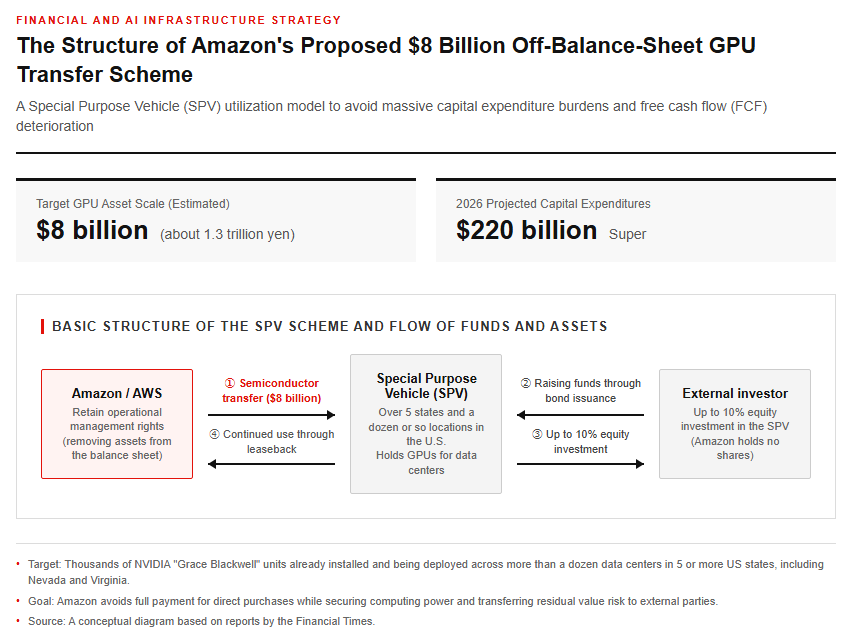
Because Amazon maintains a double-A credit rating, this SPV is expected to secure an investment-grade credit rating, aiming to attract funds from institutional investors with strict investment regulations, such as insurance companies and pension funds.
The Aim of the Asset-Light Strategy Surrounding Grace Blackwell Semiconductors
Behind Amazon’s shift away from direct ownership of AI semiconductors toward an “asset-light” financing model lies a strategic imperative to address surging demand for AI infrastructure and technological evolution. NVIDIA’s Grace Blackwell is an ultra-high-quality computing platform that tightly integrates GPUs, CPUs, and memory, serving as an indispensable core asset for model training and inference processing. Unlike traditional general-purpose servers, advanced AI systems are built integrally with liquid cooling capabilities, power, and networking, thereby requiring massive initial capital. By utilizing SPVs, Amazon can maintain access to computing resources without inflating its on-balance-sheet net debt, redirecting preserved cash toward data center building construction, the securing of power facilities, and the development of its proprietary AI chips such as “Trainium.” Because customer enterprises and developers will continue to utilize computing power through AWS as before, the operational service experience remains unchanged. On the other hand, even if legal ownership is transferred to an SPV, substantial demand risk and payment obligations may remain with Amazon through long-term fixed lease contracts, and whether it is recognized as a complete accounting risk-off depends on the final contract details.
Behind the $220 Billion Capital Expenditure and Free Cash Flow Deficit
Expanding AI Infrastructure Investment and the Pressures on Financial Statements
The fundamental factor that brought this massive off-balance-sheet scheme to light is the rapid depletion of the company’s cash reserves driven by the overheating AI investment competition among hyperscalers. Amazon has revised its 2026 capital expenditure outlook upward from the previous approximately $200 billion to $220 billion (approx. 34.7 trillion yen). CEO Andy Jassy explained that this investment increase is to cope with soaring memory chip prices and fierce AI demand. Cash-based capital expenditures for the first half of 2026 (January–June) reached $96.3 billion, and free cash flow for the trailing 12 months plunged into the negative at $7.6 billion (an approximately 1.2 trillion yen deficit). Although AWS maintained high growth with net sales up 37% year-over-year to $42.2 billion (an annualized scale of $169 billion), a situation has arisen where operating cash flow alone cannot cover the entirety of infrastructure spending. To cope with this rapid cash burn, the company issued $50 billion in corporate bonds in March, raised from an initially planned $37 billion, and additionally issued $25 billion in corporate bonds in July. As investors began demanding higher yields on long-term bonds, diversifying fundraising methods without damaging the balance sheet had become an urgent task.
Meta’s “Banyan” Model and Industry-Wide Off-Balance-Sheet Financing
The method of raising massive amounts of capital outside the balance sheet is not unique to Amazon; it is rapidly taking root across the entire AI industry. The precursor to this was the structured finance “Beignet” scheme built by US-based Meta Platforms for the Hyperion Data Center in Louisiana. Meta established a joint venture, Beignet, with alternative asset management firm Blue Owl Capital, taking only a 20% stake while Blue Owl held the remaining 80%. Beignet issued over $27 billion (approx. 4.3 trillion yen) in redeemable bonds to raise funds for data center development, and Meta entered into a 20-year long-term lease agreement. Even though Meta bears the substantive repayment responsibility and the burden of cost overruns, this huge debt is not recorded on Meta’s balance sheet. Accounting firm Ernst & Young (EY) pointed out this accounting treatment as a “key audit matter” in Meta’s 2025 annual report. Prominent Wall Street investor Steve Eisman has issued a strong warning that such methods are similar to the hidden debt tactics using SPVs that became notoriously famous during the collapse of Enron and the 2008 Global Financial Crisis (GFC). Across major tech giants as a whole, off-balance-sheet commitments on the scale of approximately $2 trillion (approx. 318 trillion yen), combining uncommenced long-term leases and procurement contracts, are said to have accumulated.
Credit Market Caution and the Structural Risks Facing AI Infrastructure Finance
The Mismatch Between Rapid Semiconductor Obsolescence and Long-Term Debt
In AI infrastructure financing, the primary concern for financial authorities and market participants is the significant “mismatch” that exists between the economic useful life of the target assets and the redemption period of the raised funds. According to reports by the Reserve Bank of Australia (RBA) and the Bank for International Settlements (BIS), while long-term debt of 20 to 30 years is issued for data center buildings and power infrastructure, AI semiconductors like GPUs installed inside them have the characteristic of becoming obsolete and outdated in just about five years due to the introduction of new-generation products. NVIDIA is poised to launch its next-generation “Vera Rubin” architecture, and risks have been pointed out that the market value of previous-generation chips could plummet rapidly. If AI demand and revenue fall short of the market’s excessive expectations, or if the transition to competing technologies progresses, the value of collateral assets could rapidly deteriorate, potentially bringing massive losses to investors and lenders. In fact, due to free cash flow deficits (negative $23.7 billion) and expanding debt associated with AI investments, Oracle had its credit rating downgraded by S&P Global to “BBB-,” just one notch above speculative grade. Market yields on AI infrastructure-related bonds are on an upward trend, and investors have begun demanding an additional return (risk premium) for hidden risks.
Future Outlook and the Trajectory of Systemic Risk Monitored by Financial Authorities
The future focus will center on whether Amazon formally agrees and completes this SPV transaction, and whether institutional investors accept advanced semiconductors as independently financeable assets. If this transaction succeeds, other hyperscalers such as Microsoft, Alphabet, and Oracle are expected to follow suit, drawing pension funds, insurance companies, and private credit funds even deeper into the AI supply chain as funding providers. However, according to BIS research, the combination of aggressive corporate investment competition and circular financing (such as vendor financing) is increasing opaque risks where the failure of a single company could trigger a chain reaction across the entire financial system through network connections. If sufficient revenue from AI adoption fails to materialize as expected by the market, there is concern that previously obscure off-balance-sheet liabilities and rating-backed guarantees could surface and spill over into the credit market as a whole. Please refer to the conceptual diagram below for the overall risk interconnection map in financial markets.
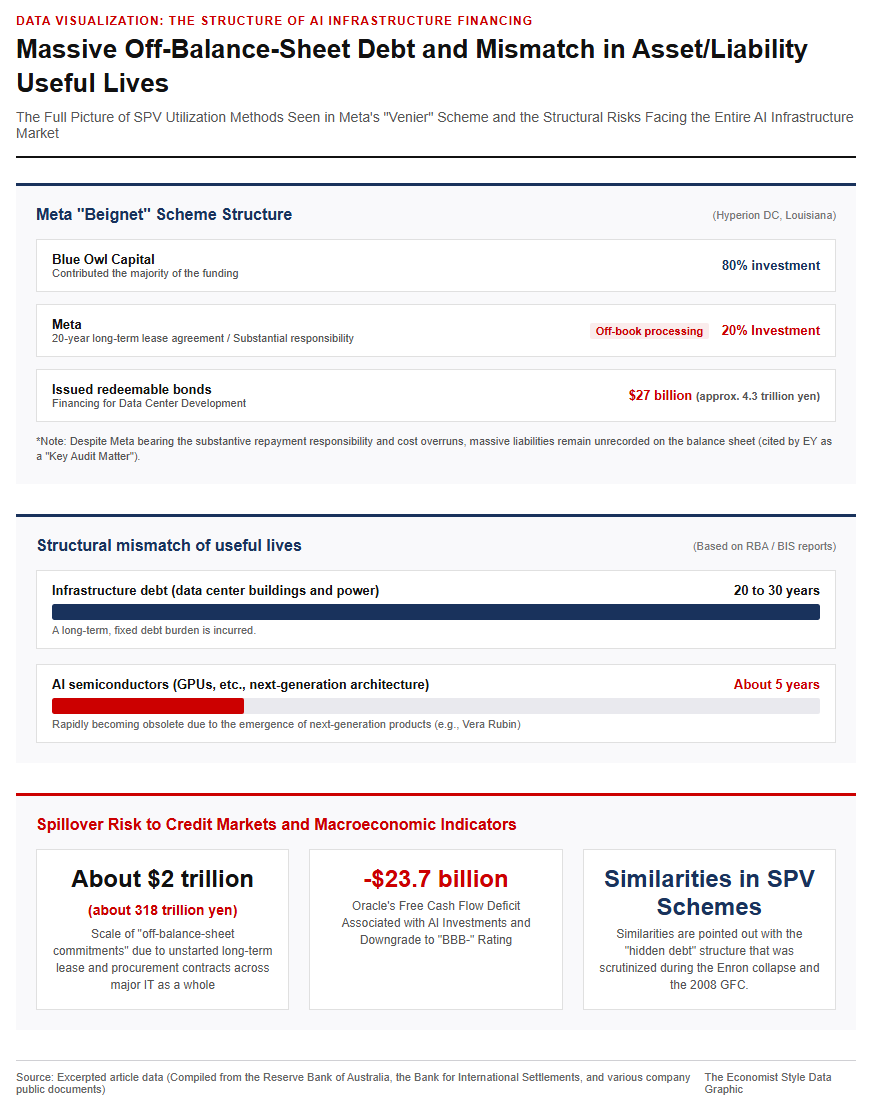
Financial authorities and investors must look beyond the superficial figure of simply “liabilities disappearing from the books” and rigorously assess the presence or absence of residual value guarantees in the final contract terms, credit rating determinations, and the actual state of disclosure obligations.
Reference page
- 【Reserve Bank of Australia】https://www.rba.gov.au/
- 【Bank for International Settlements】https://www.bis.org/
【#Amazon #NVIDIA #AIInfrastructure #OffBalanceSheetLiabilities #SpecialPurposeEntity #BusinessAndEconomy #Hyperscalers】

コメント