
Regional banks headquartered in the three Tokai prefectures of Aichi, Gifu, and Mie have decided to raise their ordinary deposit interest rates to 0.5% per annum following the Bank of Japan’s interest rate hike. This move is driven by rising funding costs associated with the transition to a world with interest rates and intensifying competition to secure deposits within the region, generating widespread impacts such as higher mortgage rates and the differentiation of regional banks based on their profitability.
- Decision to Raise Ordinary Deposit Interest Rates to 0.5% and the Impact of the BOJ Rate Hike
- The Reality of Financial Health and Loan-to-Deposit Gaps Among Major Regional Banks in the Tokai Area
- Spillover Effects on Variable-Rate Mortgages and the Dual Nature of Household Cash Flow
- The Lending Rate Pass-Through Capability That Separates the Widening and Narrowing of Loan-Deposit Spreads
- The Deposit Battle Between Internet Banks and City Banks, and Digital Strategies
- Restructuring Trends in the Tokai Region and Medium- to Long-Term Challenges
Decision to Raise Ordinary Deposit Interest Rates to 0.5% and the Impact of the BOJ Rate Hike
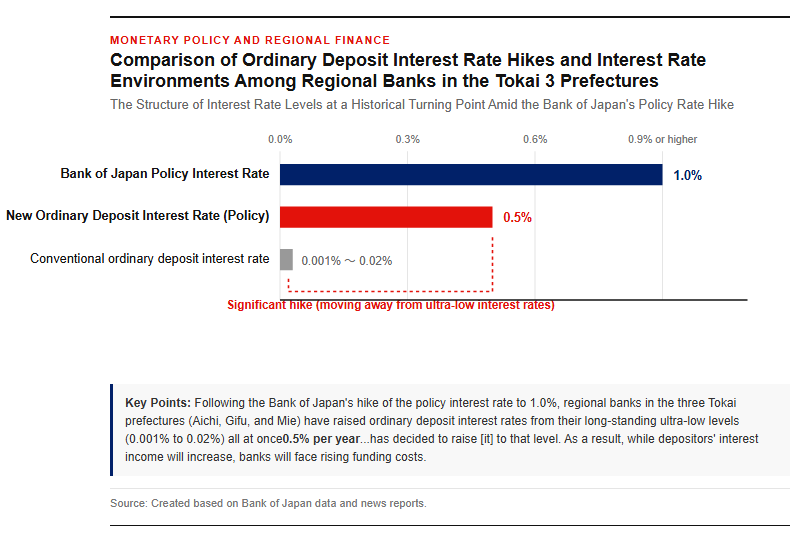
As the Bank of Japan proceeds with a phased increase in its policy interest rate, bringing it to 1.0%, regional banks headquartered in the three Tokai prefectures of Aichi, Gifu, and Mie have simultaneously moved to raise their ordinary deposit interest rates. Specifically, they plan to raise ordinary deposit rates to 0.5% per annum starting next month, marking a significant historical turning point from the prolonged ultra-low interest rate environment. This round of deposit rate hikes is a direct result of the BOJ’s normalization of monetary policy and additional rate hikes, directly impacting the funding costs and deposit strategies of regional financial institutions. The rise in ordinary deposit rates—which had been kept at extremely low levels such as 0.001% or 0.02%—to 0.5% per annum brings direct benefits to depositors, including local residents and businesses, in the form of increased interest income. On the other hand, for the banks, this represents a definite increase in funding costs (deposit interest expenses), making it an urgent priority to maintain their deposit bases and appropriately pass costs on to lending rates. Major banks in the Tokai region, such as Juroku Bank, Ogaki Kyoritsu Bank, Hyakugo Bank, San-Ju-San Bank, Bank of Nagoya, Aichi Bank, and Chukyo Bank, are being pressured to restructure their management strategies to adapt to the new interest rate environment while safeguarding their regional customer bases. Please refer to the figure below.
The Reality of Financial Health and Loan-to-Deposit Gaps Among Major Regional Banks in the Tokai Area
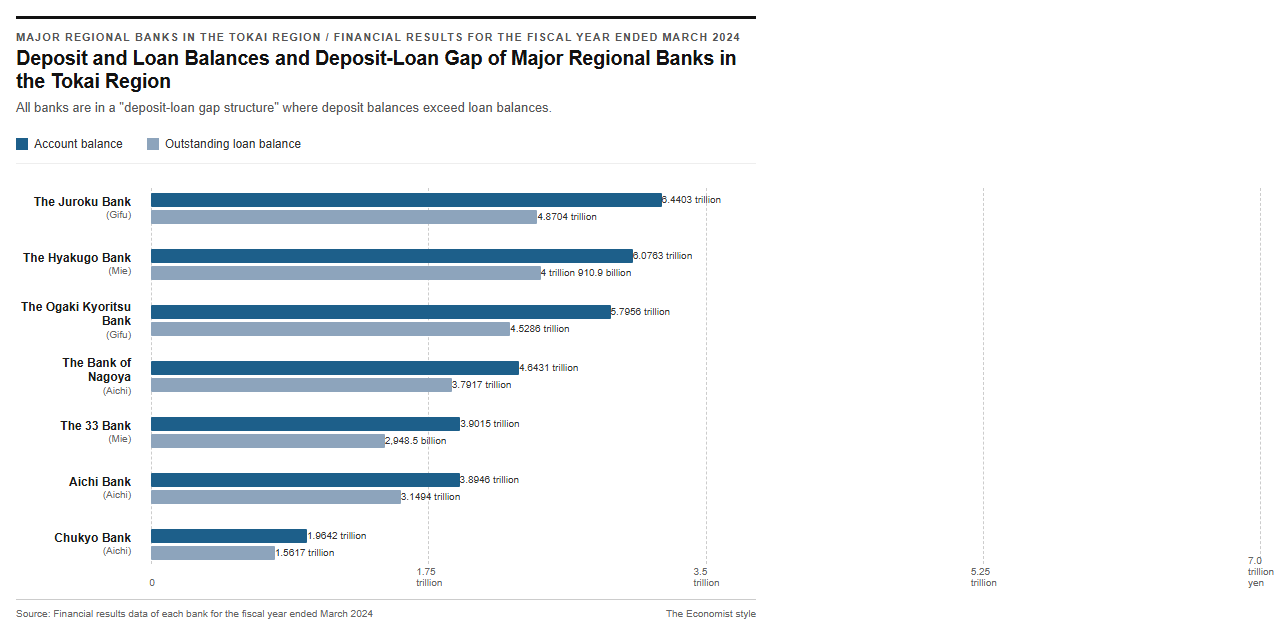
Regional banks in the three Tokai prefectures play a vital role in supporting the foundation of the regional economy, each maintaining solid loan and deposit balances. Looking at the financial results data for the fiscal year ended March 2024, Gifu Prefecture’s Juroku Bank reached 4.8704 trillion yen in loans and 6.4403 trillion yen in deposits, while The Ogaki Kyoritsu Bank also boasts 4.5286 trillion yen in loans and 5.7956 trillion yen in deposits. In Mie Prefecture, The Hyakugo Bank recorded 4.9109 trillion yen in loans and 6.0763 trillion yen in deposits, and Sanjusan Bank reported 2.9485 trillion yen in loans and 3.9015 trillion yen in deposits. In Aichi Prefecture, Bank of Nagoya holds 3.7917 trillion yen in loans and 4.6431 trillion yen in deposits. Including Aichi Bank (3.1494 trillion yen in loans, 3.8946 trillion yen in deposits) and Chukyo Bank (1.5617 trillion yen in loans, 1.9642 trillion yen in deposits) under the umbrella of Aichi Financial Group, all of these banks share a loan-to-deposit gap structure where deposit balances exceed loan balances. For regional banks with a deposit-surplus structure, a simultaneous hike in ordinary deposit rates may at first glance increase the burden in terms of funding costs, but it also brings tailwinds such as an increase in interest income on current account deposits at the Bank of Japan and an improvement in investment yields on securities such as government and corporate bonds. However, because deposit rates rise ahead of lending rates, each bank is carefully assessing the risk of a temporary compression in their lending-deposit spreads.
Impacts on Households and Businesses, and Changes in Profit Margins and Earnings Structures
Spillover Effects on Variable-Rate Mortgages and the Dual Nature of Household Cash Flow
Alongside the hikes in ordinary deposit interest rates, concerns are mounting over increases in variable-rate mortgage interest rates driven by the rise of the short-term prime rate (short prime). Many regional banks have raised their short prime rates by approximately 0.15% per annum in tandem with the Bank of Japan’s policy rate hike, which is directly linked to higher benchmark rates for variable-rate mortgages. While safety nets exist to curb sudden surges in monthly repayments for mortgage borrowers—such as the 5-year rule and the 125% rule—these are merely postponements of principal repayment and harbor the risk of generating accrued unpaid interest in the future or increasing the burden at final repayment. Meanwhile, for the household sector as a whole, holdings of financial assets such as deposits vastly exceed financial liabilities, meaning that rising interest rates also have a positive side in the form of increased interest income. However, since the majority of financial assets are concentrated among the elderly demographic, child-rearing and younger generations burdened with mortgages are prone to feeling the financial pinch first. Consequently, regional banks are urged to provide attentive support, such as offering repayment simulations and careful prior consultations, to prevent the deterioration of household cash flows.
The Lending Rate Pass-Through Capability That Separates the Widening and Narrowing of Loan-Deposit Spreads
The return to a world with interest rates presents a golden opportunity to improve regional banks’ core business net income and loan-deposit margins, which are their fundamental earning capabilities. However, not all regional banks will equally enjoy the benefits of expanding margins. While deposit rates are raised across the board at storefronts, lending rates are determined through individual negotiations with companies. Consequently, earnings disparities among banks will widen depending on their ability to pass on interest rate hikes and the ratio of fixed-rate loans. In particular, regional banks have a higher proportion of fixed-rate loans compared to major banks, presenting a structural challenge that requires time to revise interest rates on existing loans. To gain an advantage in interest rate hike negotiations, simply demanding higher interest rates is not enough; it is essential to enhance the added value of non-financial services, such as solving management issues through business feasibility evaluations, providing consulting functions, and supporting DX (digital transformation). While regional banks that successfully balance management support for client companies with passing on interest rates will significantly expand their margins, those caught in price competition will see their margins shrink, leading to further divergence in financial performance. Please refer to the figure below.
The Intensifying Competition for Deposits and the Outlook for Regional Financial Restructuring
The Deposit Battle Between Internet Banks and City Banks, and Digital Strategies
With the onset of a rising interest rate environment, the battle for deposits surrounding regional financial institutions is reaching unprecedented levels of intensity. The risk of capital outflow is becoming particularly pronounced toward internet-only banks and major city banks, where users can easily open accounts and transfer funds via smartphones or PCs. Triggered by generational wealth transfer from parents to children, a structural issue is also coming to light where deposits previously held in regional banks flow out to major metropolitan banks and pure-play internet banks. To counter this, regional financial institutions—including regional banks in the three Tokai prefectures—are not only relying on temporary incentives like high-interest campaigns and point rewards, but are also working to enhance the multifunctionality of mobile apps and improve the convenience of digital transactions by leveraging BaaS. Furthermore, to secure sticky core deposit accounts such as payroll deposits and utility bill automatic transfers, efforts are accelerating to enhance customer loyalty through strategies that fuse community-based face-to-face services with digital channels.
Restructuring Trends in the Tokai Region and Medium- to Long-Term Challenges
Environmental changes such as the shrinking regional economy, intensifying competition for deposits, and increasing valuation losses on securities are strongly driving the trend toward the restructuring and integration of regional banks. Even in the Tokai region, cross-border wide-area restructuring movements are becoming prominent, such as the announcement by Shizuoka Financial Group and the Bank of Nagoya of a business integration targeted for around April 2028. On the other hand, there are cases where negotiations ultimately broke down over leadership and management policies despite once reaching a basic agreement on integration, as seen with Aichi Financial Group and San-ju-san Financial Group, showing that significant hurdles exist to realizing wide-area restructuring. In addition, the rise in mid- to long-term interest rates accompanying the normalization of monetary policy is inflating valuation losses on securities such as government bonds purchased under past low interest rates, making the management of unrealized losses and the reinforcement of risk management systems crucial challenges for regional banks. Moving forward, the key to regional bank survival will not lie simply in integrations aimed at scale expansion, but in whether they can enhance their capability to solve regional issues—such as local business succession, decarbonization support, and DX promotion—and establish a sustainable business model.
Reference page
- [The Japan Research Institute (JRI) Research Focus] https://www.jri.co.jp
- [Bank of Japan (BOJ) Financial System Report] [suspicious link removed]
[#Aichi #Gifu #Mie #RegionalBanks #DepositInterestRates #BOJRateHike #Mortgages #LendingSpread]


コメント