It has been revealed that Mazda’s procurement parts warehouse management system at its Thailand base suffered unauthorized external access, resulting in the potential leakage of 692 items of personal information belonging to employees and business partners. This incident highlights the growing sophistication of cyberattacks targeting vulnerabilities in global supply chains, as well as the difficulty of maintaining governance and control in increasingly complex cloud environments.
- Key Points of the Personal Information Leak Discovered in the Thailand-Based Management System
- The technique of “supply chain attacks” targeting the periphery while avoiding the stronghold
- Initial Response and Preventive Measures After the Discovery of an Incident
- Growing Threats to the Automotive Industry and the Formulation of Unified Guidelines
- Cloud Supply Chain Blind Spots and Governance
- Impact on Financial Reporting and Internal Controls (J-SOX) and Incident Damage Costs
- Protecting Global Supply Chains: Multi-Layered Defense and Future Key Points
Key Points of the Personal Information Leak Discovered in the Thailand-Based Management System
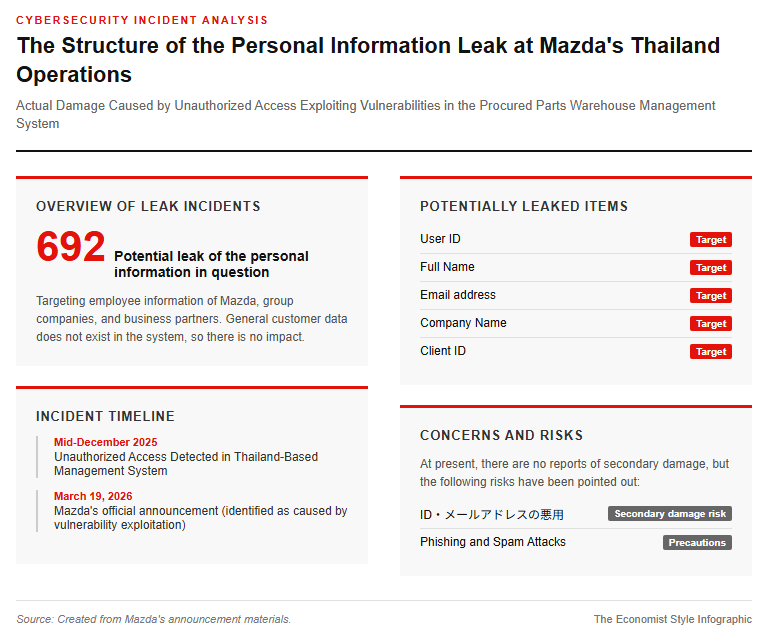
On March 19, 2026, Mazda Motor Corporation announced that it had confirmed traces of unauthorized external access to the management system used for warehouse operations of parts procured from Thailand. This incident was discovered in mid-December 2025, and as a result of investigations by internal and external specialized organizations, the cause was identified as the exploitation of a security vulnerability existing in the relevant system by a third party. The data that may have been leaked totals 692 items of information concerning employees of Mazda itself, group companies, and business partners. Specific items include company-issued user IDs, names, email addresses, company names, and business partner IDs. Furthermore, it has been confirmed that personal information regarding general customers is not registered in the system, and there is no possibility of it being leaked. Although no reports of secondary damage have been confirmed at this time, concerns remain that the leaked IDs and email addresses could be exploited for secondary use in attacks such as phishing emails and spam. Please refer to the figure below.
The technique of “supply chain attacks” targeting the periphery while avoiding the stronghold
The most noteworthy point in this incident is the structural fact that the target of the attack was not the core system of Mazda’s headquarters in Japan, but rather the management system of a procured parts warehouse located in Thailand. The method in which cyber attackers avoid direct intrusion into large enterprise headquarters with robust security measures and instead attempt to infiltrate the internal network via overseas bases, small and medium-sized business partners, or the ends of the parts supply chain, which tend to have weaker management, is called a “supply chain attack.” In the automotive industry, to manufacture a single vehicle, hundreds or more suppliers and logistics companies cooperate in complex ways, with their systems closely connected. Therefore, if a vulnerability exists even in a single location within an overseas logistics warehouse or a subsidiary’s system, it can become an entry point for attackers and escalate into a company-wide risk. The fact that user IDs and business partner IDs were included in the leaked data is particularly significant, as it carries the inherent risk that these identification credentials could be misused for unauthorized login attempts (such as password list attacks) on other systems.
Initial Response and Preventive Measures After the Discovery of an Incident
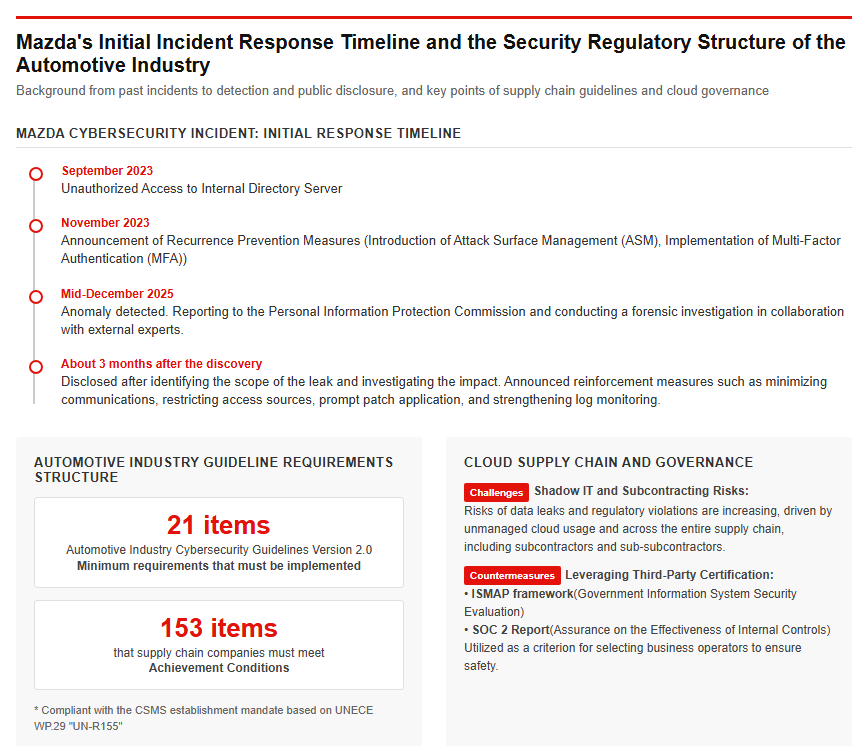
After detecting an anomaly in mid-December 2025, Mazda promptly reported the incident to the Personal Information Protection Commission, an external bureau of the Cabinet Office, and conducted a detailed forensic investigation in cooperation with an external specialized institution. The approximately three months it took from the discovery of the incident to its public announcement was the result of carefully identifying the scope of the leak and conducting an impact assessment. In the past, the company also suffered unauthorized access to its internal directory server in September 2023, and announced recurrence prevention measures in November 2023, such as the implementation of attack surface management (ASM) and multi-factor authentication (MFA). In response to this incident, the company has announced further security enhancement measures. Specifically, it has outlined a policy to review and minimize internet-based communication with the affected system, while also restricting allowable access sources, promptly applying security patches, and strengthening the log monitoring system. This once again demonstrates the importance of continuous security operations to keep pace with increasingly sophisticated attacks.
Automotive Industry Cybersecurity Regulations and Cloud Governance
Growing Threats to the Automotive Industry and the Formulation of Unified Guidelines
In the automotive industry, with the advancement of connected cars and autonomous driving technologies (CASE), vehicles, factories, and management systems have become deeply connected to the internet. Along with this, the threat of cyberattacks is increasing rapidly. In the past, for example, Kojima Industries Corporation, a supplier to Toyota Motor Corporation, fell victim to a ransomware attack that forced all of Toyota’s own plants to suspend operations, highlighting the risk of shutdowns across the entire supply chain. Against this backdrop, the cybersecurity regulation “UN-R155” was enacted under the Working Party 29 (WP.29) of the United Nations Economic Commission for Europe (UNECE), making the establishment of a Cybersecurity Management System (CSMS) mandatory for vehicle type approval. In Japan as well, the Japan Automobile Manufacturers Association (JAMA) and the Japan Auto Parts Industries Association (JAPIA) have released the “Automotive Industry Cybersecurity Guidelines Version 2.0,” presenting 21 required items and 153 achievement conditions that all companies making up the supply chain must implement as a minimum.
Cloud Supply Chain Blind Spots and Governance
The use of cloud services is rapidly expanding among many companies for the purpose of establishing remote work and improving operational efficiency. However, information leakage incidents caused by misconfigurations and the increase in “shadow IT”—which is not tracked by the IT department—are occurring frequently. When utilizing the cloud, it is essential to evaluate the risks of the “cloud supply chain,” which consists not only of vendors with which a company directly contracts, but also subcontractors and sub-subcontractors responsible for system development and operations behind the scenes. If contractor management is inadequate, companies risk violating the laws and regulations of the countries where their data centers are located and facing data leaks. In establishing cloud governance, leveraging third-party certifications is considered effective. For example, by using providers that have obtained the “ISMAP” program—under which the Japanese government evaluates and certifies security—or “SOC2 reports”—in which independent auditors guarantee the effectiveness of internal controls—as selection criteria, companies can ensure security while reducing the evaluation man-hours required for selection. Please refer to the figure below.
Financial Reporting Risks and the Defense-in-Depth Strategies Companies Should Implement
Impact on Financial Reporting and Internal Controls (J-SOX) and Incident Damage Costs
Security incidents go beyond mere IT department troubles and have a profound impact on a company’s financial reporting and business continuity itself. According to a survey conducted by PwC in February 2025, while 87.0% of companies identify cybersecurity as a business risk, only 53.5% view it as a risk related to financial reporting. However, in the event of ransomware attacks or large-scale unauthorized access, accounting systems can shut down, causing delays in the submission of securities reports, and cases identified as “material weaknesses in disclosure” under J-SOX are on the rise. Furthermore, the financial burden incurred when an incident occurs is extremely heavy. According to estimates by the Japan Network Security Association, forensic investigation costs alone to identify the cause are standard at 3 to 4 million yen, and approximately 60% of organizations require 10 million yen or more when including system restoration and the implementation of recurrence prevention measures. When including compensation, apology responses, and lost sales, the scale of damages can reach tens of millions of yen even for small and medium-sized enterprises.
Protecting Global Supply Chains: Multi-Layered Defense and Future Key Points
With the amendment of the Act on the Protection of Personal Information (APPI), in the event of a personal information breach or the risk thereof, reporting to the Personal Information Protection Commission (within 3 to 5 days for an initial report, and generally within 30 to 60 days for a comprehensive report) and notifying the affected individuals have become legal obligations. In the unlikely event that an order is violated, corporations may be subject to fines of up to 100 million yen, making corporate governance responsibilities extremely heavy. Future cyber defense requires building a defense-in-depth strategy across internal networks and cloud environments, rather than relying solely on perimeter defenses. Specifically, implementing multi-factor authentication for PC logins—which often serve as an initial foothold for intruders—long-term log retention for network-connected devices, and a framework for immediately blocking unauthorized communications are highly effective. For manufacturers with numerous overseas operations, establishing an emergency contact system (PSIRT) for crises that overcomes language and time-zone barriers, alongside improving organizational response capabilities through regular targeted phishing email simulations and BCP drills, will be the critical challenge determining future business continuity.
Reference page
- [Mazda Motor Corporation Official News Release] https://newsroom.mazda.com/ja/publicity/release/2026/202603/260319b.pdf
- [PwC Japan Group Cloud Governance Explained] https://www.pwc.com/jp/ja/knowledge/column/risk-consulting/cloud-governance.html
- [Japan Automobile Manufacturers Association Cybersecurity Guidelines] https://www.jama.or.jp/operation/it/cyb_sec/cyb_sec_guideline.html
- [Personal Information Protection Commission Official Website] [suspicious link removed]
【#Cybersecurity #SupplyChainAttacks #UnauthorizedAccess #PersonalInformationProtection #CloudGovernance #AutomotiveIndustry】
コメント