Ricoh Company, Ltd. has developed “Ricoh LMM_35B-A3B,” a Mixture of Experts (MoE) multimodal large language model that features a total of approximately 35 billion parameters while operating at high speeds using only about 3 billion parameters during inference. This development is driven by the growing demand for practical, task-specific on-premises AI that can handle advanced chart comprehension and business automation within internal closed networks, fueled by concerns regarding security, GPU availability, and power costs.
- Announcement of the 35-Billion-Parameter MoE Model “Ricoh LMM_35B-A3B”
- On-Premises AI Demand in Enterprises and the Barriers to Utilizing “Knowledge Vaults”
- The Journey of Domestic AI Foundation Model Development in the GENIAC Project
- MoE Architecture Limited to 3 Billion Active Parameters and Vast Context
- Reasoning performance and agent features rivaling commercial cloud AI
- Running on Compact AI Servers: Industry-Specific Use Cases and Future Prospects
Announcement of the 35-Billion-Parameter MoE Model “Ricoh LMM_35B-A3B”
On October 15, 2026, Ricoh Company, Ltd. announced the development of “Ricoh LMM_35B-A3B,” a multimodal large language model (LMM) capable of understanding Japanese documents and charts with high precision while operating at high speeds and with low resource consumption. This model adopts the open model “Qwen3.6-35B-A3B,” developed and provided by Alibaba Cloud, as its base model, and significantly enhances logical thinking processes (reasoning performance) in Japanese by applying Ricoh’s proprietary reinforcement learning and curriculum learning technologies. Its defining feature is that, despite being a large-scale model with a total parameter count of approximately 35 billion (35B), it leverages an architecture called Mixture of Experts (MoE) to selectively activate only about 3 billion (3B) of those parameters during inference. This drastically reduces the amount of computation per token while maintaining advanced comprehension and reasoning capabilities equal to or greater than conventional dense models, achieving extremely speedy responses and energy-efficient operation. Starting in November 2026, it is scheduled to be sequentially integrated into the “RICOH On-Premises LLM Starter Kit” offered via Ricoh Japan Corporation, initiating operations within secure internal closed networks.
On-Premises AI Demand in Enterprises and the Barriers to Utilizing “Knowledge Vaults”
In recent years, as the industrial adoption of generative AI has entered a full-fledged phase, there is a strong demand across a wide range of fields—such as manufacturing, finance and insurance, and public sectors and local governments—to effectively utilize the vast amount of documents accumulated within organizations. Specifically, unstructured data containing not only text information but also complex charts, graphs, and layouts, such as invoices, management materials, design blueprints, contract clauses, and administrative application documents, lies dormant within companies as “crystallized corporate knowledge.”
However, when using general-purpose public cloud-based AI services, concerns regarding security and governance—specifically the risk of confidential data, personal information, and technical know-how leaking to external networks—have been a major barrier. In addition, high-performance, massive cloud AIs incur high ongoing running costs because their API usage fees are based on a pay-as-per-use model. Issues have also become apparent where network delays and processing wait times hinder operational efficiency when batch-processing large volumes of documents or when a large number of employees access the system simultaneously.
Because of these factors, there has been an unprecedentedly high demand for practical, specialized on-premises AI that can securely retain such “tacit knowledge that cannot be sent to the cloud” within a company’s own premises or closed network, processing it at low cost and high speed.
The Journey of Domestic AI Foundation Model Development in the GENIAC Project
Ricoh has a history of engaging in AI research for image recognition and natural language processing since the 1980s, and in recent years, it has participated in the 2nd and 3rd phases of “GENIAC (Generative AI Accelerator Challenge),” a national project to strengthen domestic generative AI development capabilities promoted by the Ministry of Economy, Trade and Industry (METI) and the New Energy and Industrial Technology Development Organization (NEDO). Through this national innovation-promotion initiative, the company has focused on constructing high-quality training datasets for deciphering documents containing complex charts and tables unique to Japanese corporations, as well as developing proprietary evaluation metrics to measure logical thinking capabilities. In June 2026, Ricoh announced the high-precision dense model “Ricoh LMM_27B” and the lightweight model “Ricoh LMM_9B,” establishing a foundation for practical, Japan-made LLMs. The development of the “Ricoh LMM_35B-A3B” marks a further evolution of the research results from GENIAC and proprietary document-understanding technologies, symbolizing a transition from a precision-pursuit model to a new phase that integrates “speed, resource efficiency, and practicality” at a high level. As infrastructure for companies to unlock their own “knowledge vaults,” Ricoh’s AI infrastructure development is making steady progress.
Technologies Supporting High Speed, Resource Efficiency, and High Inference Performance, and Their Industrial Applications
MoE Architecture Limited to 3 Billion Active Parameters and Vast Context
The MoE (Mixture of Experts) structure, which forms the core of this model, is an advanced architecture that divides the internal network into multiple sub-networks called “experts” and selectively engages only the optimal experts to perform computations based on the characteristics of the input data and queries. As shown in the schematic diagram below, whereas conventional dense models operate all parameters (35 billion in this model) for computations regardless of the input, the MoE structure activates only about 3 billion parameters—roughly one-ninth of the total—during inference.
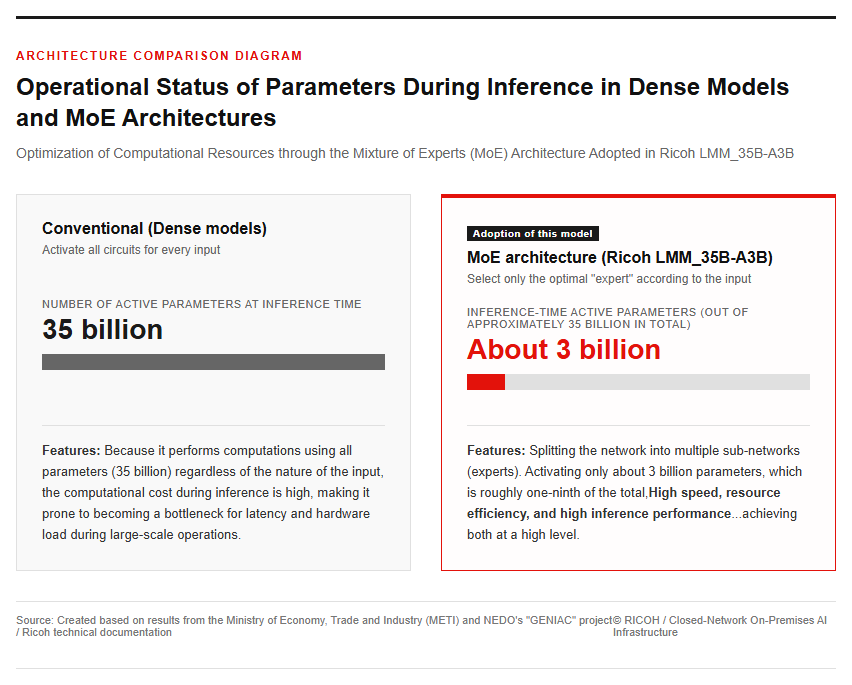
This approach successfully and dramatically reduces the computational complexity and memory consumption during inference while preserving the memory capacity and expressive power of the model as a whole. Furthermore, this model supports an extremely vast long-context length of up to 256K tokens (equivalent to hundreds of thousands of Japanese characters), making it possible to read through hundreds of pages of manuals or lengthy financial reports all at once to perform cross-sectional analysis and inference. In addition to text and still images, it also supports the input of video data, and is equipped with a tool use function that autonomously invokes external systems and APIs.
Reasoning performance and agent features rivaling commercial cloud AI
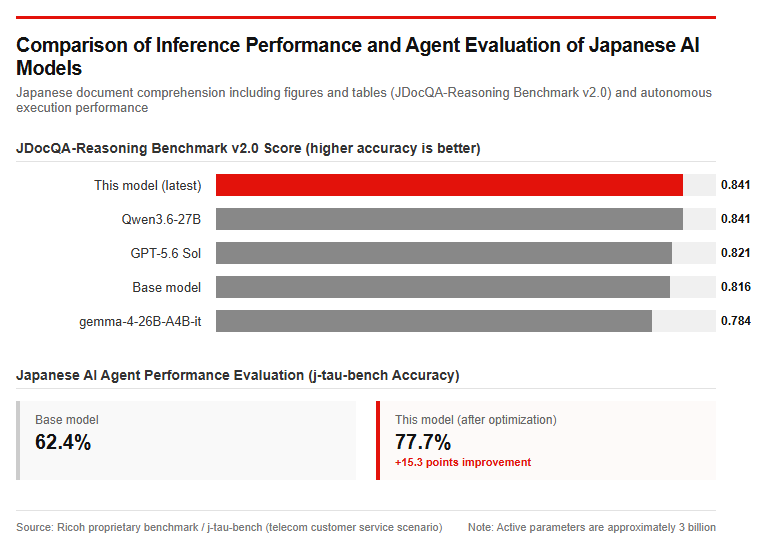
Ricoh has developed and applied proprietary reinforcement learning (RL) and curriculum learning techniques—which incrementally increase the difficulty of tasks—to the MoE architecture. By refining the reward function design, the company has strengthened logical reasoning capabilities and significantly improved the accuracy of multi-step reasoning involving complex charts, tables, and calculations. On Ricoh’s proprietary benchmark, the “JDocQA-Reasoning Benchmark v2.0,” which evaluates reading comprehension of Japanese documents including charts and tables, the model improved its score from 0.816 (the base model) to 0.841. This is a groundbreaking achievement: despite having only about 3 billion active parameters, it matches the score of the same-family Dense model “Qwen3.6-27B” (0.841), and outperforms the commercial cloud AI “GPT-5.6 Sol” (0.821) and the open model “gemma-4-26B-A4B-it” (0.784). Furthermore, in Japanese AI agent performance evaluation (specifically the telecommunications customer service scenario of j-tau-bench) for autonomously executing tasks in coordination with business systems, the accuracy rate improved by 15.3 points, rising from 62.4% in the base model to 77.7%. In addition, by incorporating a reward design that suppresses “repetitive responses”—where the same phrase is repeated during long-form reasoning—the model achieves output stability and consistent response times.
Running on Compact AI Servers: Industry-Specific Use Cases and Future Prospects
To address the challenges of cost and installation space, which have been the greatest barriers to on-premise deployment, Ricoh has developed the “NVFP4 version,” a 4-bit quantized model optimized for NVIDIA Blackwell-generation GPUs. It maintains high reasoning performance even after quantization, enabling practical local AI processing to be completed with just a single ultra-compact desk-side AI server, the “NVIDIA DGX Spark.” As shown in the system configuration image below, the LMM engine, safety monitoring safeguards, and the no-code development platform “Dify” operate in an integrated manner on the compact server.
Compared to the standard 16-bit (BF16) version, the response time has been reduced to approximately one-third (about one-fourth when combined with MTP). It achieves dramatic operational efficiency improvements across a wide range of industries, such as cross-referencing CAD drawings and specifications at manufacturing sites, high-speed review of insurance clauses and financial statements in finance and insurance, and automated data structuring of various application documents in local governments. With a portfolio that adds this MoE model to the high-precision “Ricoh LMM_27B” and lightweight “Ricoh LMM_9B,” companies can now select the optimal model to suit their budgets and infrastructure. Moving forward, we will proceed with integration into our proprietary platform “Hi.DEEN” to powerfully support the digital transformation of businesses.
Reference page
- [News Release] Ricoh Develops MoE-Based Multimodal Large Language Model “Ricoh LMM_35B-A3B” https://jp.ricoh.com/release/2026/1015_1
- [News Release] Ricoh Develops Multimodal Large Language Models “Qwen3.6-Ricoh-27B-20260522” and “Qwen3.5-Ricoh-9B-20260522” https://jp.ricoh.com/release/2026/0605_1
- [Technical Page] Ricoh’s Large Language Model (LLM) Supporting “Work” https://jp.ricoh.com/technology/ai/LLM
[#Ricoh #GenerativeAI #MultimodalLLM #MoE #OnPremisesAI #AIAgent #DX #GENIAC]
コメント