On October 14, 2026, Assured Inc. announced that it will provide free cybersecurity inspection support for cloud services to financial institutions nationwide. The initiative comes in response to warnings issued by the National Cyber Security Secretariat of the Cabinet Secretariat and the Financial Services Agency following a series of unauthorized access incidents, making the re-inspection of third-party risk management an urgent priority.
- Decision to Provide Free Inspection Support for Financial Institutions and Service Overview
- Coordinated Warnings and Heightened Urgency by the Government and the Financial Services Agency
- The Structure of Third-Party Risk That Can Cause Over 1 Billion Yen in Damages
- The Current State of SaaS Security: Multi-Factor Authentication Adoption Rate Lingers at 50%
- Standardization of Cloud Management in Financial Institutions and the Benefits of Adoption
- Future Developments and Key Focus Areas for Third-Party Risk Management
Decision to Provide Free Inspection Support for Financial Institutions and Service Overview
On October 14, 2026, Assured, Inc. launched the “Cybersecurity Inspection Support” service to encourage the re-inspection of security for cloud services currently in use or under consideration for implementation. This support targets all financial institutions, regardless of whether they are existing or new users, and will be provided free of charge as a special slot limited to the first 30 applicants. Key service offerings include the provision of an evaluation framework via “Assured Cloud Assessment Financial Edition,” which complies with major guidelines from the Financial Services Agency and the Center for Financial Industry Information Systems (FISC), as well as the issuance of a dedicated risk inspection report aligned with government alert items. The application period is set from October 14, 2026, to November 30, 2026, and the deadline for survey requests is December 31, 2026. The following figure illustrates the overview of the emergency support scheme and the workflow for report delivery.
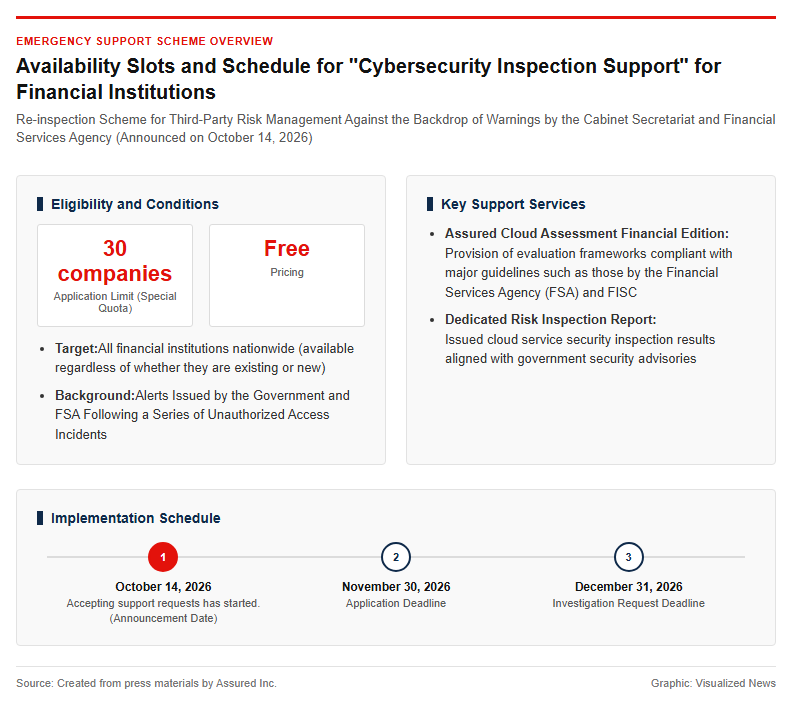
By utilizing this support, financial institutions will be able to visualize unaddressed items in the cloud services they handle and establish a rapid reporting system to management.
Coordinated Warnings and Heightened Urgency by the Government and the Financial Services Agency
The primary background leading to the provision of this support is the sharp increase in serious domestic cyber incidents and the subsequent series of warnings issued by government agencies. On October 9, 2026, the National Center of Incident Readiness and Strategy for Cybersecurity (NCO) of the Cabinet Secretariat published “Response Measures Based on Incidents Such as Data Leaks Caused by Unauthorized Access,” and on the same day, the Financial Services Agency (FSA) issued “Strengthening of Cybersecurity Measures in Light of the Current Situation and Responses Regarding Various Transaction Applications, etc.” These announcements view as problematic the incidents in which customer information, including identity verification documents such as driver’s licenses, was leaked due to unauthorized access to public-facing systems. The FSA strongly urged financial institutions to comprehensively re-inspect third-party risk management, including contractors, as well as their overall recovery and response frameworks in the event of an incident. This support was urgently decided upon to establish a framework that enables financial institutions to conduct rapid and objective security assessments against rapidly changing threats.
Serious Threats and Industry Challenges Surrounding Cloud Security
The Structure of Third-Party Risk That Can Cause Over 1 Billion Yen in Damages
According to a survey conducted by Assured in December 2025 targeting 500 information system and security personnel at major companies, 10.0% of companies that experienced incidents such as cyberattacks suffered massive economic losses of 1 billion yen or more. Furthermore, it was revealed that 14.2% of companies were forced to suspend operations for a month or more or experienced serious business disruptions. As for the origin of the incidents, while 66.8% of companies experienced direct attacks on their own systems, 58.2% also experienced incidents caused by business partners. Breaking down the responsible business partners, outsourced system development, operation, and maintenance contractors were the most common at 50.2%, followed by cloud service providers at 37.5%, highlighting the vulnerability of the entire IT supply chain. The following figure shows the analysis results of incident occurrence routes caused by business partners.
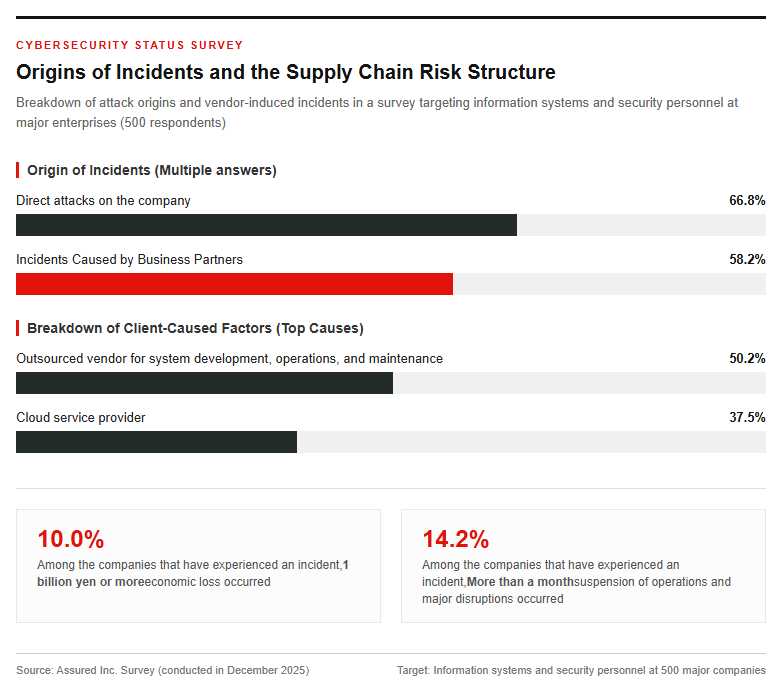
Attacks via outsourced vendors and cloud services have become a top management risk that shakes companies’ financial foundations and business continuity.
The Current State of SaaS Security: Multi-Factor Authentication Adoption Rate Lingers at 50%
According to an analytical report released by Assured in October 2026, out of 64 domestic security incidents reported between September and early October 2026, 11 cases (approximately 20%) involved cloud services (SaaS). Many of the attack vectors expanded from user account takeovers or unauthorized logins caused by phishing and other tactics. Meanwhile, an aggregation of 5,302 cloud service evaluation data entries registered in “Assured Cloud Assessment” revealed that only 53.0% of services applied multi-factor authentication (MFA) to all accounts on their service administration consoles, with the remaining roughly 30% remaining at single-factor authentication. Furthermore, the proportion of services offering multi-factor authentication for user-side login features was a mere 55.0%, and services allowing users to independently check access logs stood at just 53.0%. Such configuration flaws and lax management are major factors driving the spread of unauthorized access.
Leveraging Rating Platforms and the Outlook for the Financial Industry
Standardization of Cloud Management in Financial Institutions and the Benefits of Adoption
Historically, many financial institutions have evaluated cloud services using their own proprietary Excel-based questionnaire check sheets. However, the heavy reliance on individual evaluators and the massive workload placed on both personnel and service providers have been major challenges. As of July 2026, “Assured Cloud Evaluation,” which has been adopted by over 2,000 companies including 250 financial institutions, maintains a database of third-party evaluations by security experts, providing an objective and common evaluation scale. For example, in the case of Hokuriku Bank, it has achieved standardization of evaluations based on expert comments and a reduction in man-hours, enabling a small security team to smoothly process an average of nine cloud usage applications per month. It has streamlined not only the initial implementation phase but also regular evaluations while reducing the burden on user departments, and efficient governance through the strategic use of the “Standard Edition” and “Financial Edition” according to risk levels is expanding.
Future Developments and Key Focus Areas for Third-Party Risk Management
As a future point of focus, cloud security management in financial institutions is shifting from mere paperwork-based confirmation to real-time, highly effective third-party risk management. As the development of AI technology makes vulnerability searching and attack methods by attackers more sophisticated and accelerated—as seen in the collaboration with PwC consulting—there is a growing movement toward joint service development that incorporates new evaluation perspectives for the AI era, ranging from governance structure establishment to operational stabilization. Through this free inspection support, as financial institutions nationwide proceed with security reinspections, standardization and transparency of evaluation criteria across the entire industry are expected to accelerate further. Financial institutions will be increasingly required to position IT risk as a top management risk under the leadership of their management teams, and to work on continuous monitoring and resilience enhancement.
Reference Page
- [National Cyber Security Secretariat, Cabinet Secretariat] Regarding Responses Based on Incidents Such as Information Leaks Due to Unauthorized Access: https://www.cyber.go.jp/pdf/press/taiou.pdf
- 【Financial Services Agency】Strengthening Cybersecurity Measures in Light of the Current Situation and Responses Regarding Various Transaction Applications, etc.: https://www.fsa.go.jp/news/r8/sonota/20261009/20261009.html
- [Visional Press Release] Assured Cloud Assessment Launches “Cybersecurity Inspection Support” for Financial Institutions Cloud Services: https://prtimes.jp/main/html/rd/p/000000844.000034075.html
- [Assured Official Website] Cloud Service Security Trust Evaluation “Assured Cloud Evaluation”: https://assured.jp/cl
【#Assured #Cybersecurity #FinancialInstitutions #CloudSecurity #ThirdPartyRisk】

コメント