Three individuals, including city officials, have been arrested for allegedly leaking an undisclosed estimated design price to construction contractors regarding the bidding for a retarding basin construction project ordered by Natori City, Miyagi Prefecture. Behind this incident are the concentration of information among estimation personnel and the hollowing out of internal controls within the local government.
- Breaking News Overview of the Bid-Rigging Incident Involving Local Government Officials Discovered in Natori City, Miyagi Prefecture
- Methods of Estimated Price Leakage and Exploitation of the Comprehensive Evaluation Auction Method
- The Collusive Structure of 21 Contracts Won Over 4 Years in the Sewerage Division
- The Legal Structure of the Official Bid Rigging Prevention Act and the Crime of Obstruction of Bidding, Etc. Relating to Public Contracts
- The Hollowing Out of Internal Controls in Local Governments and Information Security Challenges
- Focus of Future Investigations and Issues for Restoring Trust in Public Procurement
Breaking News Overview of the Bid-Rigging Incident Involving Local Government Officials Discovered in Natori City, Miyagi Prefecture
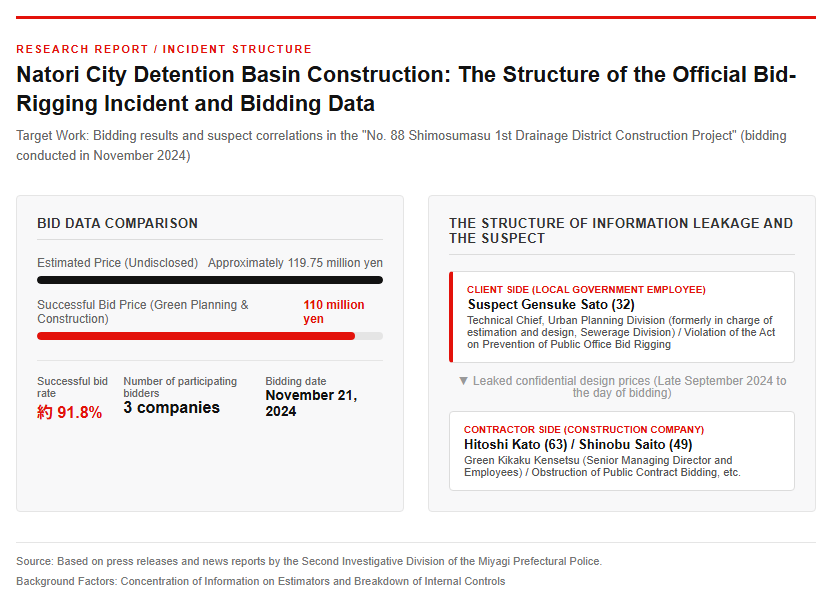
On October 14, 2026, the Second Investigative Division of the Miyagi Prefectural Police arrested Gensuke Sato (32), a technical chief in the Urban Planning Division of Natori City, on suspicion of violating the Anti-Bid Rigging Act for allegedly leaking confidential design prices to a contractor in a public works bidding process ordered by Natori City. Simultaneously, two individuals from “Green Kikaku Kensetsu,” a civil engineering and construction company in Koyama, Natori City, that won the bid after receiving the leaked information—Hitoshi Kato (63), senior managing director of the company, and Shinobu Saito (49), an employee—were arrested on suspicion of obstructing public contract tenders and auctions. The case involves the “No. 88 Shimomasuda 1st Drainage District Construction Project” (retention basin construction project) in the Mitaen district, which was publicly announced on October 31, 2024, and for which bidding took place on November 21 of the same year. Sato, who was in charge of construction estimation and design in the Sewerage Division at the time, is suspected of having communicated the confidential design prices to Saito sometime from around late September 2024 until the day of the bidding. Three companies participated in the bidding, and Green Kikaku Kensetsu won the contract with a bid of 110 million yen. Since the estimated price was approximately 119.75 million yen, the successful bid rate reached approximately 91.8 percent. On the evening of the day of the arrests, the police conducted a raid on Natori City Hall, and the following day, October 15, Natori City Mayor Shiro Yamada held a press conference to offer a deep apology to the citizens. An overview of the incident and a correlation diagram of the parties involved are shown below.
Methods of Estimated Price Leakage and Exploitation of the Comprehensive Evaluation Auction Method
In this bidding process, a “comprehensive evaluation competitive bidding system” was adopted to holistically evaluate factors such as the proposed price and the degree of contribution to the local community. Green Kikaku Kensetsu, the winning bidder, significantly outperformed the other two participating companies in evaluation categories other than price. Consequently, it is alleged that by ascertaining the undisclosed design price in advance, the company was able to set a bid price higher than its competitors while still securing the top spot in total points, thus implementing an advantageous pricing strategy that maximized its own profits. In public procurement, design prices and estimated prices are kept confidential in advance so that businesses can engage in fair price competition based on their own independent calculations and operational efforts. If a specific vendor obtains such information beforehand, free price competition is fundamentally undermined, creating the risk of keeping public funds unjustifiably high. Furthermore, according to an internal investigation by Natori City, suspect Sato served as the site supervisor in the Sewerage Division at the time of the incident, and the management system allowed four personnel within the division to easily view and confirm design prices calculated by other staff. Such organizational vulnerabilities—relying on the individual ethics of staff members while failing to implement functional viewing and access restrictions on confidential information—have been pointed out as the backdrop to the wrongdoing.
The Collusive Structure of 21 Contracts Won Over 4 Years in the Sewerage Division
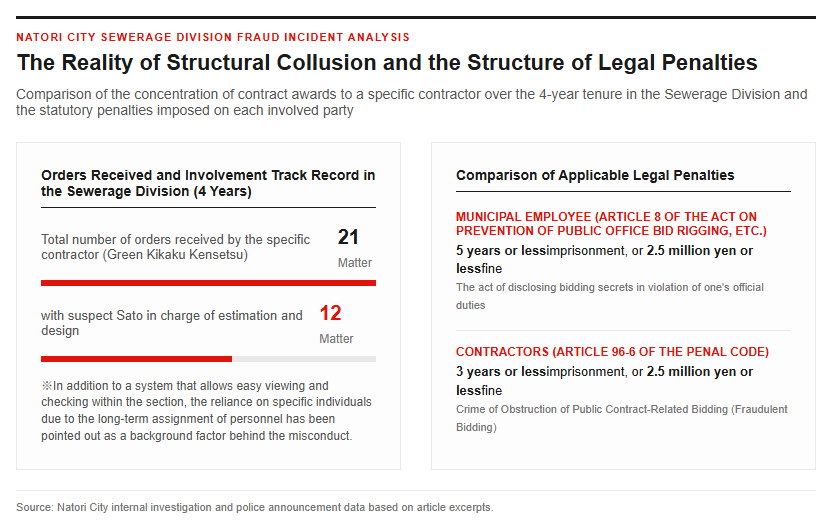
According to police and Natori City investigations, it has been revealed that during the four years Suspect Sato was assigned to the Sewerage Division’s Construction Section, Green Kikaku Kensetsu won a total of 21 bids for sewerage-related construction projects ordered by the city. Furthermore, for 12 of those 21 projects, Suspect Sato himself was in charge of calculating design prices and estimation work. The reality that a specific construction contractor continuously won orders for projects commissioned by the same department over many years strongly suggests the possibility that, rather than being a one-off information leak, a long-term close relationship or structural collusion existed between the ordering official and the specific contractor. In public works projects by local governments, community-based businesses and administrative officials are in close proximity, and checks-and-balances functions tend to decline due to the long-term assignment of personnel and the personalization of operations. Regarding the 20 past bids other than the detention basin construction project for which charges have now been brought, the police are proceeding with a full-scale corroborative investigation—including the background and circumstances of the case—to determine whether similar information leaks or illicit price adjustments were made.
Reconstructing Legal Frameworks and Municipal Governance
The Legal Structure of the Official Bid Rigging Prevention Act and the Crime of Obstruction of Bidding, Etc. Relating to Public Contracts
In this incident, different criminal penalties under separate laws have been applied to both the municipal employee, who is a public servant, and the private contractors. Article 8 of the Act on Elimination and Prevention of Involvement in Bidding Rigging etc. and Punishments for Acts by Employees that Harm Fairness of Bidding etc. (commonly known as the Anti-Official-Bidding-Rigging Act), which was applied to the municipal employee suspect Sato, punishes the act of disclosing bidding secrets in breach of official duties, carrying a statutory penalty of up to 5 years of imprisonment or a fine of up to 2.5 million yen. Meanwhile, the two individuals on the contractor side who received the information and fraudulently won the bid were charged with the crime of obstruction of public contract auctions and bids stipulated in Article 96-6 of the Penal Code, with a statutory penalty of up to 3 years of imprisonment or a fine of up to 2.5 million yen. While general “bid-rigging” between businesses is regulated as an unreasonable restraint of trade under the Antimonopoly Act, “official bid-rigging” is positioned as a grave crime that directly undermines the fairness of administrative duties and the propriety of public fund expenditures. Even if the ordering party initiates or is involved in the act, the legal responsibility of the contractors who improperly utilized non-public information is not exempted.
The Hollowing Out of Internal Controls in Local Governments and Information Security Challenges
Local governments across Japan have been developing compliance systems based on the internal control guidelines of the Ministry of Internal Affairs and Communications. However, challenges have emerged as the checks-and-balances function has become little more than a formality in practical operations. Particularly in environments where information is concentrated in individual technical staff members responsible for cost estimation and design, and where free browsing in intra-office shared folders is left unchecked, it is extremely difficult to prevent fraud.
As measures to strengthen internal controls for recurrence prevention, the first is to strictly enforce viewing privileges in electronic bidding systems and mandate regular audits of access logs. Second, it is necessary to introduce random coefficients into the calculation logic for estimated prices and minimum restricted prices, and to establish a system of mutual checks between the ordering department and the contracting department.
Furthermore, there is a strong demand for the establishment of code of conduct to prevent inappropriate contact between officials and contractors, improving the effectiveness of bidding monitoring committees composed of external experts, and developing internal whistleblowing systems. An improvement model for information management in public procurement is presented below.
Focus of Future Investigations and Issues for Restoring Trust in Public Procurement
In future investigations by the police and prosecutors, in addition to clarifying the specific communication methods and motives for the leakage of estimated prices, a major focus will be whether any benefits such as money or entertainment were provided in return for the information—specifically, whether the case will develop into suspected bribery. Additionally, attention will focus on administrative penalties, including the duration of the suspension from bidding imposed on Green Kikaku Kensetsu by Natori City and Miyagi Prefecture, as well as the scope of penalty claims based on contract violations. Takeshi Shibuya, the vice mayor of Natori City, has expressed his intention to examine the issues within the current bidding system and promptly improve areas that require reform. Public projects are taxpayer-funded initiatives that support the development of regional infrastructure and the safety of residents’ daily lives, making it essential for both project owners and contractors to maintain a high sense of ethics and rebuild a fair competitive environment. To restore trust in public procurement as a whole, ensuring thoroughly transparent procurement procedures in accordance with the intent of the Act on Promotion of Ensuring Quality of Public Works (Public Works Quality Assurance Act) has become an urgent common challenge for local governments across the country.
Reference Page
- 【Act on the Elimination and Prevention of Involvement in Bid Rigging, etc. and the Punishment of Acts by Officials that Harm the Fairness of Bids, etc.】https://laws.e-gov.go.jp/law/414AC1000000101
【#NatoriCity #BidRiggingInvolvingPublicOfficials #ActOnPreventionOfBidRiggingInvolvingPublicOfficials #ObstructionOfBiddingOnPublicContracts #PublicWorks #InternalControl】


コメント