Shimizu Corporation has developed a “construction logistics DX system” to eliminate inefficiencies in logistics and truck waiting times at construction sites, and has begun full-scale operations at sites such as the “Torch Tower” skyscraper. This initiative is driven by the “2024 problem” associated with overtime caps for truck drivers, stricter regulations under the amended Logistics Efficiency Act, and a severe labor shortage in the construction industry.
- Logistics Challenges at Construction Sites and Key Points of the “Construction Logistics DX System”
- The 2024 Logistics Problem and Stricter Regulations under the Revised Logistics Efficiency Act
- Streamlining Logistics Flow Through Centralized Cloud Management and a Dedicated Team
- Actual Operational Results at the “Torch Tower” Skyscraper Construction Site
- Benefits for General Contractors, Partner Companies, and Transport Operators
- Future Developments and Key Points to Watch in Data Utilization and AI Integration
Logistics Challenges at Construction Sites and Key Points of the “Construction Logistics DX System”
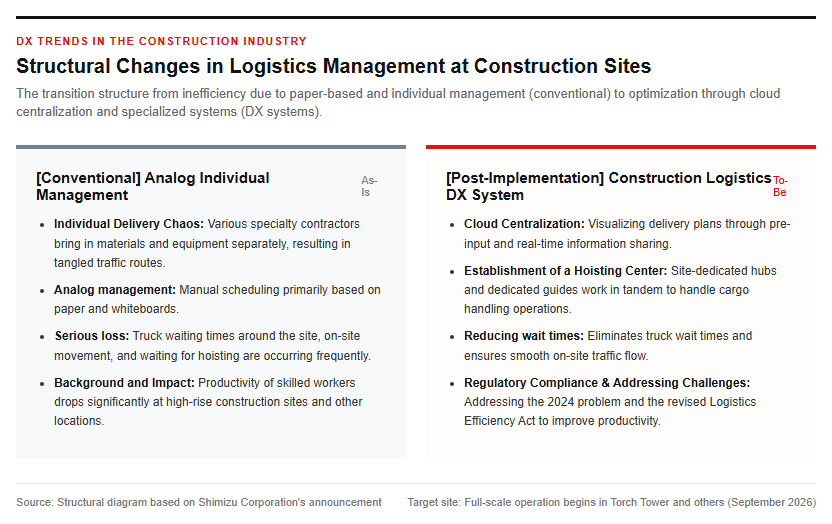
On September 28, 2026, Shimizu Corporation developed and launched the “Construction Logistics DX System,” which centralizes the management of material delivery and hoisting operations at construction sites on the cloud. In conventional construction sites, a wide variety of specialized subcontractors and partner companies have delivered materials individually, consuming a tremendous amount of effort and time for on-site movement, truck waiting times, site guidance, cargo handling, and hoisting operations. Particularly in large-scale or super-high-rise projects, the collision of delivery vehicles and movement losses to working floors have been prominent factors significantly reducing the productivity of skilled laborers. The newly developed system revamps conventional manual document management using paper or whiteboards into cloud-based digital management. Based on advance data entry by partner companies and cloud-based information sharing, the system establishes a mechanism where newly established specialized “hoisting centers” and “dedicated guides” at the site work together to handle cargo operations on behalf of others. As a result, waiting times around the site and the complication of on-site traffic lines have been significantly reduced, completely transforming the logistics environment at construction sites.
The 2024 Logistics Problem and Stricter Regulations under the Revised Logistics Efficiency Act
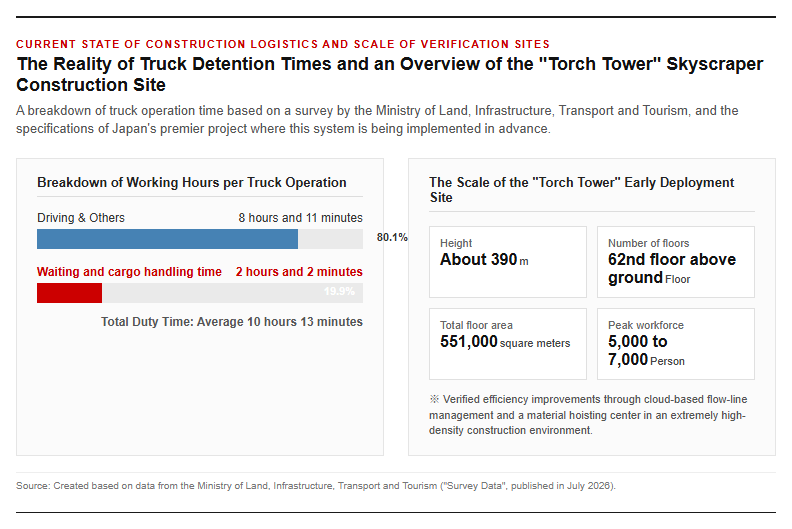
Behind the urgent need for logistics reform at construction sites are major changes in legal systems. The “2024 problem”—which took effect on April 1, 2024, capping truck drivers’ overtime at 960 hours per year—has raised concerns about declining transport capacity and labor shortages across the entire logistics industry. According to survey data released by the Ministry of Land, Infrastructure, Transport and Tourism in July 2026, the average binding time per truck operation reached 10 hours and 13 minutes, of which waiting for cargo and loading/unloading operations accounted for a total of 2 hours and 2 minutes. Furthermore, the Revised Logistics Efficiency Act, promulgated in May 2024, will be fully enforced in April 2026, designating businesses with an annual cargo handling volume of 90,000 tons or more as “specified shippers” (“specified Class 2 shippers”). Specified shippers will be required to formulate medium- to long-term plans aimed at reducing cargo waiting and loading/unloading times, and to appoint a Chief Logistics Officer (CLO). On December 12, 2025, the Ministry of Land, Infrastructure, Transport and Tourism revised its standards for disciplinary action against construction contractors, outlining a policy to impose a suspension of business operations for construction permits if they violate improvement orders or incur criminal penalties such as fines. For construction companies, improving logistics efficiency is no longer merely a target for voluntary effort, but a critical management risk directly linked to business continuity.
System Mechanism and On-Site Implementation Benefits
Streamlining Logistics Flow Through Centralized Cloud Management and a Dedicated Team
The “Construction Logistics DX System” achieves logistics standardization by combining information sharing using digital tools and task delegation by specialized on-site organizations. The main operational procedures of the system and the division of roles are as follows.
- Partner companies: Register the scheduled entry date and time of equipment/material transport vehicles, the breakdown and quantities of equipment/materials, vehicle information, etc., in the cloud system in advance.
- Hoisting Center: Formulates daily hoisting plans based on registered data, centrally manages hoisting equipment such as cranes and elevators, and handles on-site unloading and hoisting operations.
- Dedicated guide: checks logistics information on the cloud via a tablet device, communicates with delivery vehicle drivers and guides them within the site, and records entry and exit logs with a single tap.
Previously, every time equipment and materials arrived, craftspeople from partner companies had to travel from their working floor down to the first-floor gate to unload and hoist them. With this system, a dedicated hoisting center centrally manages receiving and vertical transportation, allowing partner companies to significantly reduce travel and waiting time for their workers. As a result, craftspeople can focus entirely on their core construction work, contributing to improved operational efficiency across the entire site.
Actual Operational Results at the “Torch Tower” Skyscraper Construction Site
Shimizu Corporation has introduced this system on a pilot basis at the construction site of the “Torch Tower” skyscraper currently being built in Chiyoda Ward, Tokyo. The Torch Tower is Japan’s tallest skyscraper project, boasting 62 stories above ground, a height of approximately 390 meters, and a total floor area of about 551,000 square meters, and is an extremely high-density construction site where the number of daily workers involved will reach 5,000 to 7,000 at its peak.
On such large-scale construction sites, there is a high risk that delayed arrivals of delivery vehicles or congestion in front of the gates will immediately ripple out to traffic congestion on surrounding roads and delays in subsequent processes. At the Torch Tower construction site, the system was launched in sync with the timing when full-scale steel framing on the ground floor began, implementing minute-by-minute delivery berth reservations and the automatic allocation of hoisting equipment. As a result, truck waiting times around the site were minimized, and waiting and movement losses of workers associated with delivery operations were eliminated. Partner companies working on-site have also highly praised the system, commenting that “wasteful movement has been eliminated and actual working hours have increased,” making it a model case for logistics DX in high-rise building construction.
Ripple Effects Across the Entire Industry and Future Outlook
Benefits for General Contractors, Partner Companies, and Transport Operators
The implementation of construction logistics DX systems has a positive impact on all players involved in the construction supply chain. The specific ripple effects on each entity are as follows.
- General contractor: In addition to reducing the coordination burden on construction managers, digitizing vehicle entry and exit records makes it easier to comply with the shipper obligations and periodic reporting required by the revised Logistics Efficiency Act.
- Specialty contractors (subcontractors): Eliminates elevator travel and waiting time losses between the working floor and the ground-level gate, enabling greater focus on actual construction work, shorter working hours, and improved man-hour efficiency.
- Carriers: Enables prompt unloading at the specified time and eliminates uncertain waiting times around the site, which leads to improved vehicle turnover rates and reduced driver working hours.
In this way, cargo handling and hoisting operations—which were previously dispersed among individual contractors and left to their own responsibility—are consolidated and provided as a “common site infrastructure service,” thereby achieving efficiency across the entire construction site rather than merely individual optimization.
Future Developments and Key Points to Watch in Data Utilization and AI Integration
Shimizu Corporation has indicated its policy to further expand functions moving forward by utilizing entry and exit records and hoisting data accumulated in its construction logistics DX system. Specifically, by combining accumulated big data with artificial intelligence (AI), it aims to automatically optimize dispatch plans and hoisting schedules, provide predictive guidance based on congestion forecasts, and implement algorithms to reduce waiting vehicles on surrounding roads. In addition, the operational style in which the general contractor consolidates and takes over the loading, unloading, and hoisting costs—which were previously included in subcontractors’ estimates—is driving new challenges and transformations in construction estimation and contract systems, as well as in the allocation methods for shared temporary work expenses. Dealing with the worsening labor shortage and the “2024 problem” extends beyond individual general contractors; it is a shared challenge for the entire construction industry. A major point of interest going forward will be whether the on-site logistics shared service model developed by Shimizu Corporation will spread to other construction sites and the broader construction industry, and whether it will become established as a pioneering case study for the logistics structural reforms promoted by the government.
Reference Page
- [Shimizu Corporation News Release: Developed and Launched “Construction Logistics DX System”] https://www.shimz.co.jp/company/about/news-release/2026/2026039.html
- 【Ministry of Land, Infrastructure, Transport and Tourism: Regarding the Logistics Efficiency Act】https://www.mlit.go.jp/seisakutokatsu/freight/seisakutokatsu_freight_mn1_000034.html
[#ShimizuCorporation #ConstructionDX #Logistics2024Problem #LogisticsEfficiencyAct #TorchTower #ConstructionLogistics #SocialInfrastructure #WorkStyleReform]

コメント