LattePanda has announced the “LattePanda Sigma 2,” an x86 single-board server capable of running 35B-class large language models locally. Equipped with the latest Intel processors and high-capacity memory, it meets the growing demand for cloud-independent edge AI processing.
- Key Highlights of the LattePanda Sigma 2 Single-Board Server Announcement
- A Hybrid Processor Architecture Achieving a Total of 180 TOPS
- Local Inference with 64GB of High-Capacity Memory and a 35B-Class MoE Model
- Comprehensive high-speed interfaces and pre-installed development environment
- The Significance of Embedding in Industrial Automation and Autonomous Robots
- Rapid Expansion of the Edge AI Market and Key Focus Areas Going Forward
Key Highlights of the LattePanda Sigma 2 Single-Board Server Announcement
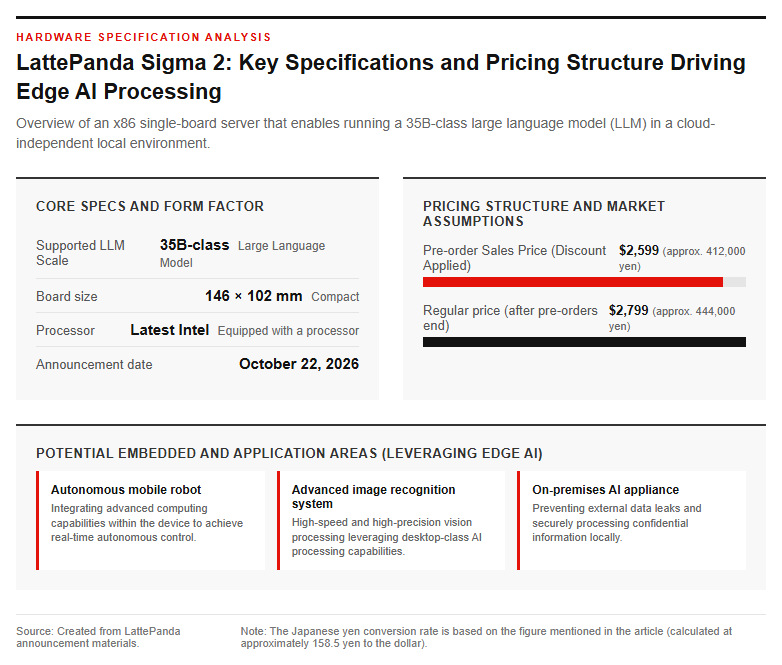
On October 22, 2026, the LattePanda team officially announced the “LattePanda Sigma 2,” an x86 single-board server designed to embed high-performance local AI computing directly inside devices. Despite its compact board size of 146 x 102 mm, it features desktop-class AI processing capabilities. The price during the pre-order period is set at $2,599 (approximately 412,000 yen), and the regular price after the pre-order period ends is scheduled to be $2,799 (approximately 444,000 yen).
Unlike conventional compact PCs that are installed and used as standalone units, this product is designed as an “embedded AI single-board server” to be operated by being integrated directly into various equipment and industrial systems. It is expected to be used in environments where high reliability and processing power are simultaneously required, such as autonomous mobile robots, advanced image recognition systems, and on-premises AI appliances handling confidential data that must not be leaked externally. The figure below shows an image summarizing the product specifications.
The introduction of this device is a symbolic development that embodies the shift toward edge AI, where the inference processing of advanced generative AI models—previously handled on the cloud—is executed entirely on compact hardware.
A Hybrid Processor Architecture Achieving a Total of 180 TOPS
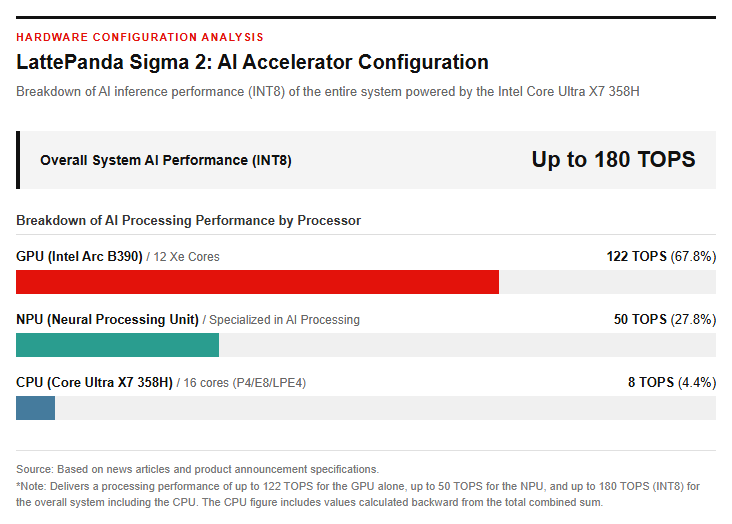
At the heart of the LattePanda Sigma 2 is Intel’s “Core Ultra X7 358H” processor, which belongs to the Panther Lake generation. This processor features a total 16-core CPU consisting of 4 performance cores (P-cores), 8 efficiency cores (E-cores), and 4 low-power efficiency cores (LPE-cores), with a maximum clock frequency reaching 4.8 GHz.
The integrated graphics incorporate the “Intel Arc B390” with 12 Xe cores, delivering an AI inference performance of up to 122 TOPS in INT8 precision from the GPU alone. Furthermore, the NPU (Neural Processing Unit), specialized for AI processing, provides a processing capacity of up to 50 TOPS, bringing the total AI performance of the entire system—combining the CPU, GPU, and NPU—to a maximum of 180 TOPS in INT8.
By significantly enhancing graphics capabilities—which in conventional single-board computers were limited to rendering and lightweight inference—it has become possible to execute advanced vector operations and AI inference workloads in parallel with extremely low latency. A conceptual diagram of the internal AI accelerator configuration of the system is shown below.
Memory Bandwidth and Software Infrastructure Enabling Edge LLM Inference
Local Inference with 64GB of High-Capacity Memory and a 35B-Class MoE Model
When running Large Language Models (LLMs) smoothly in a local environment, the greatest obstacles are insufficient memory capacity and memory bandwidth. The LattePanda Sigma 2 is equipped with up to 64GB of LPDDR5X memory operating at 8533 MT/s, securing an exceptionally wide memory bandwidth of 136.5 GB/s.
Of this 64GB of main memory, a maximum of 59GB can be allocated exclusively for AI processing as VRAM (graphics memory). This makes it possible to fit 35B (35 billion) parameter-class quantized MoE (Mixture of Experts) models—which previously required a graphics board equipped with massive VRAM—as well as the KV cache necessary for AI agents that maintain long contexts, onto a single board.
In actual benchmark tests, it has been confirmed that combining INT4 quantization with the OpenVINO toolkit allows the “Qwen3.6-35B-A3B” model to be executed locally at a practical speed of approximately 30 tokens per second. A major strength is that it eliminates the need to send data to the cloud, enabling large-scale models to be driven with high responsiveness while strictly protecting privacy.
Comprehensive high-speed interfaces and pre-installed development environment
The LattePanda Sigma 2 is not limited to its standalone computing performance, but is equipped with a wealth of expansion interfaces for linking with external sensors and external AI accelerators. In addition to being equipped with four M.2 slots (three M-Key, one E-Key) for storage and expansion, it features an OCuLink port supporting PCIe 4.0 x2 connectivity and two Thunderbolt 4 ports. Additionally, it is equipped with two 10Gigabit Ethernet (10GbE) ports for high-speed network communication, supporting high-bandwidth data transfer.
For real-time hardware control, the “RP2350” microcontroller is onboard, allowing direct control of various sensors and actuators via GPIO. Furthermore, MicroPython firmware is pre-installed, enabling rapid program implementation.
The OS supports Windows 11 and Ubuntu 24.04 LTS or later. The onboard SSD comes pre-configured with Ubuntu, GPU/NPU drivers, OpenVINO Model Server (OVMS), OpenClaw, and major local AI models, allowing users to build an AI environment immediately after deployment.
Practical Application, Societal Significance, and Future Outlook of the Edge AI Market
The Significance of Embedding in Industrial Automation and Autonomous Robots
The technological advancements brought by the LattePanda Sigma 2 will powerfully drive digital transformation in industrial settings such as manufacturing and robotics. In Autonomous Mobile Robots (AMRs) and Automated Guided Vehicles (AGVs), the significance of being able to process environmental assessment, navigation, real-time motor control, and natural language instruction comprehension all at once on a single board is of immense significance.
Furthermore, for applications where immediacy and low latency are critical—such as medical monitoring devices and AI visual inspection systems in factories—a locally contained inference infrastructure capable of avoiding the risk of network failures is essential. Moreover, it is ideal for use cases where companies cannot send confidential or personal information outside their organization, allowing them to build proprietary RAG (Retrieval-Augmented Generation) systems and internal AI agents in an on-premise environment.
Manufacturers also provide long-term supply guarantees of three years or more, BIOS customization services, and engineering support for individual projects, establishing an industrial-grade operational framework designed with product integration in mind.
Rapid Expansion of the Edge AI Market and Key Focus Areas Going Forward
According to market research data, the global edge AI market size is projected to reach 30.1 billion US dollars in 2026 and expand to 137.5 billion US dollars by 2034, with a compound annual growth rate (CAGR) of 20.9%. Similarly, the single-board computer market is expected to expand to 7.4861 billion US dollars by 2032, with decentralized on-site real-time data processing and AI processing serving as the main drivers of market growth.
Emerging against this backdrop, the LattePanda Sigma 2 transcends the boundaries of traditional microcontrollers and ARM-based SBCs, pioneering a new hardware category that condenses server-grade processing power onto a palm-sized board.
Looking ahead, key areas of focus include the balance between power-saving performance and thermal management in edge environments, the evolution of further model compression technologies (such as TinyML and quantization methods), and the establishment of software update and management systems for distributed AI devices, which are currently being explored. As local AI transitions from mere technological demonstrations to integration into actual products and social infrastructure, the role played by high-performance SBCs like this device will likely become increasingly important.
Reference page
- [LattePanda Sigma 2 Official Product Page] https://www.lattepanda.com/lattepanda-sigma-2
- [LattePanda Official Website] https://www.lattepanda.com/
【#LattePanda #SingleBoardComputer #EdgeAI #LocalLLM #Intel #Hardware】


コメント