NTT Corporation has developed a technology that automatically converts existing software assets into a format that AI can easily understand and utilize. This comes in response to the challenge that the adoption of generative AI has lagged in the supplemental development of existing systems, hindered by barriers such as inconsistencies between documentation and code, as well as insufficient testing.
- Key Points of the Event and Background of the Development
- Traceability Analysis Technology Supporting Automatic Conversion
- Comprehensive Automated Test Generation Technology Based on ISO Quality Characteristics
- Results of Inconsistency Detection and Bug Detection in Preliminary Experiments
- Breaking Away from Legacy Systems and Improving Development and Maintenance Productivity
- Future Developments and Prospects for AI-Native Development
Key Points of the Event and Background of the Development
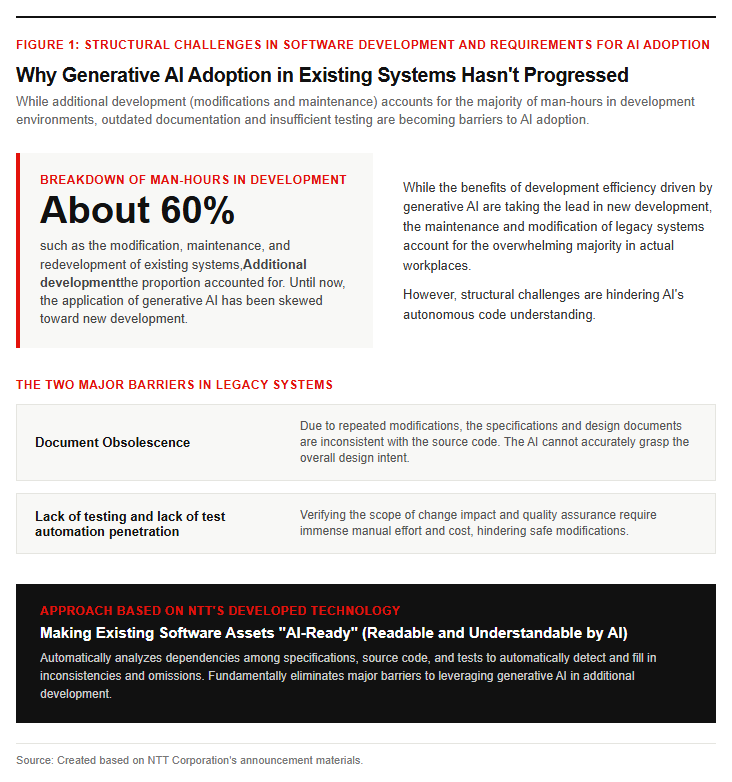
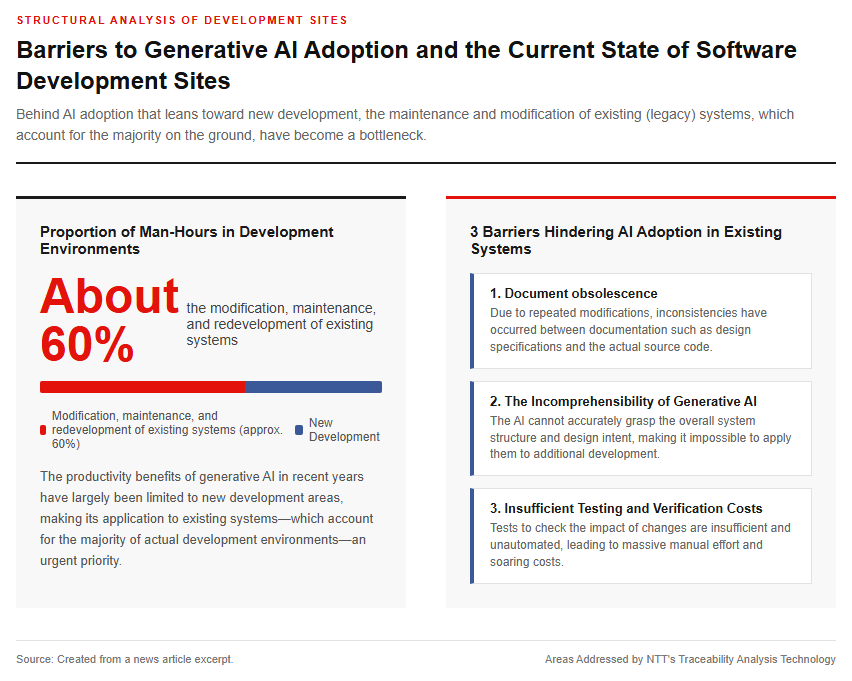
On October 23, 2026, NTT Corporation announced a technology that analyzes documents such as specifications and design documents of existing systems, source codes, and test dependencies to automatically detect and supplement inconsistencies and missing descriptions. While efficiency through the use of generative AI has been progressing in recent software development, its application has remained largely limited to new development. However, in actual software development sites, additional development such as modification, maintenance, and redevelopment of existing systems accounts for about 60% of the total. In legacy systems that have been operated for many years, the obsolescence of documents—where the contents of design documents no longer match the actual source code due to repeated modifications—has become a chronic issue. This has prevented generative AI from accurately grasping the overall structure and design intent of the system, posing a major obstacle to the utilization of AI in additional development. In addition, because tests for verifying the scope of impact caused by changes are insufficient or not automated, confirming the impact on existing functions and quality assurance associated with modifications have required a vast amount of manual work and cost. This technology aims to solve these issues and convert existing assets into development assets that AI can read (AI-Ready). As shown in the figure below, this approach is expected to solve the challenges of additional development.
Traceability Analysis Technology Supporting Automatic Conversion
The first pillar of the technology developed by NTT is traceability analysis technology. Based on international standards and guidelines related to requirements engineering, such as those from ISO, this technology automatically structures disparate deliverables including specifications, design documents, code, and development intent information such as meeting logs. In conventional existing systems, the format and amount of information vary greatly from document to document, making it difficult to appropriately extract functional units through simple text segmentation. Therefore, this technology introduces a mechanism that evaluates the degree of association between each sentence and a specific function, dynamically adjusting the segmentation granularity according to the content. Furthermore, to address the problem where expressions and information volumes differ by development phase even for the same function, it restores information for subsequent phases based on the key points of preceding phases, aligns the granularity, and determines dependency relationships. This makes it possible to identify omissions and inconsistencies in descriptions among specifications, designs, and code with high accuracy, converting them into traceability information that can be understood by AI. As shown in the demo results below, it enables the automatic detection and correction of contradictions between code and documents.
Comprehensive Automated Test Generation Technology Based on ISO Quality Characteristics
The second pillar is comprehensive automated test generation technology. In existing systems, although a vast number of tests have accumulated over years of development, it has been difficult to track the overall picture of which functions or conditions each test covers. This technology constructs a test perspective space by combining specifications, designs, and code whose consistency is ensured through traceability analysis, along with ISO quality characteristics. By mapping the accumulated existing tests to this space, it objectively visualizes verified areas and missing areas. A key feature is its ability to specifically identify unverified areas—such as exceptional cases, boundary value processing, combinations of multiple conditions, and operations during inter-feature coordination—which are prone to omissions compared to normal cases. For the identified missing parts, systematic testing techniques such as decision tables are applied to supplement them, and automatically executable test cases that cover the impact of changes are automatically generated. This significantly reduces the enormous amount of manual re-testing work and makes it possible to establish a verification environment that ensures quality even in AI-driven modifications.
Results of the Demonstration Experiment and Impact on Industry and Society
Results of Inconsistency Detection and Bug Detection in Preliminary Experiments
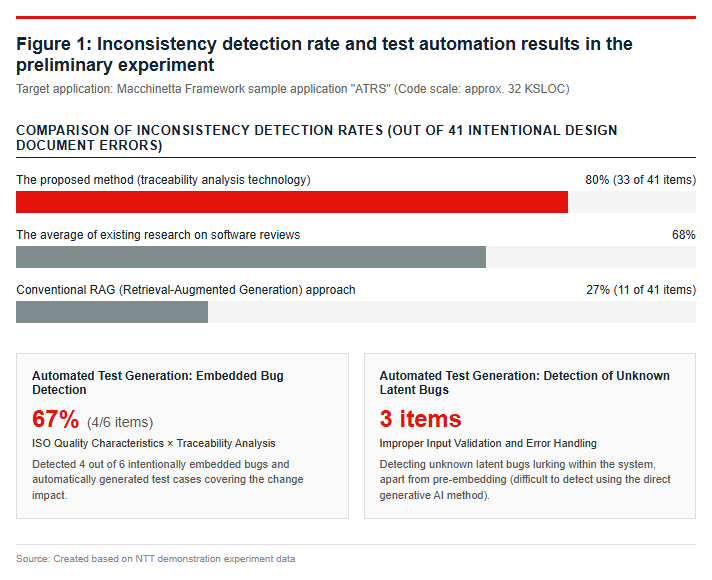
To verify the effectiveness of this technology, NTT conducted a preliminary experiment using “ATRS,” a sample application of the Macchinetta Framework (with a code scale of approximately 32 KSLOC). In an inconsistency detection experiment targeting 41 errors intentionally embedded in the design documents (contradictions with specifications or code, omissions, and gaps), while the conventional RAG (Retrieval-Augmented Generation) method detected only 11 errors (a detection rate of 27%), the proposed method detected 33 errors (a detection rate of 80%), demonstrating a significant performance improvement. This achieves a high standard even when compared to the average defect detection rate of 68% in existing research on software reviews. Furthermore, in the evaluation experiment for automated test generation, in addition to detecting 4 of the 6 embedded bugs (67%), the system successfully detected 3 unknown latent bugs lurking within the system independent of the pre-embedded ones. These latent bugs were related to input validation and error handling, which could not be detected by the conventional approach of directly generating tests using generative AI. By referring to the graph of the experimental results below, the superiority of this method can be clearly understood.
Breaking Away from Legacy Systems and Improving Development and Maintenance Productivity
In Japan’s IT industry, the “2025 Cliff” caused by the aging and black-boxing of legacy systems, along with the shortage of IT talent toward 2030, has become a serious management challenge. Approximately 60% to over 70% of corporate IT budgets are spent on maintaining and operating existing systems, which is a key factor hindering the reallocation of resources toward new DX investments. While conventional applications of generative AI have tended to focus on partial processes like code generation, it is actually the preceding and following processes—such as understanding legacy system specifications, impact analysis, and test verification—that have served as the bottlenecks for development as a whole. By resolving discrepancies between documentation and code through this technology and establishing a seamless, automated environment (AI-Ready) spanning from impact scope identification to test execution, the man-hours and risks involved in maintaining and modifying existing systems can be dramatically reduced. This serves as a powerful driving force to break away from labor-intensive system integration (SI) structures reliant on human labor and to reallocate limited IT talent toward the creation of strategic new businesses.
Future Developments and Prospects for AI-Native Development
Moving forward, NTT plans to proceed with evaluation of applying the technology to actual legacy systems of various scales and characteristics, aiming to expand the targeted deliverables, supported programming languages, tacit knowledge extraction technologies, and quality perspectives. In actual development and maintenance projects, the company will verify the effectiveness of seamlessly executing everything from understanding system specifications to identifying modification areas, making fixes, and generating and executing tests in collaboration with generative AI. In the future, it also envisions offering this as a service for external system integrators (SIers) and corporate information systems departments. The research results are scheduled to be exhibited and presented at the NTT R&D FORUM 2026, to be held from November 18 to 25, 2026. By continuously maintaining existing software assets in a state that AI can understand and utilize, and accelerating the transition to AI-native development (AI-Native) where AI autonomously handles everything from system understanding to testing, this is expected to contribute to improving the overall productivity and reliability of software supporting social infrastructure.
Reference Page
- [NTT News Release] https://group.ntt/jp/newsrelease/2026/10/23/261023a.html
- [Macchinetta Framework ATRS Repository] https://github.com/Macchinetta/atrs
- 【NTT R&D FORUM 2026】https://www.rd.ntt/forum/2026/
[#NTT #GenerativeAI #SoftwareDevelopment #TraceabilityAnalysis #TestAutomation #AINative]

コメント