JFE Steel and major Indian steelmaker JSW Steel have decided on a capital investment to expand the crude steel production capacity of the Sambalpur steelworks in Odisha, eastern India, from 4.5 million tons per year to 9.5 million tons per year through their jointly funded joint venture. Behind this are the rapid growth of domestic steel demand in India driven by the expansion of infrastructure investment and JFE Steel’s strategic goal of strengthening earnings from its overseas business.
- Expanding crude steel production capacity at Odisha steel plant to 9.5 million tons
- Overview of the New Facilities and Schedule Aimed at 2030 Operations
- Positioned as the “third integrated steelworks” following the domestic East and West steelworks.
- Deepening Partnership with JSW Steel and Cost Advantages Through Captive Mines
- Market Growth Driven by Surging Infrastructure Demand and Per Capita Steel Consumption
- Challenges Toward the 2035 Goals and Their Impact on the Global Steel Market
Expanding crude steel production capacity at Odisha steel plant to 9.5 million tons
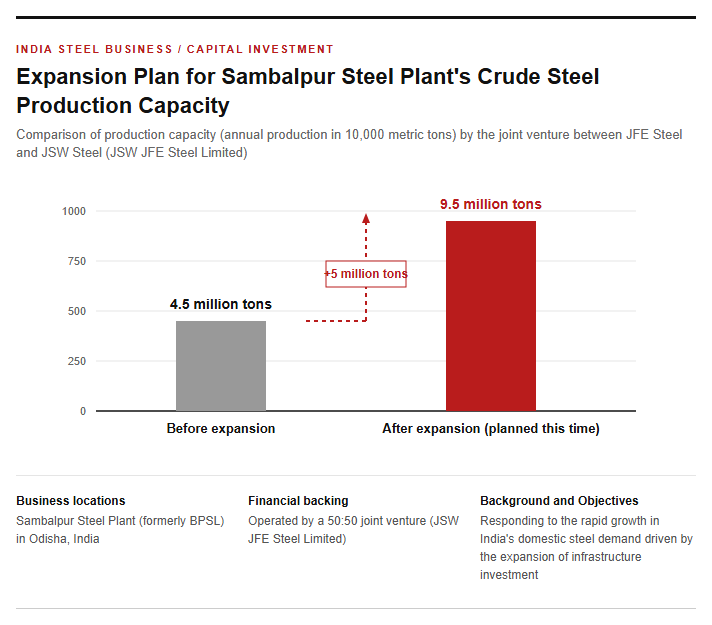
On October 23, 2026, JFE Steel announced that its joint venture with its strategic alliance partner in India, JSW Steel—named “JSW JFE Steel Limited”—has decided on a capital investment to expand the production capacity of the Sambalpur Steel Plant located in Odisha. Through this investment plan, the crude steel production capacity of the plant will be expanded by 5 million tons per year in a single leap, increasing it from the current 4.5 million tons per year to 9.5 million tons per year. In December 2025, the company had decided to invest 157.5 billion rupees (approximately 270 billion yen) into the business base—formerly Bhushan Power & Steel (BPSL)—to make it a 50-50 joint venture. Subsequently, after holding a local establishment launch ceremony in April 2026, business operations commenced, and this decision marks the second phase of investment to further accelerate the growth of the joint venture. By establishing a full-fledged production base in the rapidly growing Indian market, a system is put in place to directly capture local demand. Please refer to the figure below.
Overview of the New Facilities and Schedule Aimed at 2030 Operations
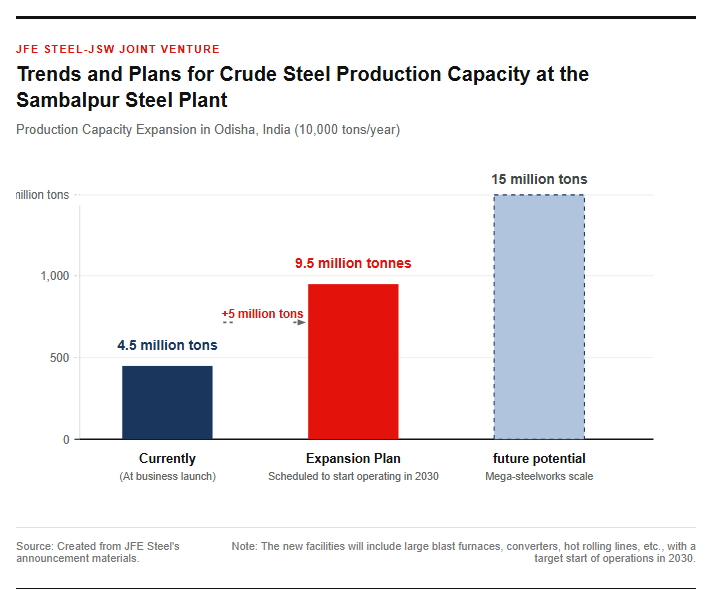
This capital investment involves large-scale expansions across the entire integrated steelmaking process, from ironmaking to steelmaking and rolling. In the ironmaking process, newly constructed facilities will include one large blast furnace, along with two coke plant batteries and one pellet plant. In the steelmaking process, two converters and two continuous slab casters will be introduced, and a new hot rolling line for producing high-quality steel sheets will be installed in the rolling process. Furthermore, utility infrastructure such as captive power generation facilities will be developed simultaneously to support the operation of these facilities. The new facilities are scheduled to begin operations in 2030. This expansion plan, which amounts to 5 million tons per year, will be carried out utilizing approximately 700 acres of already secured expansion land, enabling a rapid startup. The steelworks has the potential to expand its crude steel production capacity to a scale of 15 million tons per year in the future, and is expected to develop into one of India’s leading mega-steelworks.
JFE Steel’s Overseas Strategy and the Background of Joint Ventures
Positioned as the “third integrated steelworks” following the domestic East and West steelworks.
For JFE Steel, this joint venture steelworks is of extreme importance from a management strategy perspective. In its long-term management vision, “JFE Vision 2035,” the company aims to achieve 500 billion yen in steel business segment profits by fiscal 2035, and is moving forward with a target of generating 200 billion yen of that from overseas business earnings. Having previously depended on its two major domestic production bases—East Japan Works and West Japan Works—the company has positioned this steelworks in Odisha as its “third integrated steelworks” following them. It plans to enter the growing Indian market, driven by ongoing population growth and economic development, as an insider, thereby enhancing the profitability of existing bases and achieving organic growth through reinvestment. Amid a shrinking trend in domestic demand, directly owning production capacity in a growth market directly translates to stabilizing its long-term revenue base. Please refer to the figure below.
Deepening Partnership with JSW Steel and Cost Advantages Through Captive Mines
The relationship between JFE Steel and India’s major JSW Steel dates back to the strategic comprehensive partnership agreement concluded in 2009. Starting with a capital participation in 2010 (a 15% equity stake), the two companies have strengthened their partnership in stages, including technology licensing for automotive steel sheets and non-oriented electrical steel sheets, as well as the establishment of a joint venture for the production of grain-oriented electrical steel sheets. In this joint venture, JFE Steel’s world-class steelmaking technology will be combined with JSW Steel’s exceptional plant operation capabilities and sales network within India. Furthermore, Odisha State, where the steel mill is located, is home to the Netrabandha iron ore mine (estimated reserves of approximately 80 million tons), which is scheduled to begin operations in 2026. The geographical advantage of being able to directly procure high-quality iron ore from their own mine at low cost will provide a major cost competitive edge over rival companies.
The Rapidly Growing Indian Steel Market and Future Outlook
Market Growth Driven by Surging Infrastructure Demand and Per Capita Steel Consumption
India’s steel demand continues to expand at a rapid pace of about 8% per year. The country’s per capita steel consumption reached 102.6 kg in 2024. As historical data from Japan, South Korea, and China shows, once per capita consumption exceeds 100 kg, it enters a phase called the “growth opportunity,” where steel consumption explodes for about 20 years until it reaches 800 kg. Currently, under the Modi administration, infrastructure development such as roads, railways, and ports is accelerating, while the sophistication of manufacturing and the expansion of automobile production are providing additional tailwinds. To keep pace with this rapid market growth, competitors such as Tata Steel, AMNS India (a joint venture between ArcelorMittal and Nippon Steel), and state-owned SAIL are successively moving forward with large-scale production capacity expansion plans.
Challenges Toward the 2035 Goals and Their Impact on the Global Steel Market
Under its National Steel Policy, the Indian Government has set an ambitious target to raise domestic crude steel production capacity to 300 million tons by 2030 and 400 million tons by 2035. Along with this, a fierce competition for capital investment among companies is intensifying, while short-term concerns persist regarding issues such as fluctuations in raw material prices, oversupply concerns, and bottlenecks in logistics infrastructure. Under such an environment, what becomes important is not merely the expansion of volume, but the promotion of high value-added products. JSW JFE Steel Limited is adopting a strategy to secure profitability by increasing the manufacturing ratio of high-tensile steel sheets and high-grade building material steel sheets through the introduction of advanced technology from JFE Steel. Whether it can successfully complete the expansion to a 9.5 million-ton-per-year system by 2030 and take steady steps toward the future vision of 15 million tons per year will be a focal point to watch, determining the success or failure of Japan-India cooperation in the global steel market moving forward.
Reference page
- [JFE Steel Corporation News Release] Regarding the Decision to Expand Production Capacity at JSW JFE Steel Limited
https://www.jfe-steel.co.jp/release/2026/261023.htmlwww.jfe-steel.co.jp - [JFE Steel Corporation News Release] Regarding the Integrated Steel Mill Joint Venture with JSW Steel in India
 JFEスチール株式会社JFEスチール株式会社 -わたしたちは、常に世界最高の技術をもって社会に貢献します-www.jfe-steel.co.jp
- [JFE Holdings, Inc. IR Materials] Regarding the Integrated Steel Mill Joint Venture with JSW Steel in India
https://www.jfe-holdings.co.jp/common/pdf/investor/library/otherbriefings/250808.pdf

【#JFESteel #IndianSteelMarket #JSWSteel #OverseasBusinessStrategy #CrudeSteelProductionCapacity #EconomicNews #CapitalInvestment】


コメント