The Thai government has officially approved the country’s first-ever “National Semiconductor and Advanced Electronics Industry Development Strategy,” announcing a policy aimed at attracting a cumulative $80 billion in investment and achieving $150 billion in annual industrial revenue by 2050. The background behind this move is a strong ambition to leapfrog Thailand from a conventional backend processing hub into a comprehensive semiconductor hub that produces “Made in Thailand” chips, amid the restructuring of global supply chains driven by US-China trade friction and the rapid expansion of AI and electric vehicles.
- The Core of the Strategy for 2050 and Numerical Targets
- The “Made in Thailand Chip” Initiative Driven in Three Stages
- Three core priority platforms for power semiconductors, optical semiconductors, and sensors
- 13-year tax exemption and generous support through the “Siam Silica” human resource development plan
- The Entry of Major German Company Infineon and the Expansion of Japan-Thailand Industry-Academia Collaboration
- Medium-to-Long-Term Outlook and Key Points for Becoming an Intra-ASEAN Hub
The Core of the Strategy for 2050 and Numerical Targets
The National Semiconductor and Advanced Electronics Industry Policy Committee of Thailand, chaired by Deputy Prime Minister and Minister of Finance Ekniti Nitithanprapas, has approved the country’s first National Semiconductor Strategy. This strategy is a long-term and comprehensive national roadmap designed to establish Thailand as a manufacturing and development hub for advanced technologies in Southeast Asia. As specific numerical targets, it outlines attracting a cumulative 80 billion US dollars (approximately 2.5 trillion baht) in foreign direct investment (FDI) by 2050 and raising the industry’s total annual revenue to the 150 billion US dollar scale. Furthermore, through this massive project, the country aims to create over 230,000 jobs, including highly skilled engineers and researchers. Up to now, Thailand’s electronics industry has primarily focused on printed circuit board (PCB) manufacturing and assembly and testing—known as backend processes—maintaining a noticeable presence in the global backend market. However, because the foundation for upstream processes, such as designing and manufacturing the chips themselves, has been extremely limited, the policy aims to increase the overall value-added of the industry through this national strategy. Please refer to the structural diagram below.
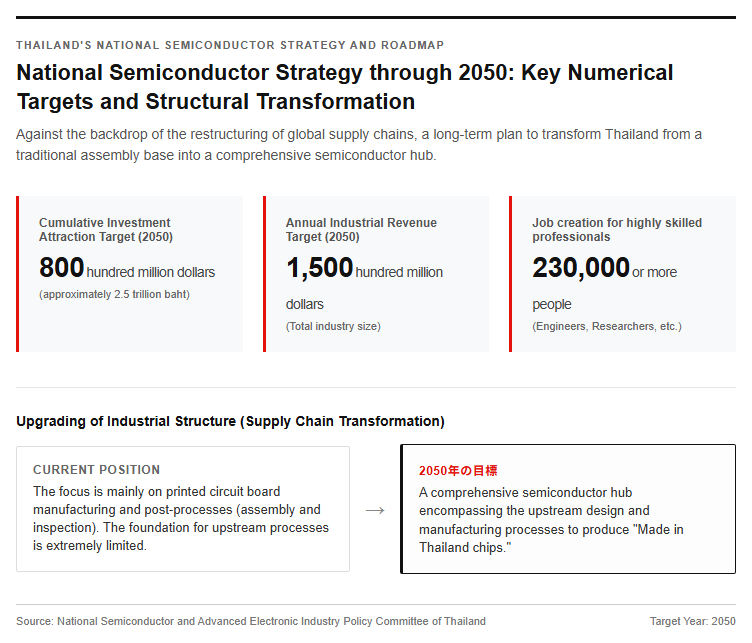
Thus, by providing state-led, comprehensive industrial support, it is seeking to fundamentally transform Thailand’s position in the global semiconductor supply chain.
The “Made in Thailand Chip” Initiative Driven in Three Stages
This national strategy will be implemented in stages over a 25-year period from 2026 to 2050, divided into three phases. In the first phase (2026–2030), while strengthening existing back-end and testing infrastructure, groundwork will be laid for expanding advanced packaging technologies and constructing front-end (wafer manufacturing) fabs. Already, between 2023 and June 2026, the Thailand Board of Investment (BOI) has received 879 investment applications for semiconductors and advanced electronic components totaling approximately $27.2 billion (about 909 billion baht), and initial investment momentum is rapidly increasing. In the following second phase (2030–2040), efforts to attract anchor companies specializing in integrated circuit (IC) design and wafer fabs will be intensified to fill gaps in the supply chain. In the final third phase (2040–2050), the plan is to complete a comprehensive domestic semiconductor ecosystem and establish a framework in which local Thai companies can lead technological innovation in the global market as local champions. Through these long-term steps, the country intends to completely transition away from being a contract assembly nation.
Key Technology Domains and Foreign Investment Attraction & Investment Incentives
Three core priority platforms for power semiconductors, optical semiconductors, and sensors
The Thai government has scrutinized the intersection of its existing industrial base and global growth markets, formulating a strategy to selectively concentrate resources on three technology platforms. The first pillar is power semiconductors, which are essential for electric vehicles (EVs), clean energy infrastructure, and power grids. As one of Southeast Asia’s leading automotive production hubs, Thailand aims to achieve local production for local consumption of high-efficiency power modules in response to the transition toward next-generation mobility. The second pillar is optical semiconductor (photonics) technology for artificial intelligence (AI) data centers and high-speed communications. Thailand has cultivated an ecosystem in the optical field through the concentration of hard disk drive (HDD) production, and will apply this strength to the advanced AI infrastructure sector. The third pillar is the advancement of various sensor technologies (including MEMS) that support smart devices, healthcare, and automation technologies. As shown in the diagram below, by concentrating resources on these priority areas, the country seeks to establish a unique competitiveness tailored to its own conditions.
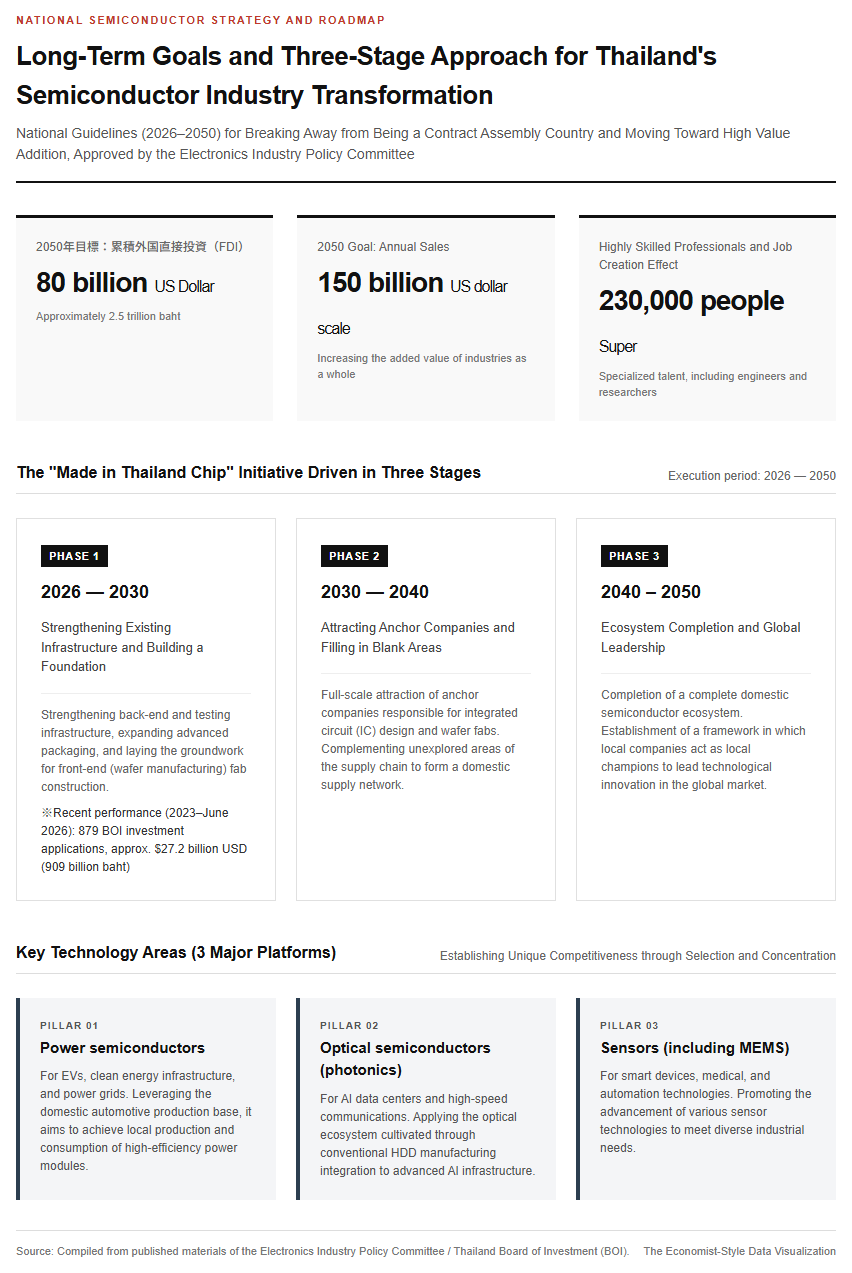
Rather than competing head-on with Big Tech in cutting-edge, ultra-fine processes, this is a strategy to establish a strong presence in sectors with robust industrial demand.
13-year tax exemption and generous support through the “Siam Silica” human resource development plan
To attract massive investment, the Thai government is developing robust financial and non-financial incentives. Under the BOI’s tax incentives, corporate income tax exemptions of up to 13 years will be applied to front-end fabs such as wafer manufacturing, while exemptions of up to 8 years will be granted to large back-end operations and IC design companies. In addition, to secure the highly skilled talent most essential to the success of the semiconductor industry, a talent development program led by the Ministry of Higher Education, Science, Research and Innovation (MHESI), called “Siam Silica,” has been approved. Through the introduction of university sandbox schemes and collaboration with international academic institutions, the plan aims to develop a total of 86,600 people by 2030, including 84,900 highly skilled professionals and approximately 1,700 advanced researchers. Furthermore, the government is promoting the creation of a public-private talent development ecosystem by, for instance, requiring companies to participate in industrial workforce education and technology transfer programs as a condition for receiving preferential treatment. Streamlining administrative procedures into a one-stop service and regulatory easing are also being implemented simultaneously, creating an increasingly attractive environment for foreign investors.
International Collaboration and Future Prospects
The Entry of Major German Company Infineon and the Expansion of Japan-Thailand Industry-Academia Collaboration
Along with the launch of national strategies, the expansion of major global semiconductor companies into Thailand and international partnerships are accelerating. Germany’s Infineon Technologies, the world’s largest power semiconductor manufacturer, has opened its first large-scale back-end plant in the country in Samut Prakan Province. The plant will manufacture power modules for EVs and clean energy, with plans to create up to 5,000 jobs, establish a research and development center, and formulate joint curricula with Thai educational institutions. Furthermore, movements toward industry-academia collaboration with Japan are rapidly expanding. Thailand’s Minister of Higher Education, Science, Research and Innovation, Yochanan, met with the presidents of Japan’s Kyoto University and Osaka University, and agreed on joint research in the fields of AI-driven materials science, advanced semiconductors, and IC design. Specifically, initiatives have begun to advance data integration between Kyoto University’s “AI4M-hub” and Thailand’s “Siam Silica” to significantly shorten the development period for new materials. Thus, movements combining European advanced manufacturing technology with Japan’s academic and AI research infrastructure are spreading.
Medium-to-Long-Term Outlook and Key Points for Becoming an Intra-ASEAN Hub
Thailand’s national semiconductor strategy extends beyond the structural reform of its own economy, evolving into a move that envisions the integration of supply chains across the entirety of Southeast Asia. At the ASEAN Ministerial Meeting held in Vientiane, the Thai government proposed the launch of the “ASEAN CHIPS Act (ACA)” to integrate the regional semiconductor industry. This initiative aims to position ASEAN as a whole as a robust semiconductor ecosystem by advancing human resource development, the sharing of research infrastructure, and supply chain resilience. Amid the prolonged geopolitical U.S.-China friction, as global semiconductor companies intensify “China Plus One” strategies to diversify their manufacturing bases, Thailand—with its neutral stance and well-developed surrounding infrastructure—has become an ideal investment destination. Moving forward, the greatest point of focus will be whether the announced national strategy is executed as planned and whether the mass production of prototype chips, the construction of domestic fabs, and the supply of highly skilled talent progress smoothly. Intense global attention is focused on whether Thailand can transform from a back-end manufacturing base into an advanced technology hub boasting “Made-in-Thailand.”
Reference page
- [Thailand Board of Investment (BOI) Official Announcement] https://www.boi.go.th/index.php?page=press_releases_detail&topic_id=139424&_module=news&from_page=press_releases2
- [Infineon Technologies Press Release] https://www.infineon.com/press-release/2026/infpr202610-144
【#Thailand #Semiconductors #NationalStrategy #BOI #EconomicNews #Infineon #ASEAN #InvestmentPromotion】


コメント