The preliminary Eurozone consumer confidence index for October 2026 worsened to -17.9, causing the euro to extend its decline. The backdrop includes concerns over a slowdown in the European economy driven by political instability in France, a widening fiscal deficit, and the re-acceleration of inflation.
- Decline in October Consumer Confidence Index and Falling Short of Market Expectations
- The Decline of the Euro-Dollar to the .11 Range and Compound Selling Pressure
- Widening German-French Yield Spread and Its Impact on the Eurozone Financial Markets
- ECB’s Policy Interest Rate Outlook and Its Impact on Prices and Growth
- Analysis of the Risk of European Debt Crisis Resurgence and Future Points to Watch
Decline in October Consumer Confidence Index and Falling Short of Market Expectations
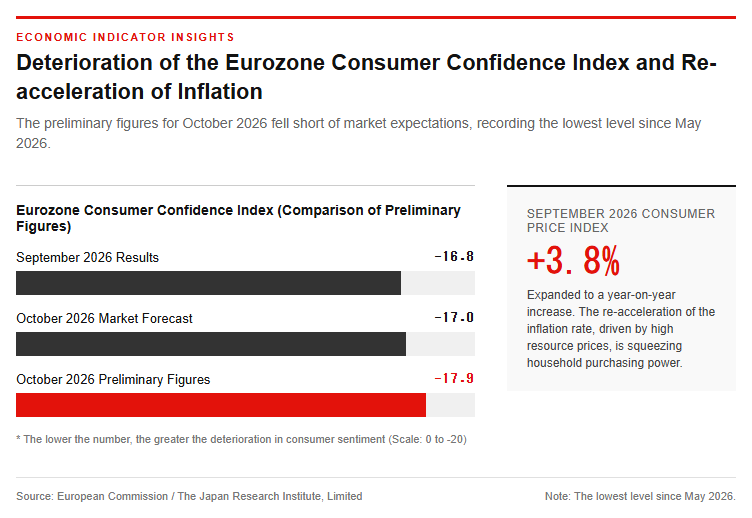
The flash estimate of the euro area consumer confidence index for October 2026, released by the European Commission, came in at minus 17.9, worsening more than expected from minus 16.8 in the previous month of September. It fell below the market expectation of minus 17.0, recording its lowest level since May 2026. In the euro area household sector, persistently high energy prices and rising living costs are depressing purchasing power, and a cooling of consumer appetite has become prominent. According to a report by the Japan Research Institute, the euro area’s Consumer Price Index for September 2026 expanded to a positive 3.8 percent year-on-year, and the re-acceleration of the inflation rate driven by high resource prices is putting pressure on living standards. Although the service sector maintains resilience in some areas, production activity in the goods sector, including intermediate and consumer goods, is likely to face a prolonged slump. The deterioration in consumer sentiment is not merely a temporary fluctuation in figures, but an important signal suggesting a growth slowdown for the broader European economy from the second half of 2026 into early 2027. Please refer to the figure below.
The Decline of the Euro-Dollar to the .11 Range and Compound Selling Pressure
Prompt: Translate Japanese text to natural, complete English for a tech/business news blog. Preserve Markdown, inline code, punctuation. Translate ENTIRE text. Output ONLY translated text.
Source text:
消費者信頼感指数の悪化を受けて外国為替市場ではユーロ売りが加速し、ユーロドル相場は一時1.1189ドルまで下落した。また、ユーロ円も175円55銭まで下落し、約1年ぶりの円高・ユーロ安水準を更新する動きとなった。ユーロは9月上旬に1.16ドル台前半で推移していたが、10月に入りフランスの財政不安や米国の堅調な経済指標を背景にユーロ安・ドル高傾向を強めていた。為替市場の分析では、現在のユーロ相場には欧州特有の財政リスクプレミアムや地政学的リスクが色濃く織り込まれていると指摘されている。欧州圏が消費する石油や天然ガスの大半を輸入に依存している構造から、世界的なエネルギー価格の変動や貿易条件の悪化はユーロの下落圧力に直結しやすい。市場関係者の間では、欧州中央銀行の金融政策判断や政治的交渉の行方によっては、ユーロドル相場が年末にかけて一段と下振れするリスクが警戒されている。
Translation:
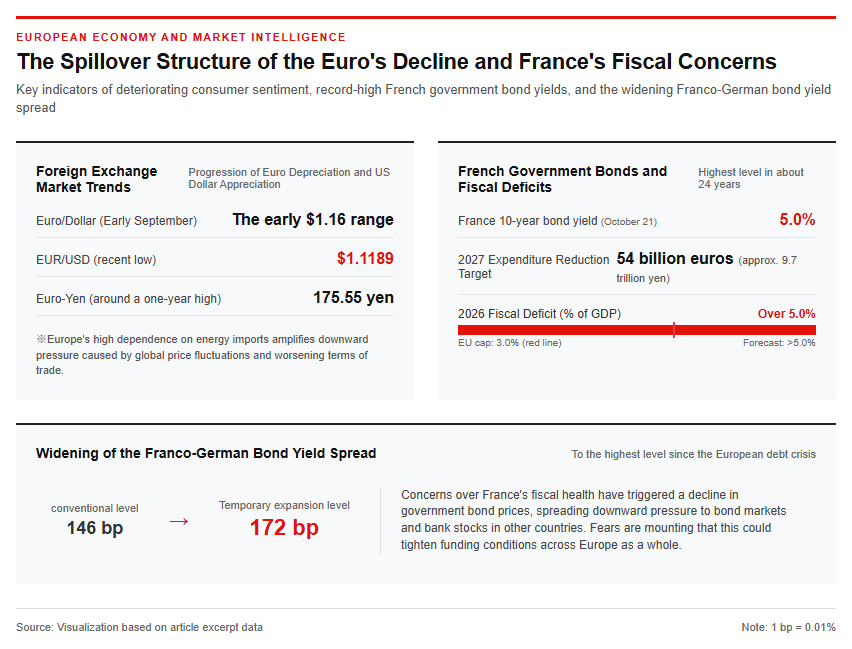
In response to the deteriorating consumer confidence index, selling of the euro accelerated in the foreign exchange market, and the euro-dollar exchange rate temporarily fell to $1.1189. In addition, the euro-yen rate dropped to 175.55 yen, updating to a level of yen appreciation and euro depreciation not seen in about a year. The euro was trading in the low $1.16 range in early September, but entering October, it strengthened a trend of euro depreciation and dollar appreciation against the backdrop of fiscal anxiety in France and strong economic indicators in the US. Foreign exchange market analyses point out that the current euro exchange rate heavily prices in Europe-specific fiscal risk premiums and geopolitical risks. Due to the structural reliance of the eurozone on imports for the majority of the oil and gas it consumes, fluctuations in global energy prices and deterioration in terms of trade easily translate directly into downward pressure on the euro. Among market participants, there is growing caution that, depending on the European Central Bank’s monetary policy decisions and the outcome of political negotiations, the euro-dollar exchange rate risks sliding further downward toward the end of the year.
Political and Fiscal Uncertainty in France and the Escalation of Market Risks
A major backdrop to the continued depreciation of the euro is the political and fiscal uncertainty in France, the eurozone’s second-largest economy. The yield on French 10-year government bonds briefly reached 5.0 percent on October 21, 2026, marking its highest level in about 24 years since 2002. In addition to large-scale protests and riots that escalated over the weekend, difficulties in deliberating the 2027 budget bill in a divided parliament are fueling market concerns. Prime Minister Lecornu has set a target for spending cuts on the scale of 54 billion euros (approximately 9.7 trillion yen) in the 2027 budget, and Finance Minister Lescure has also touched upon the possibility of forcibly enacting the budget without a parliamentary vote by utilizing Article 49, Paragraph 3 of the Constitution. However, France’s fiscal deficit for 2026 is projected to exceed 5.0 percent of GDP, making compliance with the EU’s 3.0 percent upper limit extremely difficult. Public backlash against spending cuts and political turmoil are severely shaking market confidence in French government bonds.
Widening German-French Yield Spread and Its Impact on the Eurozone Financial Markets
Due to concerns over France’s fiscal situation, the yield premium of 10-year French government bonds over low-credit-risk 10-year German bonds (the Franco-German yield spread) widened from 146 basis points to a peak of 172 basis points. This widening of the spread reached its highest level since the European debt crisis in the early 2010s, and downward pressure spread to the bond markets and bank stocks of other major eurozone countries such as Italy. European finance ministers’ meetings and the European Central Bank have strongly urged the French government to urgently pursue sound fiscal consolidation to ensure predictability and market confidence. However, strict conditions such as compliance with EU fiscal rules exist for the activation of the European Central Bank’s emergency bond-buying program, the Transmission Protection Instrument (TPI), and the fact that officials have not shown a stance toward easy market intervention is also leading to a cautious stance among investors. The decline in government bond prices negatively impacts the asset valuations of financial institutions holding them, raising concerns that it will tighten the funding environment across Europe as a whole. Please refer to the figure below.
The European Central Bank’s Policy Stance and Medium- to Long-Term Economic Outlook
ECB’s Policy Interest Rate Outlook and Its Impact on Prices and Growth
The European Central Bank raised its policy interest rate by 0.25 percentage points at its September 2026 Governing Council meeting, and expectations are growing that it will implement an additional rate hike at the December 2026 meeting in response to mounting inflationary pressures. An analysis of central bank communication from the academic research paper “From Tone to Trajectory” demonstrates that the emotional trajectory and placement of emphasis in meeting explanatory documents significantly impact market interest rate predictions and inflation expectations. The rise in policy rates suppresses residential investment and corporate capital expenditure, acting as a downward pressure on domestic demand. The eurozone’s real GDP growth rate is projected to decelerate from 0.9 percent in the third quarter of 2026 to 0.6 percent in the fourth quarter of 2026, and the economy is expected to remain in a standstill state. As high prices and high interest rates simultaneously squeeze households and businesses, the European Central Bank is forced into a difficult balancing act between curbing inflation and avoiding an economic downturn.
Analysis of the Risk of European Debt Crisis Resurgence and Future Points to Watch
Despite market turmoil spreading due to France’s worsening fiscal condition and rising government bond yields, it is analyzed that the situation is unlikely to spread or recur into a severe crisis like the former European debt crisis. During the 2010 Greek crisis, the current account deficit exceeded 10 percent of GDP, but France’s current account deficit currently remains at less than 1 percent of GDP, and the external balance of the eurozone as a whole is also favorable. Furthermore, market defense measures such as the Transmission Protection Instrument are in place at the European Central Bank, functioning as a deterrent against extreme market turmoil. Key points to watch moving forward include the landing point of the 2027 budget deliberations in France, trends in the inflation rate reflecting resource price movements, and the interest rate decision at the December meeting of the European Central Bank. For the European economy to overcome the economic slowdown and head toward recovery, the restoration of political stability and the prevention of structural deterioration are essential conditions.
Reference page
- [Japan Research Institute: European Economic Outlook (October 2026)] https://www.jri.co.jp/report/medium/euro/
- 【arXiv Paper: From Tone to Trajectory: Continuous Sentiment and the Shape of Monetary Policy Communication】[suspicious link removed]
[#Eurozone #ConsumerConfidence #EuropeanEconomy #ECB #ForeignExchange #FrenchFinances]


コメント