Amazon Web Services (AWS) and Microsoft have launched a preview of a managed interconnect service that facilitates private connectivity between their respective clouds. This comes amid the challenge that while corporate multi-cloud adoption is accelerating, network setup and operational management between the providers have become increasingly complex.
- Key points of managed interconnection between AWS and Azure
- The Progress of Multi-Cloud Adoption and the Background of Open Specification Formulation
- Structural Differences from Conventional Hand-Built Closed Networks
- Quad-redundant design ensuring high availability and encryption
- Expected Practical Benefits and Easily Overlooked Risk Factors
- Future Market Expansion and Evaluation Metrics for Production Adoption
Key points of managed interconnection between AWS and Azure
On August 31, 2026, AWS announced the public preview of “AWS Interconnect – multicloud,” which enables private connectivity with Microsoft Azure. Simultaneously, Microsoft announced the launch of “Azure Multicloud Interconnect for AWS,” establishing this as a joint interconnection feature by the two mega clouds.
With this announcement, enterprise users can now rapidly provision private communication paths between the two clouds simply by operating a single logical resource from the AWS and Azure management consoles, CLIs, or APIs. Regarding availability status, while support for Google Cloud and Oracle Cloud (OCI) has already reached General Availability (GA), this Azure integration is positioned as a public preview.
Initial availability is limited to four regions: US East (N. Virginia), US West (Northern California), Asia Pacific (Sydney), and Europe (Frankfurt). Since the Tokyo region is not included at this time, domestic-only system designs will require verification that takes regional characteristics into account.
The Progress of Multi-Cloud Adoption and the Background of Open Specification Formulation
A multi-cloud strategy, in which companies use multiple cloud providers in combination, has evolved beyond simply avoiding vendor lock-in or ensuring business continuity planning (BCP) in the event of an outage. It is now evolving into an architecture that combines generative AI and data analytics platforms—in which each company excels—on a right-person-for-the-right-job basis. Research and analysis at the end of 2025 also show that configurations linking AWS and Azure are gaining strong support, particularly in the financial and tech industries.
However, building networks that span across different cloud providers has faced numerous barriers, such as the procurement of physical lines and mismatched operational policies. To resolve these challenges, AWS released open specifications for network interoperability on GitHub at its annual conference “re:Invent 2025” in November 2025, calling for participation from the entire ecosystem.
Microsoft Azure’s adoption of this open specification can be seen as a symbolic example of major cloud providers stepping in sync toward the standardization of interoperability. Standardized interfaces are expected to reduce cross-provider infrastructure management overhead.
Technical Specifications and Differences from Traditional Architecture
Structural Differences from Conventional Hand-Built Closed Networks
Traditionally, when establishing a private connection between AWS and Azure, it was common for user companies to individually arrange AWS Direct Connect on the AWS side and Azure ExpressRoute on the Azure side, connecting them physically and logically through data centers, colocation providers, or NaaS providers. This approach required coordinating BGP routing configurations, redundancy designs, and circuit monitoring across multiple vendors, resulting in a lead time of several weeks to several months before service activation.
The following diagram shows a comparison of the architectures between the conventional hand-built configuration and the new managed interconnect.
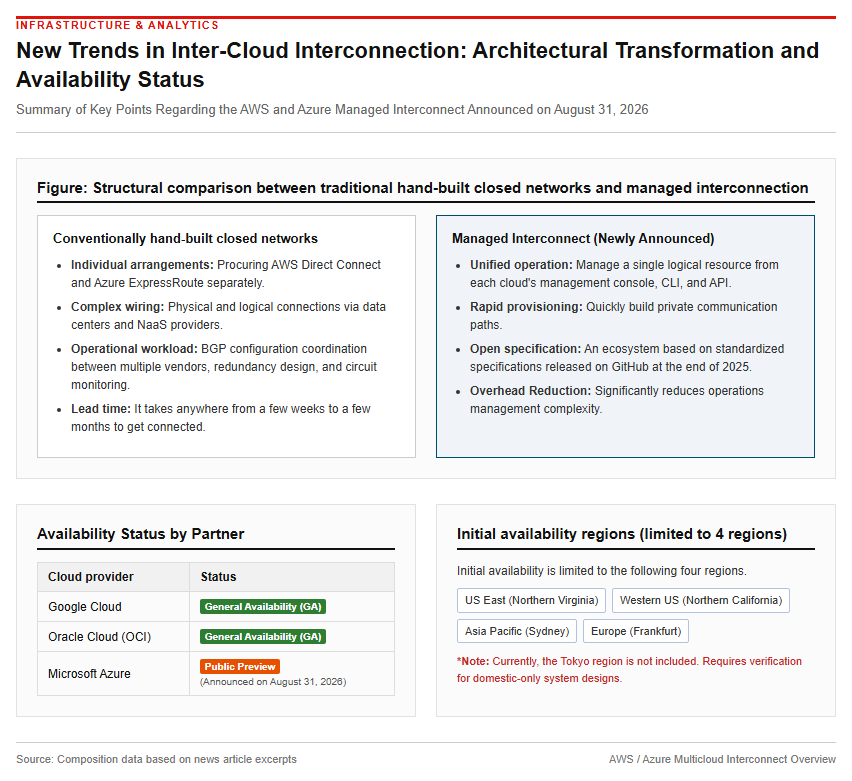
In the new method, physical layer infrastructure management and complex peering configurations are consolidated under the cloud provider’s management, making it possible to spin up a connection environment in just a few minutes. Note that this service is not intended to completely replace Direct Connect or ExpressRoute; rather, it is based on a design philosophy that integrates the communication layers between clouds in a managed way while maintaining existing services between on-premises and the cloud.
Quad-redundant design ensuring high availability and encryption
To support mission-critical system integration, this connection infrastructure incorporates high levels of fault tolerance and security technologies as standard. For network redundancy, a “quad-redundant” architecture is adopted, and four independent logical paths routing through physically separated sites and routers are automatically secured for each connection.
This redundant design ensures that communication continuity is maintained even in situations such as scheduled maintenance of a single router, unexpected independent failures, or the total loss of an entire connection site. Based on this robust architecture, Microsoft sets a target availability SLA of 99.99%.
For security, MACsec (Media Access Control Security) encryption at the link layer is enabled by default and automatically. Traffic flowing between the cloud provider’s edge routers is protected at Layer 2, ensuring secure data communication without any exposure to the public internet.
Benefits, Challenges, and Future Outlook of Implementation
Expected Practical Benefits and Easily Overlooked Risk Factors
Direct interconnection between AWS and Azure is effective across a wide range of use cases, such as batch transfers of large volumes of data, distributed processing combining data lakes on AWS with analytics and AI models on Azure, and disaster recovery (DR) failover. Utilizing dedicated bandwidth that does not traverse the public internet, stable and low-latency communication can be expected.
On the other hand, when implementing this in actual operations, several precautions and potential risks must be calmly evaluated. First, the usage fees for the connection feature itself have not been announced during the preview stage, so there is uncertainty in the cost structure. Second is the existence of outbound data transfer (egress charges) flowing between clouds.
Even with a private closed network, data transfer fees specified by respective providers are incurred, so neglecting cost estimations based on the volume of data moved risks leading to unexpected spikes in operational costs. Moreover, although MACsec is applied at the link layer, it is essential to implement defense-in-depth measures that combine application-layer encryption, such as TLS, with granular access authorization.
Future Market Expansion and Evaluation Metrics for Production Adoption
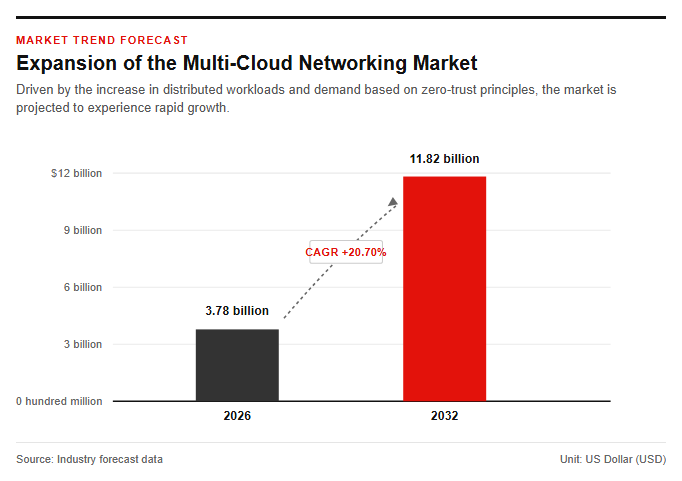
The multi-cloud networking market is projected to expand from approximately US$3.78 billion in 2026 to US$11.82 billion by 2032, growing at a compound annual growth rate (CAGR) of about 20.70%. This rapid growth is driven by an increase in distributed workloads and the demand for secure network integration based on zero-trust principles.
The following diagram shows the overall picture of monitoring and operational management in future cross-cloud connections.
When companies consider the production deployment of this direct connection, their immediate focus will be the timing of the transition from public preview to general availability (GA), along with the disclosure of the accompanying official pricing structure. Furthermore, early deployment to Asian hubs, including the Tokyo region, is anticipated to meet the low-latency and data sovereignty requirements of financial institutions and manufacturers in Japan. For engineering organizations, ensuring observability across both clouds and establishing operational workflows with clearly defined demarcation of responsibility during failures will dictate future success.
Reference Page
- [AWS Official Announcement] https://aws.amazon.com/about-aws/whats-new/2026/08/aws-announces-AWS-interconnect-multicloud-microsoft-azure-preview/
- [Azure Official Announcement] https://azure.microsoft.com/en-us/blog/introducing-azure-multicloud-interconnect-for-aws/
- [AWS Interconnect Open Specification] https://github.com/aws/Interconnect
[#AWS #Azure #MultiCloud #CloudNetworking #PrivateNetwork #InfrastructureTechnology #Security]

コメント