
In October 2026, the average hourly wage for temporary workers in the three major metropolitan areas reached 1,728 yen, setting a record high for the sixth consecutive month. In addition to the worsening structural labor shortage, the revised Worker Dispatching Act implemented in October 2026 and the growing corporate demand for immediate contributors and specialized talent are driving the upward trend in hourly wages.
- Key takeaway from the event: Temp staff hourly wage data hits a record high
- The deepening labor shortage and the demand structure on the corporate side
- Wage Polarization and Its Background by Job Category
- The Amended Worker Dispatching Act Effective October 2026 and Corporate Practice
- Wage Increase Momentum and Labor Market Analysis by the Bank of Japan and Rengo
- Future Outlook and Key Focus Areas: Management Strategies in the Temporary Staffing Industry and Workers’ Work Styles
Key takeaway from the event: Temp staff hourly wage data hits a record high
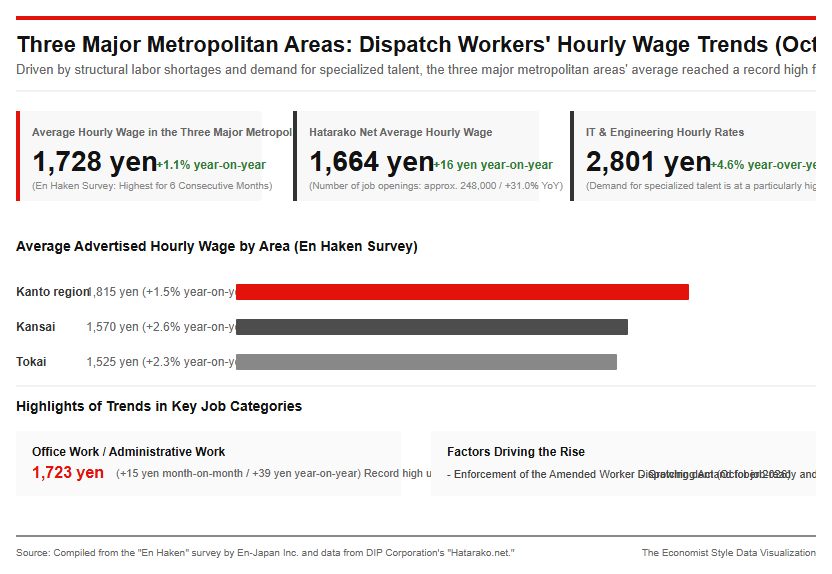
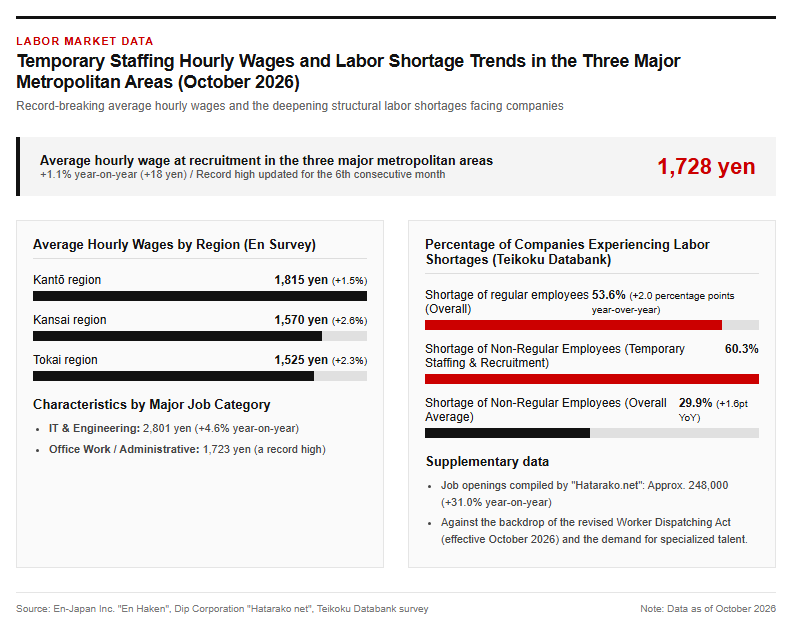
The average hourly wage for dispatched workers at the time of recruitment continues to rise across the three major metropolitan areas. According to the October 2026 “En Dispatch” survey published by En Japan Inc., the average hourly wage in the three major metropolitan areas reached 1,728 yen, marking a 2 yen (0.1%) increase from the previous month and an 18 yen (1.1%) increase compared to the same month last year. This is the sixth consecutive month of setting a record high, and the 49th consecutive month of exceeding the figures from the same month of the previous year. Furthermore, according to data compiled by Dip Corporation’s “Hatarako-net,” the average hourly wage in October was 1,664 yen (a 16-yen increase year-on-year), and the number of job listings reached approximately 248,000, showing a significant year-on-year increase of 31.0%. By region, the En survey showed that the Kanto area stood at 1,815 yen (a 1.5% year-on-year increase), the Tokai area at 1,525 yen (a 2.3% increase), and the Kansai area at 1,570 yen (a 2.6% increase), maintaining positive growth across all three regions. By job category, IT and engineering roles remained high at 2,801 yen (a 4.6% year-on-year increase), while office work and clerical positions also reached a record high of 1,723 yen (a 15-yen increase from the previous month and a 39-yen increase year-on-year). The following chart shows the trends in hourly wages and growth rates for major job categories.
Such data strongly underscores a market-wide upward trend in wages, rather than a temporary supply-demand imbalance.
The deepening labor shortage and the demand structure on the corporate side
The background behind the high level of temporary staffing wages is the severe labor shortage facing companies. According to the “Corporate Trends Survey on Labor Shortage” conducted by Teikoku Databank in October 2026 targeting 11,614 companies nationwide, 53.6% of companies responded that they are facing a shortage of regular employees (an increase of 2.0 points from the same month of the previous year), approaching the record-high level of 53.9% recorded in November 2018. Furthermore, companies feeling a shortage of non-regular employees also remained at a high level of 29.9% (an increase of 1.6 points from the same month of the previous year). By industry, the shortage ratio for non-regular employees was highest in “Temporary Staffing and Placement” at 60.3%, followed by “Restaurants” at 56.4%, and “Maintenance, Security, and Inspection” at 55.9%. As Japan’s working-age population continues to decline due to the declining birthrate and aging population, companies find themselves in a situation where they cannot secure the necessary personnel through the direct hiring of regular employees alone. Consequently, they are increasing their reliance on temporary staffing talent, which can be deployed to the field immediately with suppressed training costs, and competition to acquire top talent is accelerating the upward pressure on hourly wages.
Wage Polarization and Its Background by Job Category
In the temp staffing market, the polarization of hourly wage increases has become even more pronounced depending on the required skills and the difficulty of the tasks. In the IT and engineering sectors, where demand is surging in particular—driven by the promotion of generative AI utilization and active DX (Digital Transformation) investment—high-paying jobs with hourly wages around 3,000 yen for advanced professionals such as database engineers, PMs, and PMOs are emerging one after another. Furthermore, in office work and administrative roles, job openings requiring specialized knowledge—not just general clerical work, but also accounting/finance, general affairs/human resources, and information security—have increased, serving as a factor pushing up average hourly wages. On the other hand, in areas where large-scale hiring takes place, such as year-end tax adjustment and tax return-related call centers, average amounts occasionally settle down temporarily, but unit prices themselves are on an upward trend due to the growing sophistication of contracted operations. The figure below illustrates the image of the job-opening-to-applicant ratio and wage gaps between specialized and general occupations.
Companies are shifting toward a structure where they evaluate and compensate for immediate proficiency in specific skills, rather than merely supplementing tasks.
Regulatory Changes, Macroeconomics, and Future Outlook
The Amended Worker Dispatching Act Effective October 2026 and Corporate Practice
The amended Ordinance for Enforcement of the Worker Dispatch Act and related guidelines, which came into effect on October 1, 2026, have a direct impact on improving the wages and treatment of dispatched workers. Under this amendment, regulations regarding equal pay for equal work have been strengthened, obligating temporary staffing agencies to clearly state upon hiring or the commencement of a dispatch that workers “may request an explanation regarding the details and reasons for differences in treatment compared to regular employees.” In addition, the guidelines on equal pay for equal work have been clarified based on judicial precedents, making the judgment criteria for unreasonable differences in treatment regarding bonuses, retirement allowances, housing allowances, family allowances, and various leave systems more stringent. Furthermore, client companies are also required by the guidelines to provide feedback to staffing agencies regarding work performance, offer conveniences such as parking lots, and give consideration to appropriate negotiations on dispatch fees. Driven by these legislative developments, companies are forced to re-examine the validity of their dispatch fees and hourly wage settings from both compliance and talent acquisition perspectives.
Wage Increase Momentum and Labor Market Analysis by the Bank of Japan and Rengo
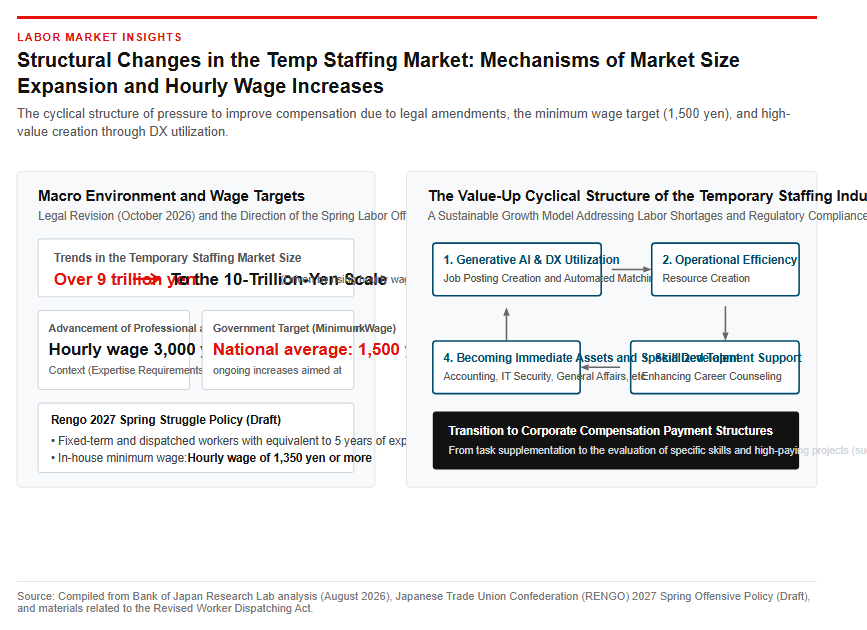
From a macroeconomic perspective as well, the momentum for wage increases across the entire workforce, including dispatched workers, is strengthening. The draft of the 2027 Spring Labor Offensive policy confirmed by RENGO (Japanese Trade Union Confederation) sets forth a policy to continue demanding wage hikes of 5% or more, including regular pay raises, while aiming for an hourly wage of 1,500 yen or more for fixed-term, part-time, and dispatched workers with the equivalent of five years of experience, and an in-house minimum wage of 1,350 yen or more. Furthermore, according to an analysis by the Bank of Japan’s Research Lab released in August 2026, the “nominal wage rigidity (particularly the suppression of upward wage adjustments)” that had become entrenched during the deflationary period has recently begun to ease, showing that the distribution of wage growth rates, which had been concentrated around 0%, is shifting in a positive direction. As structural issues that hinder productivity gains from being fairly reflected in wages head toward resolution, labor mobility triggered by wage increases is becoming more active, giving rise to a virtuous cycle that leads to higher overall economic productivity and rising real wages.
Future Outlook and Key Focus Areas: Management Strategies in the Temporary Staffing Industry and Workers’ Work Styles
The temporary staffing market going forward is expected to maintain a moderate upward trend in hourly wages, driven by the continuous rise in minimum wages and ongoing structural labor shortages. Government-led revisions aimed at achieving the national average minimum wage target of 1,500 yen will function to raise overall temporary staffing wages. Along with this, the market size of the staffing industry is projected to expand from over 9 trillion yen to the 10-trillion-yen scale; however, this growth will be driven by rising hourly rates rather than an increase in the number of dispatched staff. For staffing agencies, it will be crucial to pursue operational efficiency through the use of generative AI and DX to automate job description creation and matching, while simultaneously reinvesting the freed-up resources into skills-upgrading support and career counseling for registered staff. The following figure illustrates the cyclical structure of rising hourly wages and the utilization of DX in the future staffing industry.
For workers, it is also becoming increasingly important to enhance their specialized skills, capitalize on the wave of rising hourly wages, and pursue autonomous career development.
Reference Page
- [En-japan Press Release] Average Hourly Wage for Temporary Workers in October 2026 Was 1,728 Yen. Reaching a Record High for 6 Consecutive Months. https://prtimes.jp/main/html/rd/p/000001312.000000725.html
- [DIP Corporation News Release] Average Hourly Wage for Agency Workers in October 2026 https://www.dip-net.co.jp/news/2199
- [Ministry of Health, Labour and Welfare] Regarding Equal Pay for Equal Work for Disacted Workers (Effective October 1, 2026) https://www.mhlw.go.jp/stf/seisakunitsuite/bunya/0000077386_00001.html
- [Bank of Japan Research LAB] Why Productivity Gains Were Not Reflected in Wage Increases: Lessons from Japan’s Deflationary Period https://www.boj.or.jp/research/wps_rev/lab/lab26j02.htm
- [Japanese Trade Union Confederation (RENGO)] 2027 Spring Struggle for a Better Living Policy (Draft) [suspicious link removed]
【#TemporaryStaffHourlyWage #WorkerDispatchActAmendment #LaborShortage #EqualPayForEqualWork #WageTrends #October2026 #TemporaryStaffing】


コメント