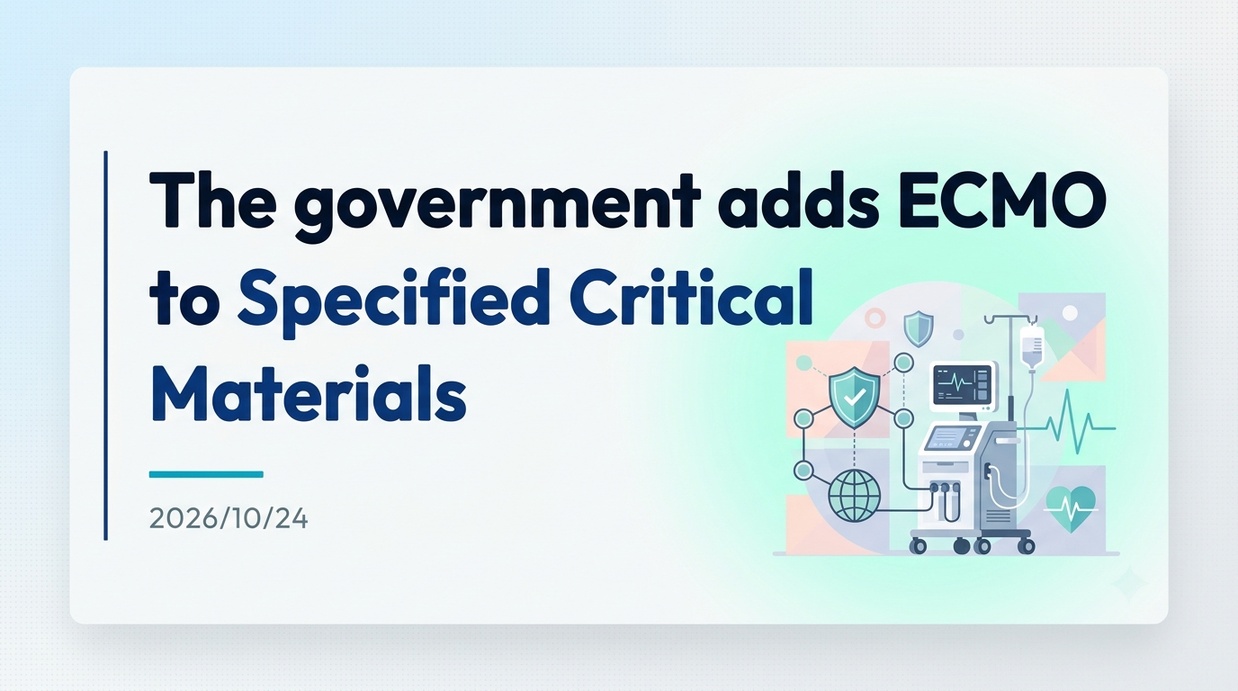
Based on the Economic Security Promotion Act, the government has made a Cabinet decision to additionally designate extracorporeal membrane oxygenation (ECMO)—which is directly linked to the life support of severely ill patients—as a specified critical material. The move comes as part of efforts to strengthen the medical supply chain by eliminating the risk of overseas dependence amid growing uncertainty in international affairs and infectious disease outbreaks, and by establishing domestic alternative production and procurement systems.
- Key points of the government designating ECMO as a specified critical material
- The Role of ECMO in Medical Settings and the Risks of Overseas Dependence
- Diversified financial and monetary support measures for certified businesses
- Medium-to-Long-Term Goals for Reducing Import Dependency on Medical Devices
- Expansion of the ECMO Market Domestically and Internationally and Technical Challenges
- Future Developments and Key Points for Supply Chain Resilience
Key points of the government designating ECMO as a specified critical material
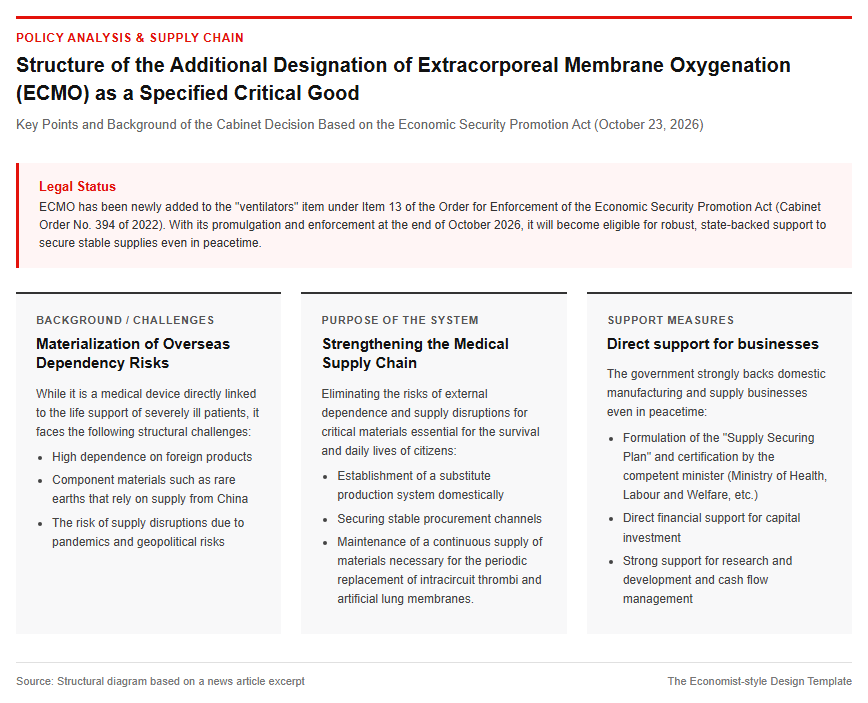
On October 23, 2026, the Japanese government approved a cabinet decision on a Cabinet Order revision to add extracorporeal membrane oxygenation (ECMO) systems to the list of specified critical materials, pursuant to the Act on the Promotion of Ensuring National Security through Integrated Implementation of Economic Measures (Economic Security Promotion Act). With this Cabinet Order revision, ECMO will be newly added to the “artificial ventilators” item listed in Article 13 of the Order for Enforcement of the Economic Security Promotion Act (Cabinet Order No. 394 of 2022). The revised Cabinet Order is scheduled to be promulgated at the end of October 2026 and take effect upon promulgation.
“Specified critical materials” is a system under which the government strongly supports securing the supply of critical materials during peacetime, by designating items that are indispensable for the survival of citizens, or upon which public livelihood and economic activities broadly rely, and which carry a high risk of excessive external dependence or supply disruption. With this designation, an environment has been put in place where businesses that manufacture and supply ECMO and its main components domestically can create a “supply securing plan” and receive certification from competent ministers such as the Minister of Health, Labour and Welfare, enabling them to receive direct financial support and financing support for capital investments and research and development.
The Role of ECMO in Medical Settings and the Risks of Overseas Dependence
ECMO (Extra Corporeal Membrane Oxygenation) is an advanced life-support system that extracts blood from a patient’s body, oxygenates it and removes carbon dioxide using an artificial lung, and then returns it to the body. Broadly categorized into VV-ECMO for severe respiratory failure and VA-ECMO (PCPS) which supports both cardiac and respiratory failure, it is utilized in clinical settings as a last resort for treatment in conditions where saving lives is difficult with conventional mechanical ventilation or drug therapy.
However, many of the ECMOs operating in Japan, along with their peripheral devices and major components, rely heavily on foreign products, and their constituent parts include rare earth elements whose supply depends on China. It has been pointed out that if overseas manufacturing countries shift to prioritizing domestic supplies due to infectious disease pandemics or increasing geopolitical risks, supplies to Japan could be cut off, posing a serious risk to patients’ lives. Furthermore, there is a high demand for regular replacements due to blood clots in ECMO circuits and the degradation of artificial lung membranes, making the sustained supply of materials a top priority for medical security. As shown in the illustration below, a rigorous maintenance system and a continuous supply of consumables are indispensable for safety management and the stable operation of equipment in clinical settings.
Support Systems and Industrial Policies Based on the Economic Security Promotion Act
Diversified financial and monetary support measures for certified businesses
Following the designation of ECMO as a specified critical material, comprehensive support measures will be launched to encourage the establishment of domestic manufacturing lines and the research and development of alternative parts and materials. Businesses certified under the Economic Security Promotion Act will be able to utilize the following multifaceted support systems.
- Subsidy Program: The government will subsidize 1/2 to 2/3 of the cost for the new installation and expansion of manufacturing facilities, the development of stockpiling warehouses, and the domestic production of parts and materials or the development of alternative technologies.
- Two-step loan: Provides long-term, low-interest, fixed-rate financing through designated financial institutions such as the Development Bank of Japan Inc.
- Stock underwriting and credit guarantees: Supporting fundraising through the underwriting of shares and other equities by Small and Medium Business Investment and Consultation Co., Ltd., and the expansion of guarantee limits by credit guarantee associations.
As a specific administrative move, the Ministry of Health, Labour and Welfare has allocated 940 million yen in its budget概算要求 (approximate budget request) for fiscal year 2027 for related budgets concerning medical devices requiring secured stable supply, including ECMO. Furthermore, the Ministry of Economy, Trade and Industry has established a long-term support framework for research and development and domestic production base reinforcement spanning 10 years starting from fiscal year 2027 as the “Stable Supply Medical Device Project,” advancing the restructuring of a supply chain that unites industry, government, and academia.
Medium-to-Long-Term Goals for Reducing Import Dependency on Medical Devices
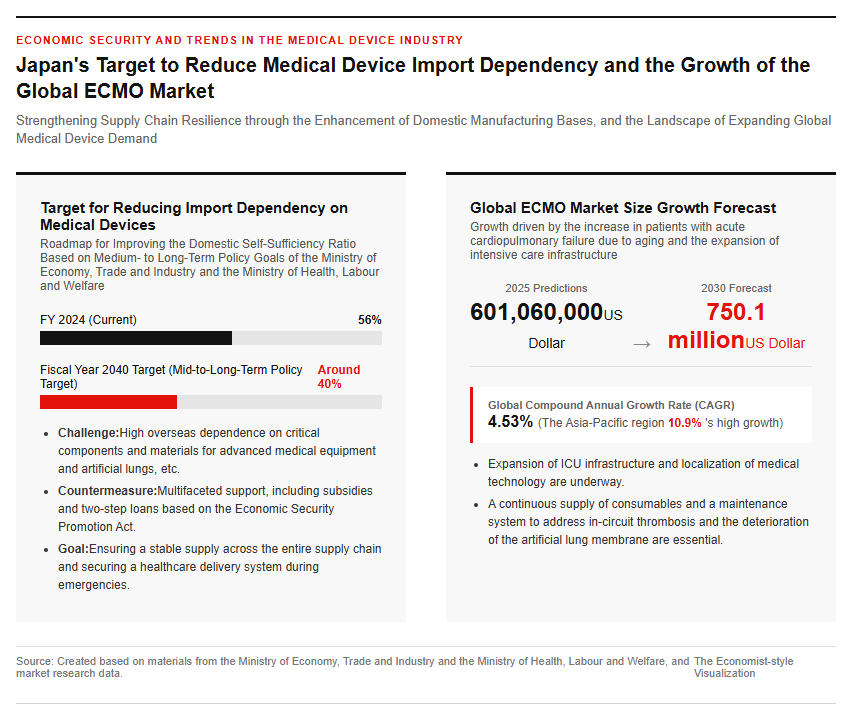
The greatest challenge facing Japan’s medical device industry is its high reliance on imports. As of fiscal 2024, the domestic import dependency for medical devices stands at approximately 56%, with a particularly pronounced reliance on overseas manufacturing bases for critical components and materials, such as advanced medical equipment and artificial lungs. Medium- to long-term policy targets established by the Ministry of Economy, Trade and Industry and the Ministry of Health, Labour and Welfare aim to reduce this import dependency to around 40% by fiscal 2040.
To achieve this goal, it goes beyond simply assembling existing products in domestic factories, requiring improvements in self-sufficiency rates at the raw material and key component levels. Particularly for ECMO, key technologies include material science for membrane oxygenators using hollow fiber membranes and advanced precision processing technologies such as magnetically levitated centrifugal pumps. In the government’s growth strategy as well, ensuring a stable supply of advanced medical devices that substitute for the functions of the heart, lungs, kidneys, and other organs across the entire supply chain is positioned from the perspective of “strategic indispensability.” The establishment of a domestic manufacturing base is expected not only to prevent the total collapse of the healthcare delivery system in times of emergency, but also to have the effect of bolstering future medical device innovation and expansion into global markets.
Market Trends and Future Prospects for Domestic Production
Expansion of the ECMO Market Domestically and Internationally and Technical Challenges
The global ECMO system market is showing a continuous expansion trend against the backdrop of an increase in patients with acute cardiopulmonary failure due to aging and the spread of intensive care protocols. According to market research data, the global ECMO market size is projected to grow from $601.06 million in 2025 to $750.10 million in 2030, at a compound annual growth rate (CAGR) of 4.53%. Particularly in the Asia-Pacific region, including Japan, the expansion of ICU infrastructure and the localization of medical technology are progressing, and a high growth rate of 10.9% is expected. The global market size and growth projections are structured as shown in the following image.
On the other hand, there are also technical and staffing challenges in the clinical application and industrial expansion of ECMO. In clinical settings, specialized care by highly knowledgeable clinical engineers and perfusionists is essential to avoid risks of complications such as membrane oxygenator degradation during operation, intracircuit thrombus formation, and bleeding. On the technological front, progress is being made in the development of magnetically levitated pumps that minimize hemolysis, improvements in portability through downsizing and weight reduction, and the implementation of AI-driven automated blood flow control and predictive trouble detection functions. For domestic manufacturers to establish market superiority, the development of next-generation ECMO systems incorporating these safety-enhancing technologies is indispensable.
Future Developments and Key Points for Supply Chain Resilience
Prompted by the government’s addition of ECMO to the list of specified critical materials, Japan’s medical security policy has entered a new phase. Moving forward, the formulation of policy guidelines for ensuring a stable supply by relevant ministries and agencies, as well as the application and certification procedures for “supply assurance plans” by business operators, will get into full swing. The first point to watch will be whether medical device manufacturers and component makers can join forces to rapidly advance the development of alternatives for heavily overseas-dependent parts and the establishment of domestic production systems.
From a medium- to long-term perspective, there is also the challenge of “self-sustainability,” which involves maintaining domestic production capacity and ensuring market competitiveness during normal times. Even if production lines and stockpile warehouses are established in preparation for emergencies, if domestic demand and overseas export markets cannot be secured during normal times, maintenance costs could balloon and business continuity may be compromised. For this reason, the Ministry of Economy, Trade and Industry (METI) and the Ministry of Health, Labour and Welfare (MHLW) plan to implement hands-on support, including development support for startups, acquiring overseas regulatory approvals, and formulating reimbursement strategies. Whether government financial support and private sector technological innovation will collaborate to build a resilient medical device supply chain that remains unshaken even in emergencies will dictate the future course of Japan’s healthcare economy and national security.
Reference page
- Cabinet Office: “Efforts to Strengthen Supply Chains (System for Ensuring the Stable Supply of Critical Materials)” https://www.cao.go.jp/keizai_anzen_hosho/suishinhou/supply_chain/supply_chain.html
- e-Gov Law Search “Cabinet Order for Enforcement of the Act on the Promotion of Ensuring National Security through Integrated Implementation of Economic Measures” https://elaws.e-gov.go.jp/document?lawid=504CO0000000394
【#SpecifiedCriticalGoods #ECMO #EconomicSecurity #SupplyChain #MedicalDevices #CabinetOffice】

コメント