On November 20, 2026, the Ministry of Economy, Trade and Industry announced that it has agreed with Saudi Arabia to triple the domestic storage volume for the “joint stockpiling with oil-producing countries” program, raising it from the conventional 8 million barrels to a maximum of 24 million barrels. Behind this is the aim to strengthen oil security by expanding domestic stockpiling bases even in peacetime, in response to supply risks associated with escalating tensions in the Middle East.
- Overview of the Agreement to Triple Stockpiles and Background of the Crisis Response
- The Mechanism of Joint Oil Stockpiling with Producing Countries and the Benefits for Both Japan and Saudi Arabia
- Current Dependence on the Middle East and Concerns Over the Strait of Hormuz Risk
- Rising Costs and Price Pass-Through Challenges Pressuring Corporate Management
- Domestic Tank Capacity and the Gritty Realities of Infrastructure Maintenance
- Legal System Development and Future Trends/Points to Watch
Overview of the Agreement to Triple Stockpiles and Background of the Crisis Response
On November 20, 2026, the Ministry of Economy, Trade and Industry announced that it had reached an agreement with Saudi Arabia to triple the storage volume under the “Joint Oil Stockpiling with Oil-Producing Countries” program—whereby Middle Eastern oil companies store crude oil in Japan—from the conventional 8 million barrels to a maximum of 24 million barrels. The agreement also includes provisions to begin replenishing the Saudi-held stockpiles released in response to the worsening situation in the Middle East since March 2026, alongside a policy for the Japanese government to newly purchase up to an additional 8 million barrels from Saudi Arabia for its national stockpiles. During a ministerial dialogue in May 2026, the two countries confirmed their cooperative policy on crude oil stockpiles and energy supply chains, and have held repeated discussions on concrete frameworks through a dedicated working group. In Japan, facilities such as the Okinawa Oil Base (Uruma City, Okinawa Prefecture), ENEOS Kiire Base (Kagoshima Prefecture), and Shibushi National Oil Stockpiling Base (Kagoshima Prefecture) are utilized as crude oil storage facilities. The diagram below shows a conceptual layout of major domestic stockpiling bases.
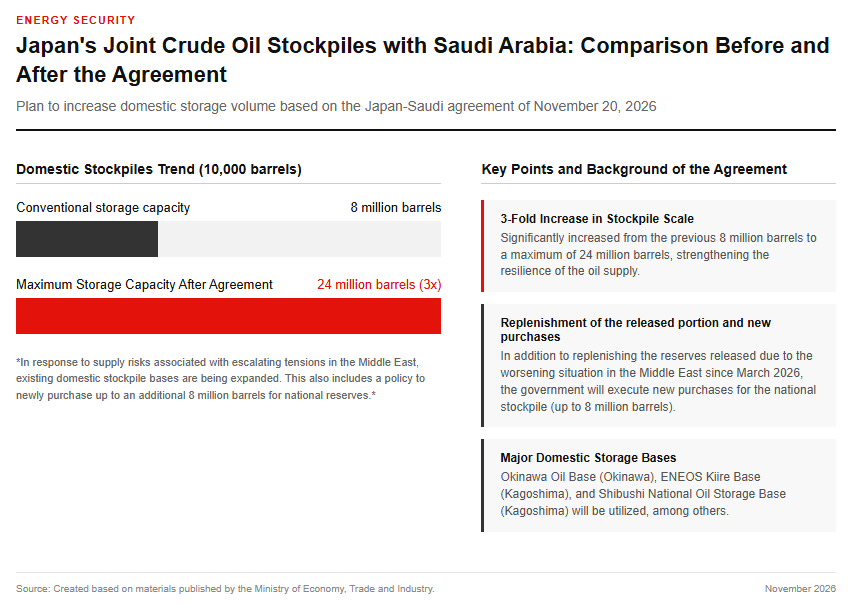
In late February 2026, when navigation through the Strait of Hormuz became difficult following US and Israeli attacks on Iran, Japan prevented supply disruptions by gradually releasing a cumulative 71 days’ worth of reserves, including 15 days of private reserves, 30 days of national reserves, and approximately 6 days of joint reserves with oil-producing countries. Through this threefold increase agreement, the government intends to expand priority procurement rights during emergencies and further strengthen the foundation for a stable energy supply.
The Mechanism of Joint Oil Stockpiling with Producing Countries and the Benefits for Both Japan and Saudi Arabia
The joint oil stockpiling program with oil-producing countries is a dual-track system that leases domestic oil tanks in Japan to state-owned oil companies of producing nations, bringing economic and security benefits to both sides. In peacetime, oil-producing countries like Saudi Aramco utilize Japan’s tanks as their own logistics hubs for Asia at near-zero cost, enabling immediate shipments and resales to China, South Korea, and Southeast Asian nations. By having the Japanese government (such as JOGMEC) subsidize tank management and security inspection costs, oil-producing nations acquire a massive, free logistics warehouse in the distant, major consuming market of Asia, allowing them to secure market share and lock in customers. Meanwhile, for Japan, the arrangement secures a “priority purchase right” to preferentially buy the crude oil stored in domestic tanks at international market prices in the event of an emergency. In times of crisis, crude oil stockpiled domestically can be supplied to refineries immediately without waiting for the roughly 20 to 25 days of shipping time from the Middle East to Japan, thereby drastically reducing transportation risks during contingencies. In addition to Saudi Arabia, the United Arab Emirates (UAE) and Kuwait also participate in the joint oil stockpiling program, functioning as a vital emergency safety net for Japan, which relies heavily on the Middle East. Specifically, the benefits of this joint stockpiling include the following.
- Advantages for oil-producing countries: Establishing a supply base for the Asian market and reducing transportation costs and geopolitical risks
- Benefits for the Japanese side: Securing priority purchase rights during contingencies and instantly reducing transport time to zero
Thus, it is established not merely as a one-way form of support, but as a rational agreement of interdependence.
Crude Oil Procurement Structure and Impact on Domestic Industries and Markets
Current Dependence on the Middle East and Concerns Over the Strait of Hormuz Risk
Japan’s crude oil procurement structure has long been characterized by an extreme concentration on the Middle East region. According to trade statistics from the Ministry of Finance, in fiscal 2025, Saudi Arabia accounted for 42.3% and the United Arab Emirates (UAE) for 41.0% of Japan’s crude oil imports, bringing the total import share from the Middle East to 93.1%. Of this, approximately 90% of the crude oil is transported to Japan via the Strait of Hormuz, a choke point about 33 km wide located at the exit of the Persian Gulf. When the strait fell into a de facto blockade at the end of February 2026, shipping companies experienced successive suspensions of war risk insurance coverage and halts in navigation, leading to a significant decrease in the volume of crude oil imports from the Middle East compared to the same period of the previous year. The government rapidly quadrupled imports of U.S. crude oil year-on-year (reaching approximately 360,000 barrels per day as of May), while also promoting alternative procurement from Mexico, Latin America, and Central Asia, temporarily lowering the dependency on the Middle East to 67.2%. The following figure shows the trends in crude oil import partners.
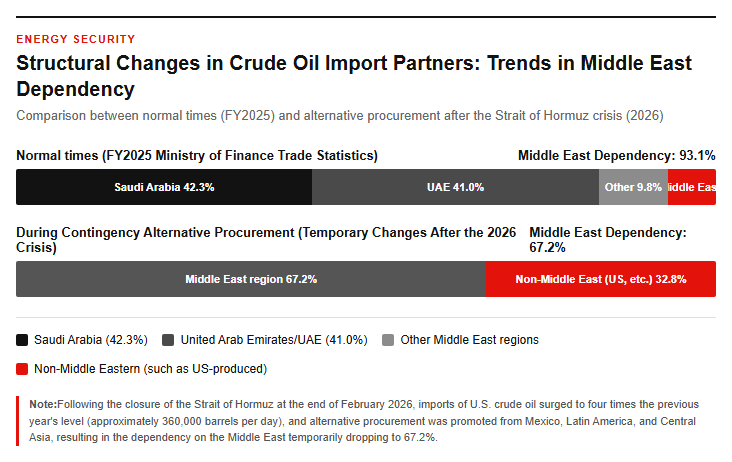
However, transportation from distant locations such as the United States not only results in longer transit times, but also causes shipping costs and insurance premiums to skyrocket, leading to a surge in costs that drove the crude oil import unit price per kiloliter to 114,000 yen (a 67.1% increase year-on-year). This recent agreement with Saudi Arabia to triple stockpiles is a vital measure to secure stable procurement while structurally mitigating the risk of dependence on the Middle East.
Rising Costs and Price Pass-Through Challenges Pressuring Corporate Management
The soaring prices of crude oil and energy are having a profound impact on a wide range of industries and corporate management in Japan. According to a survey conducted by Teikoku Databank targeting approximately 22,000 companies nationwide in June 2026, 89.4% of companies—or about 90%—reported that rising energy prices are having a negative impact on their business. As for the specific details of these impacts, the following items rank at the top.
- Increase in raw material and resource costs: 76.5%
- Rising logistics costs: 58.5%
- Rise in utility and fuel costs: 55.0%
- Profits decline as price pass-through fails to keep pace: 47.1%
By industry, approximately 60% of companies in fuel-dependent sectors such as “Transportation and Warehousing” and “Agriculture, Forestry, and Fisheries” reported experiencing a “major negative impact.” Furthermore, difficulties in procuring naphtha—a raw material for petrochemical products—and surging prices are driving up production costs across a wide range of materials, including plastics, paints, synthetic fibers, and pharmaceutical raw materials. While the government has prevented retail prices from soaring by providing drastic cushioning subsidies (ranging from over 30 yen to more than 48 yen per liter) to keep gasoline prices at around 170 yen per liter, concerns remain regarding the government’s fiscal burden associated with maintaining these subsidies and the delayed ripple effects on prices when support is scaled back in the future.
Strengthening Energy Security and Medium- to Long-Term Outlook
Domestic Tank Capacity and the Gritty Realities of Infrastructure Maintenance
Although an agreement has been reached to triple the volume of stored crude oil from Saudi Arabia from 8 million barrels to 24 million barrels, many challenges remain regarding domestic receiving infrastructure. Expanding to 24 million barrels means accepting a massive volume of oil domestically, equivalent to approximately 190 million drums or more than 10 Very Large Crude Carriers (VLCCs). However, Japan currently lacks vast vacant tanks ready for immediate use. Constructing new giant oil tanks would take 5 to 10 years or more—including site negotiations, environmental assessments, and design—along with immense construction funds, meaning it is unlikely to serve as an immediate solution. A realistic approach is the repurposing of idle tanks on the sites of closed refineries resulting from refinery consolidation. However, repairing aged tanks that are 40 to 50 years old would require costs ranging from billions to tens of billions of yen, and cost allocation—specifically whether the Japanese side or the oil-producing nation should bear the periodic open-inspection costs mandated by the strict Fire Service Act—remains up for debate. The figure below shows an overview of tank management and maintenance costs.
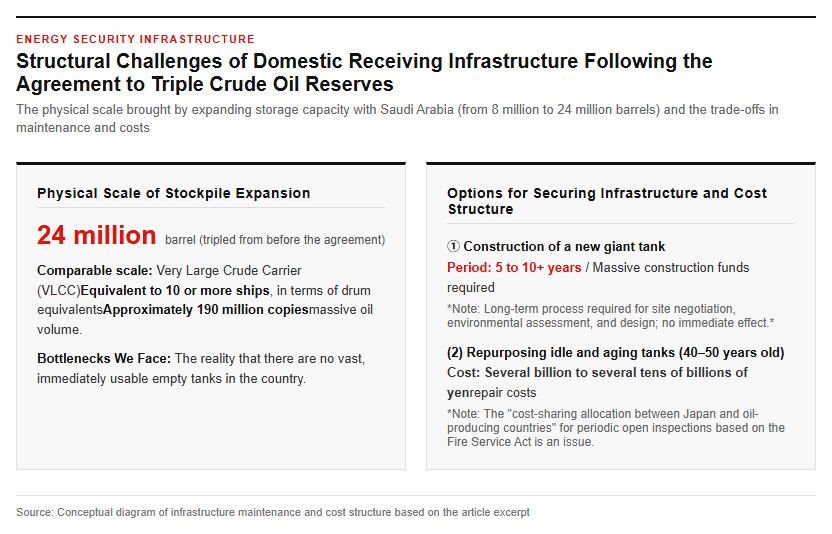
Also, while an acrobatic “ultra-C” plan to lease part of the national reserve tanks to oil-producing countries has surfaced, there is also persistent caution regarding the shift from the nation’s secure ownership to ownership encumbered by another country’s right of first refusal. Going forward, realistic infrastructure development will be essential, such as coordinating and distributing the allocation of joint receiving slots between Japan and South Korea.
Legal System Development and Future Trends/Points to Watch
In light of the Middle East crisis, the government has submitted the “three energy-related bills” (the Crude Oil Procurement Diversification Bill, the Crude Oil Transport Insurance Bill, and the Bill to Amend the JOGMEC Act) to the Diet, aimed at ensuring the stable procurement of crude oil and other resources and strengthening transportation networks, thereby advancing institutional backing. The mechanism prepares subsidies for securing alternative routes through a contribution system during normal times, and in the event of an emergency, the government supplements marine transport insurance to support the navigation of vessels. In the short term, the burden of the contributions may act as a factor pushing up prices for gasoline, kerosene, diesel oil, heavy oil, naphtha, and other fuels, but in the medium to long term, it is expected to serve as a “national insurance” that mitigates economic losses caused by supply disruptions or sudden surges in import unit prices. Regarding future developments and points of attention, the following elements will be important.
- Compliance Investment for Domestic Refining Facilities: Refinery Upgrades to Accommodate Light and Heavy Oils
- Advancing the Power Asia Initiative: Building a $10 Billion Shared Energy Network with ASEAN Nations
- Ensuring Transparency of Levy Burdens: Strict Verification of Price Pass-Through Status and Subsidy Effectiveness
Rather than simply securing the “volume” of oil, whether we can integrally promote appropriate domestic distribution, a stable supply of the industrial raw material naphtha, and price suppression measures will be the key to determining the future stability of the Japanese economy.
Reference page
- 【METI Agrees with Saudi Arabia to Triple Crude Oil Reserves Stored in Japan – Livedoor News】https://news.livedoor.com/article/detail/32865229/
【#EnergyPolicy #OilReserves #SaudiArabia #METI #EnergySecurity #JointOilStockpiling】

コメント