
Resona Holdings, Inc. has entered into a capital and business alliance with major M&A brokerage M&A Capital Partners, acquiring a 5% stake. Amid diversifying business succession needs among small and medium-sized enterprises (SMEs), the move is drawing industry attention as a new strategic stepping stone combining the customer base of a major financial group with the expertise of a specialized brokerage.
- Overview of the Surprise Capital and Business Alliance and Share Acquisition
- Merging a Customer Base of Approximately 500,000 Companies and Large-Scale Deal Creation Capabilities
- Changing Roles of Financial Institutions and Expansion of Business Succession Support
- Tightening Industry Regulations and Countermeasures Against Malicious Buyers
- Earnings Recovery of the Big Four and the Polarized Market Structure
- Points to Watch and Ripples Across the Stock Market and Financial Industry
Overview of the Surprise Capital and Business Alliance and Share Acquisition
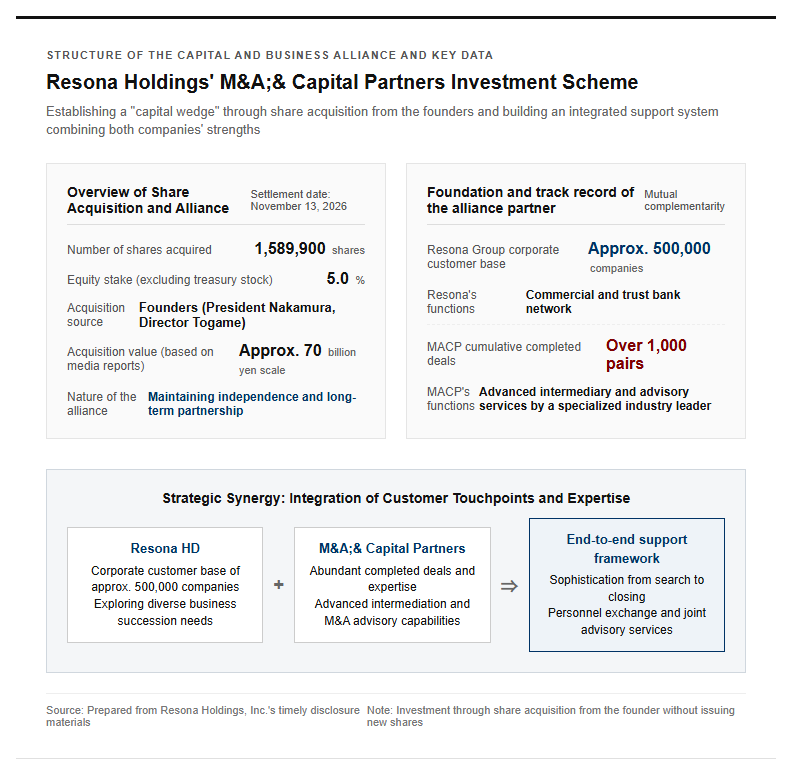
On November 10, 2026, Resona Holdings, Inc. (President: Masahiro Minami) and major M&A brokerage M&A Capital Partners Co., Ltd. (Representative Director and President: Satoru Nakamura, hereinafter “MACP”) officially announced the execution of a capital and business alliance agreement. Under this alliance, Resona Holdings will acquire 1,589,900 shares of common stock held by MACP founder and President Satoru Nakamura and Director Yozo Togame. This acquired share count corresponds to 5.0% of the total issued shares excluding treasury stock, with the scheduled share delivery date set for November 13, 2026. Because the acquisition represents 5% or more on a voting rights basis, disclosures were made pursuant to “share accumulation acts prescribed by Cabinet Order as equivalent to a tender offer” under Article 167, Paragraph 1, etc., of the Financial Instruments and Exchange Act. While the acquisition price in the disclosure is undisclosed, press reports estimate the scale to be approximately 7 billion yen. This share acquisition involves a transfer from the founders personally rather than a new share issuance, meaning no direct capital inflow into MACP, and is not aimed at making MACP a subsidiary or fully acquiring management control. Strongly serving as a “capital wedge” that solidifies a robust cooperative relationship while maintaining independence, it is positioned as a strategic investment aimed at building a medium- to long-term partnership.
Merging a Customer Base of Approximately 500,000 Companies and Large-Scale Deal Creation Capabilities
The core of the alliance lies in the mutual complementation of customer touchpoints and M&A know-how possessed by both companies. The Resona Group combines commercial and trust banking functions, building a broad corporate customer base spanning approximately 500,000 companies across the group. MACP, on the other hand, is a major specialized firm with a proven track record of over 1,000 completed deals, offering a wide range of solutions from brokerage operations to financial advisory (FA) services supporting business restructuring and going-private transactions for large enterprises. Through this alliance, the two companies will proceed with mutual referrals of client companies with M&A needs and the joint deployment of advisory services. Furthermore, they plan to foster M&A specialists through employee dispatches and personnel exchanges between the two firms, upgrading both proposal capabilities and execution power. This will establish a support system that provides end-to-end accompaniment from scouting to closing, addressing not only business succession issues driven by aging management and a lack of successors, but also sophisticated M&A needs aimed at business growth and industry restructuring. The conceptual diagram below illustrates the alliance relationship and synergistic effects of both companies.
Structural Changes and Background Surrounding the Banking and M&A Brokerage Industries
Changing Roles of Financial Institutions and Expansion of Business Succession Support
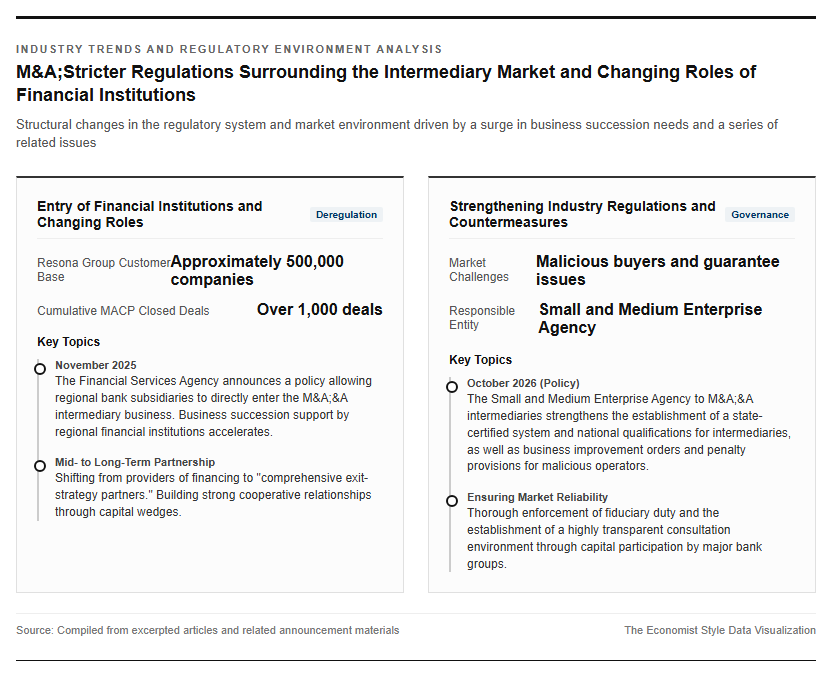
For medium- and small-sized enterprises supporting Japan’s regional economies, the shortage of successors accompanying the aging of management has become a critical issue, and business succession utilizing M&A has firmly established itself as an indispensable tool. Against this backdrop, the role of financial institutions is also transforming from traditional providers of loans into “comprehensive exit strategy partners.” In November 2025, regulatory relaxation for regional financial institutions’ business succession support progressed, with the Financial Services Agency announcing a policy to permit direct entry into M&A brokerage operations by regional banks’ subsidiaries. While megabanks primarily handle large-scale deals worth several billion yen or more, a division of roles has taken shape: regional banks provide community-based networks and loans in an integrated manner, while brokerage firms offer high matching precision and a sense of speed. While banks possess the strength to propose M&As in combination with direct financing (such as LBO loans) and debt adjustments, the capital alliance with MACP—a major specialized firm—can be said to symbolize a trend across the entire financial industry aimed at early identification of deal generation and improved closing rates.
Tightening Industry Regulations and Countermeasures Against Malicious Buyers
While the M&A brokerage market is rapidly expanding, serious problems shaking the entire industry have also come to light. The presence of “malicious buyers” who fraudulently siphon funds from seller companies post-acquisition, alongside inappropriate operations regarding the procedures for releasing managerial guarantees, have occurred one after another, heightening a sense of caution among SME managers. In response, the Small and Medium Enterprise Agency announced a policy in October 2026 to fundamentally tighten regulations, including the establishment of a national certification system and national qualifications for M&A intermediaries, as well as the formulation of business improvement orders and penalty provisions for malicious operators. As discussions toward legal revision progress, intermediary operators are required to achieve even greater governance and thoroughness in fiduciary duty (customer-oriented business operations). With Resona Holdings—a highly reliable major banking group—taking a capital stake, deal transparency and governance structures are expected to be strengthened, creating an environment where customers can consult on business succession with peace of mind. The figure below illustrates the trend toward enhanced industry compliance.
Polarization of the M&A Advisory Market and the Medium- to Long-Term Impact of Partnerships
Earnings Recovery of the Big Four and the Polarized Market Structure
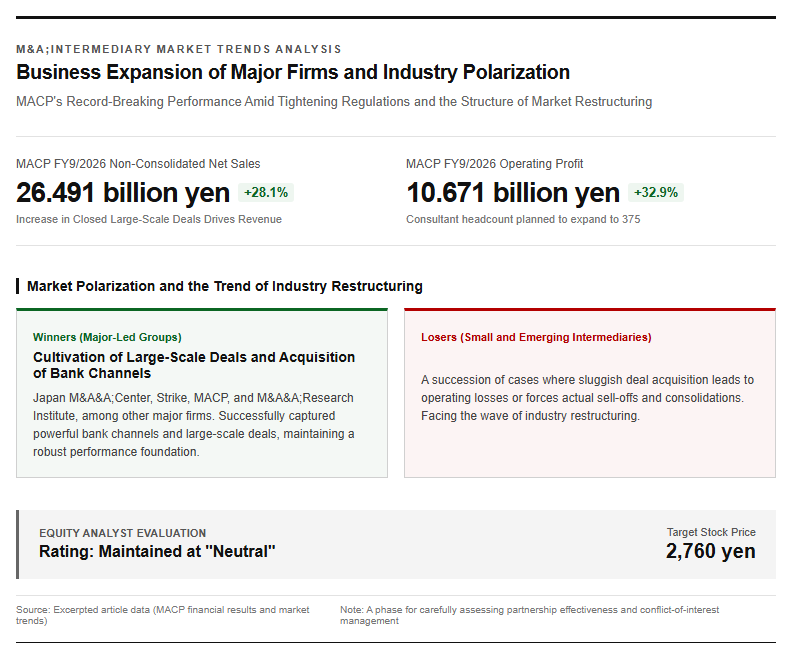
In the current M&A advisory industry, the polarization between “winners” and “losers” in terms of performance has become stark. Major firms such as the industry leader Nihon M&A Center, Strike, MACP, and M&A Research Institute have successfully cultivated large-scale deals with higher fees per transaction, maintaining a solid earnings foundation. For MACP’s full-year fiscal year ending September 2026, non-consolidated net sales reached 26.491 billion yen (up 28.1% year-on-year) and operating profit reached 10.671 billion yen (up 32.9% year-on-year), recording all-time high results. An increase in completed large-scale deals has driven earnings, and the company has announced aggressive personnel expansion plans to scale its consultant structure up to 375 people in the next fiscal year. In contrast, some small and emerging advisory firms are seeing sluggish deal acquisition, leading to falling into the red or being forced into virtual distressed sales and consolidation. Amid the progress of major-led industry restructuring, MACP’s advantage—having secured a powerful bank channel—is seen as growing even further.
Points to Watch and Ripples Across the Stock Market and Financial Industry
While the direct impact of this partnership on Resona Holdings’ consolidated earnings is considered minor, it is expected to contribute to the expansion of non-interest income (fee revenue) and the strengthening of engagement with client companies over the medium to long term. Securities analysts have maintained a “Neutral” rating while setting a target price of 2,760 yen, reflecting a cautious stance in evaluating the practical effectiveness of the partnership’s results. Future true evaluation depends on factors such as whether customer referrals from Resona Bank’s frontline sales bases will run smoothly, and whether conflict-of-interest management and fee-allocation rules will be clearly implemented. Additionally, as a new model case of a capital partnership between an independent advisory firm and a financial group has been presented, attention will be focused on whether other megabanks, regional banks, and specialized advisory firms will make moves to follow suit. For small and medium-sized enterprise owners, while options will expand to receive high-quality M&A support through trusted main banks, the perspective of carefully assessing the objectivity of proposal content will also become important. The diagram below illustrates the industry outlook following the partnership.
Reference Pages
- [Resona Holdings Timely Disclosure Materials] https://www.resona-gr.co.jp/holdings/news/newsrelease_c/2026/files/20261110_7t.pdf
- [M&A Capital Partners Timely Disclosure Materials] https://www.ma-cp.com/pdf_files/202611101428201729732116.pdf
[#ResonaHD #MACapitalPartners #CapitalAndBusinessAlliance #BusinessSuccession #MAAdvisory #FinanceAndEconomy]


コメント