
The Finance Minister concurred with the Fiscal System Council’s recommendations to ensure market confidence and reduce the debt-to-GDP ratio. This backdrop stems from the long-term interest rate temporarily rising to the 3% range for the first time in about 30 years, heightening market concerns over ballooning expenditures and credit risk surrounding government bonds.
- Submission of the Fiscal System Council’s Recommendations in November 2026 and Emphasis on Market Confidence
- Press Conference Statements by the Finance Minister and the Scale of Fiscal 2027 Budget Requests
- The Era of 3% Long-Term Interest Rates and Changes in the Supply-Demand Structure Surrounding Super-Long Bonds
- Market Volatility Driven by BOJ Bond Purchase Reductions and Overseas Investor Trends
- Institutional Reforms to Curb the Expansion of Social Security-Related Expenses and Rising Burden Rates
- Outlook for Securing Medium- to Long-Term Fiscal Sustainability and Maintaining Market Confidence
Submission of the Fiscal System Council’s Recommendations in November 2026 and Emphasis on Market Confidence
On November 20, 2026, Fiscal System Council Chairman Masakazu Tokura presented the recommendations for compiling the fiscal 2027 budget to Finance Minister Satsuki Katayama. The recommendations recognized that the Japanese economy has entered a new phase characterized by inflation and rising interest rates, emphasizing that ensuring market confidence is now indispensable. In particular, the report noted that long-term interest rates briefly hit the 3% range for the first time in about 30 years, warning that if market expectations regarding fiscal sustainability collapse, soaring interest payments via rising interest rates will severely impact people’s livelihoods and national governance. Even in the responsible expansionary fiscal policy promoted by the government, the prerequisite is a consistent stance toward fiscal consolidation and trust from the markets. With outstanding government bond issuance exceeding 1.1 quadrillion yen, there is a call to return the expenditure structure to normal times and demonstrate a specific path to stably lowering the debt-to-GDP ratio. Please refer to the figure below.
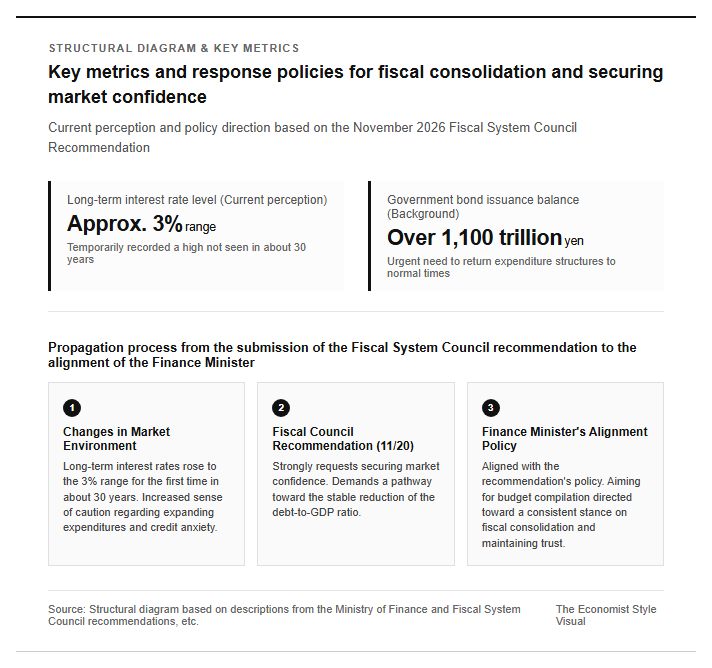
The recommendations urge curbing mere scale expansion and strictly scrutinizing project necessity and policy effects.
Press Conference Statements by the Finance Minister and the Scale of Fiscal 2027 Budget Requests
At a post-Cabinet press conference on November 24, 2026, Finance Minister Katayama touched upon the Fiscal System Council’s recommendations and fully concurred with the view that a stable reduction in the debt-to-GDP ratio and consistent government action are essential for gaining market confidence. The Minister stated that this aligns with what they keep in mind, once again expressing her stance toward maintaining fiscal discipline. Meanwhile, initial budget requests for fiscal 2027—excluding itemized requests—have reached approximately 143.1 trillion yen, swelling to a record high. Amid the inclusion of large-scale measures such as the 370 trillion yen public-private investment framework advocated by the Takaichi administration and the “Strong and Prosperous Japan” investment framework aimed at crisis-management and growth investments, concerns remain over strict screening of request levels. Incorporating outcome-based mechanisms and focusing financial resources on fields that truly contribute to growth will be key to enhancing persuasiveness in the market. As budget compilation reaches its climax, the presentation of specific reduction figures and the avoidance of easy reliance on deficit-covering bonds are being tested.
Transformation of the Government Bond Market and Structural Challenges Posed by Rising Interest Rates
The Era of 3% Long-Term Interest Rates and Changes in the Supply-Demand Structure Surrounding Super-Long Bonds
In Japan’s government bond market, the long-standing ultra-low interest rate environment is being left behind, and the transition to a world with interest rates is progressing rapidly. Yields have surged not only on 10-year government bonds but also on super-long bonds such as 20-year, 30-year, and 40-year bonds, making loosening supply and demand in the market prominent. Behind this is a situation where life insurance companies and other major underwriters have strengthened their reluctance to buy due to the expansion of unrealized losses on government bonds purchased during the past ultra-low interest rate period and tightened risk management. Facing deteriorating supply and demand, the Ministry of Finance announced the unusual step in June 2025—midway through the fiscal year—of cutting the issuance plans for 20-year, 30-year, and 40-year bonds by 100 billion yen each per auction. In the holding structure of government bonds, the ownership share of deposit-taking financial institutions has fallen from 37.9% at the end of March 2013 to a level below 100 trillion yen by June 2024. The stable mechanism for absorbing government bonds, which has hitherto been supported by a thick base of domestic investors, is reaching a structural turning point amid the phase of rising interest rates.
Market Volatility Driven by BOJ Bond Purchase Reductions and Overseas Investor Trends
The Bank of Japan has supported the market as the largest buyer, holding approximately 50% of outstanding government bond issuance under its quantitative easing, but with the normalization of monetary policy, it has begun reducing purchases and shrinking its asset holdings. The focus is on who will fill the supply-demand gap created by the BOJ’s purchase reductions, and the presence of overseas investors is growing. However, overseas investors are sensitive to exchange rate risks, hedging costs, and global interest rate fluctuations, and there is no guarantee they will provide stable demand over the long term. Empirical research points out that an increase in the overseas ownership ratio of government bonds tends to increase upward pressure on interest rates and market volatility. Bloomberg analyses also show that price volatility in the Japanese government bond market has reached its highest level in over 20 years, with spillover effects onto overseas markets such as the U.S. Treasury market also confirmed. There are also concerns that if Japan’s sovereign credit rating were downgraded, bond yields would skyrocket, causing foreign currency procurement costs for domestic companies and financial institutions to surge.
Expenditure Reform and Key Points in Future Fiscal Management
Institutional Reforms to Curb the Expansion of Social Security-Related Expenses and Rising Burden Rates
The natural increase in social security-related expenses is the biggest factor putting pressure on the national budget. Social security-related expenses in the initial budget for fiscal 2026 reached 39.1 trillion yen, and have further expanded to 39.7 trillion yen in the approximate budget requests for fiscal 2027. Looking at the trends in the number of workers, those in health, hygiene, and social work—including medical care and nursing care—have surged from 3.5 million in 1994 to 9.64 million in 2024, creating a massive structural change in terms of labor resources as well. The government’s Basic Policy 2026 promotes the establishment of an all-generation social security system, setting a containment target so that the social security burden rate for fiscal 2027 does not rise compared to fiscal 2025. The implementation of concrete reform processes is required, such as reviewing the proportion of out-of-pocket medical expenses for the elderly, optimizing drug price revisions and medical remuneration, and improving productivity through medical DX and AX. Please refer to the figure below.
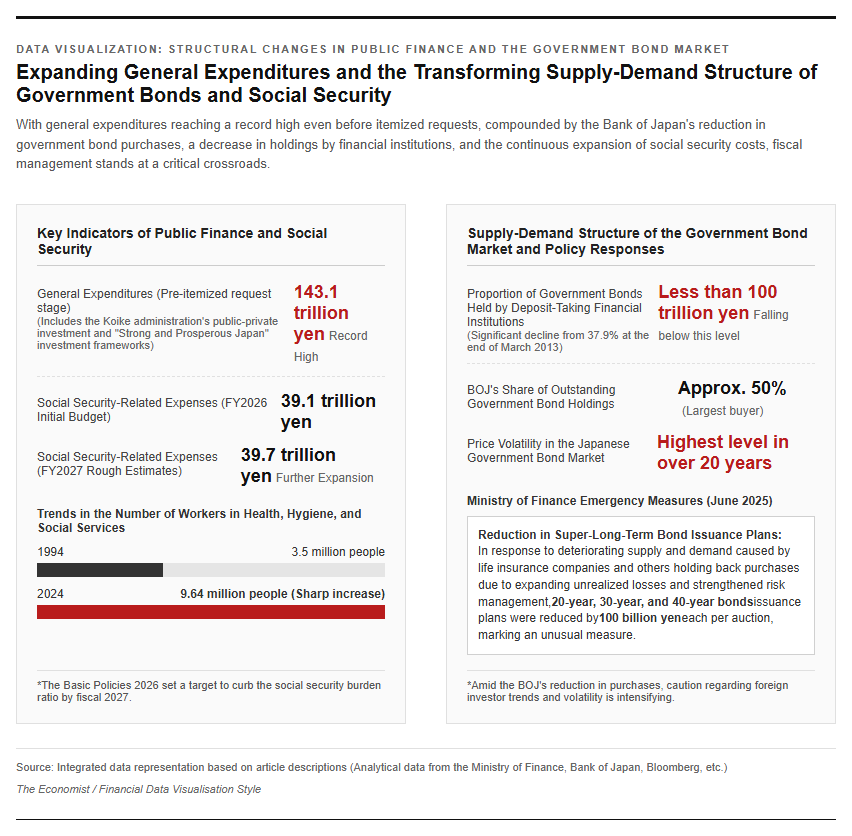
It is essential to curb the growth of the working-generation’s social insurance premium burden and achieve a sustainable balance between benefits and burdens.
Outlook for Securing Medium- to Long-Term Fiscal Sustainability and Maintaining Market Confidence
In future fiscal management, the top priority issue is to achieve a high-level compatibility between economic expansion through active growth investment and the maintenance of market confidence through strict fiscal discipline. The “good interest rate hike” aimed at by the Takaichi administration is intended to raise the potential growth rate through the revitalization of domestic investment and technological innovation, thereby achieving a nominal growth rate of around 3%. However, if the environment transitions to one where interest rates exceed the growth rate, an increase in interest payment costs risks accelerating the deterioration of the debt-to-GDP ratio. The coalition government agreement between the Liberal Democratic Party and Nippon Ishin no Kai also includes considerations for a temporary consumption tax exemption on food and the institutional design of a refundable tax credit, and how to reliably present alternative revenue sources for the decrease in tax revenues is being closely watched. Rather than simply drifting toward expanding expenditures, advancing expenditure reform and growth strategies as two wheels of a cart and impressing upon domestic and foreign investors the sustainability of the fiscal policy will be the point of greatest focus for the stable development of the Japanese economy.
Reference Page
- [Ministry of Finance] https://www.mof.go.jp/
[#FiscalConsolidation #MarketConfidence #LongTermInterestRates #JGBMarket #SocialSecurityReform #JapaneseEconomy]


コメント