On November 25, 2026, the Ministry of Internal Affairs and Communications’ Kinki Bureau of Telecommunications held the “Cyber Incident Exercise in Kobe” in Kobe City, Hyogo Prefecture, targeted at small and medium-sized enterprises (SMEs), organizations, and local government officials. Amid growing information security threats such as the misuse of AI technology and ransomware attacks, a practical program was conducted with the aim of improving initial response capabilities during emergencies and ensuring business continuity.
- Purpose and Participation Framework of Exercises Protecting Regional Businesses
- Pitfalls of Initial Response and the Importance of Confirming Emergency Contact Information
- Hands-on Exercises Simulating Phishing Emails and Luring Tactics
- Tabletop Exercises Learning Organizational Consensus-Building and Reporting Processes
- Legal Response Obligations Required by the Amended Local Autonomy Act and New Guidelines
- Creation of a national expert dispatch team and construction of a wide-area cooperative defense network
Purpose and Participation Framework of Exercises Protecting Regional Businesses
The MIC’s Kinki Bureau of Telecommunications and the Kansai Cybersecurity Network Secretariat (comprising the Kinki Bureau of Telecommunications, the Kinki Bureau of Economy, Trade and Industry, and the Kansai Institute of Information Systems) held the “Cyber Incident Exercise in Kobe” from 13:00 to 17:00 on November 25, 2026, in Rooms 507 + 508 of the Sannomiya Convention Center in Chuo-ku, Kobe City. This exercise was co-organized by the Kinki Information and Communications Council, with the Kobe Chamber of Commerce and Industry and the Information-technology Promotion Agency, Japan (IPA) participating as sponsors. Against a capacity of 40 participants, about 25 people—including management executives of SMEs and organizations inside and outside Kobe, IT system operations personnel, and local government officials—attended the session. In recent years, cyberattacks are rapidly increasing not only against specific government agencies and large corporations, but also against SMEs and local public entities that exploit vulnerabilities in supply chains. To prevent social and economic losses when infection damage spreads, prompt initial response and the strengthening of cyber resilience have become urgent issues for the regional community as a whole. The overall structure of the exercise is as follows.
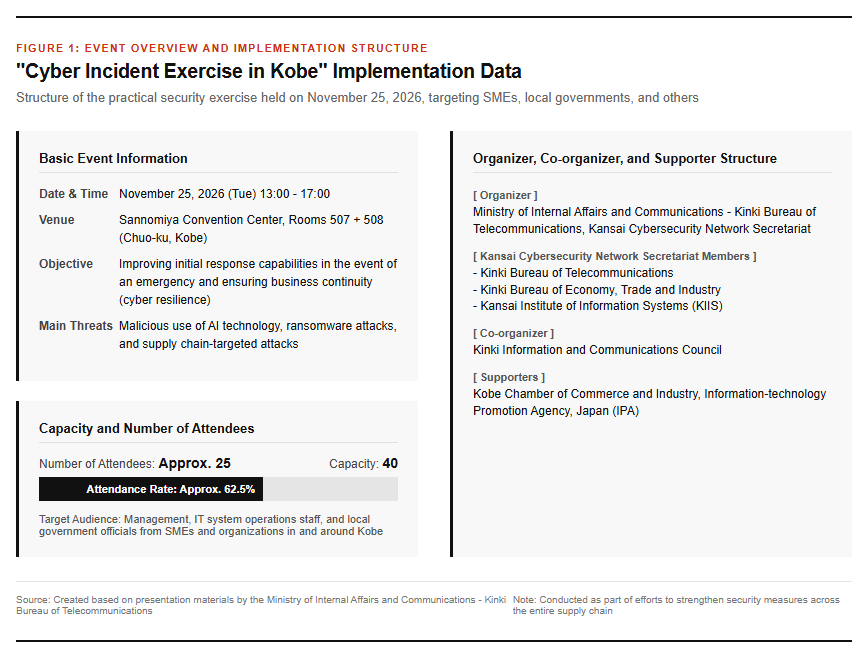
- Organizer: MIC Kinki Bureau of Telecommunications, Kansai Cybersecurity Network Secretariat
- Instructor: Kenichi Oba, Executive Principal, Cybersecurity Division, BD Lab Inc.
- Participation Fee: Free (registration required in advance)
Pitfalls of Initial Response and the Importance of Confirming Emergency Contact Information
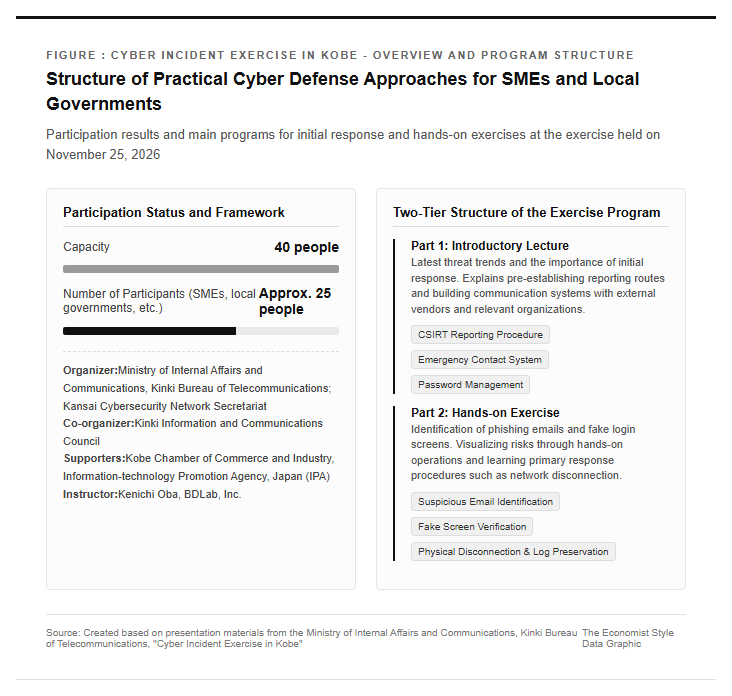
In Part 1’s introductory seminar, “Latest Threat Trends and ‘Who to Contact First,'” emphasis was placed on acquiring techniques and knowledge so that even general employees who are not routinely engaged in IT operations—rather than specialized experts—can appropriately deal with emergencies. Kenichi Oba of BD Lab Inc., who led the lecture, explained familiar threat examples such as ransomware and suspicious emails, and emphasized that preparing reporting routes in advance upon detecting anomalies directly leads to preventing the spread of damage. In particular, the necessity of organizing in advance the contact information of internal IT system personnel, external vendors contracted for system construction, and the police and relevant organizations was pointed out. In addition, Satoshi Iwamoto, Director of the Cybersecurity Office at the Kinki Bureau of Telecommunications, warned that human operational lapses, such as simplified or reused passwords, become system vulnerabilities. Routine awareness-raising and the creation of an organizational culture that heightens sensitivity to anomalies form the basis for suppressing the risk of security incidents occurring. The checklist presented in the lecture is as follows:
- Clarification of reporting procedures to internal CSIRT and IT system departments
- Establishment of emergency contact systems for external vendors and maintenance providers
- Appropriate management of authentication credentials and prevention of ID/password reuse
Practical Cyber Defense Approach Through Hands-on Programs
Hands-on Exercises Simulating Phishing Emails and Luring Tactics
In the hands-on exercise conducted in Part 2, participants operated their own PCs to experience firsthand the sophisticated luring techniques used by cyberattackers. The exercise used examples such as invoice confirmation emails sent disguised as business partners. Key points for identifying differences between the sender display or URL notation shown on the screen and the actual destination IP address were explained step-by-step. In addition, by directly operating the process of being lured to a fake login page used in phishing scams, participants verified the mechanism by which unintended information leaks occur. As primary response measures upon clicking a suspicious attachment or URL, initial response procedures such as physical disconnection from the network and saving logs were specifically demonstrated. By visualizing the attacker’s approach through actual terminal operations, participants were able to intuitively understand the risks lurking in their daily work. An overview summarizing the scene of the exercise is shown in the figure below.
Tabletop Exercises Learning Organizational Consensus-Building and Reporting Processes
In the tabletop exercise conducted in Part 3, organizational decision-making and response processes were verified through group-format simulations. Participants deepened their discussions based on complex troubleshooting scenarios, such as malware infection of a contractor’s terminal and personal information leakage due to website defacement. They exchanged opinions on triage criteria that should be prioritized given limited information, as well as the formulation of work procedures for system recovery. Furthermore, the importance of external risk communication—such as reporting to regulatory authorities and explaining matters to affected business partners and residents—was shared. By organizing the timeline of the initial response flow in coordination with external vendors as well as within the company, practical insights to enhance organizational cyber resilience were gained. The main steps of the incident response practiced in the exercise are as follows.
- Step 1: Detection of unauthorized communication or suspicious behavior and receipt of internal reports
- Step 2: Prioritization (triage) based on log analysis and understanding of the damage situation
- Step 3: Identification of the impact scope, containment, and requests for cooperation from external specialized vendors
- Step 4: Chronological reporting and publication to regulatory authorities, victims, and the public
Mid- to Long-Term Outlook for Strengthening Security in Local Governments and Enterprises
Legal Response Obligations Required by the Amended Local Autonomy Act and New Guidelines
The backdrop to the holding of this exercise lies in significant changes in the legal systems surrounding local governments and related businesses. With the enforcement of the amended Local Autonomy Act on April 1, 2026, the implementation of information security measures by local public entities shifted from a conventional discretionary obligation to a clear legal obligation. Based on the Minister for Internal Affairs and Communications guidelines notified in April 2025 and the Guidelines on Information Security Policies for Local Public Entities revised in March 2026, each local government is required to reconstruct its basic policies and exercise strict operational management. Detailed, effective safety management measures are progressing, including thorough vulnerability management for operating systems and software, supply chain risk measures for external contractors, and strengthened access control. Moving beyond formal regulatory maintenance, organizational evaluation through regular staff training and information security audits has become indispensable. The main points of the legal amendments are as follows.
- Legal mandate for information security policy formulation and appropriate use measures
- Enhanced management of outsourced business partners and cloud usage within the supply chain
- Mandating regular security evaluations and self-inspections by external auditors
Creation of a national expert dispatch team and construction of a wide-area cooperative defense network
To cope with increasingly sophisticated cyberattacks, the Ministry of Internal Affairs and Communications is rolling out an expansion of its on-site support system in the event of major incidents. When damage occurs that is difficult to handle independently, the policy is to establish a system in fiscal 2027 to dispatch an expert-composed recovery support team (major incident response expert team) to the site. In addition to conventional guideline formulations aimed at pre-vention and information sharing, the scope of support is being expanded to include on-site recovery after an incident occurs, with the aim of minimizing impacts on residents’ lives and the spread of damage to government systems. Furthermore, through the utilization of practical cyber defense exercises (CYDER) provided by the National Institute of Information and Communications Technology (NICT) and local government CSIRT councils, wide-area human resource development and know-how sharing are being strengthened. The implementation of regular exercises in each region and the promotion of public-private partnerships will be the key to shoring up the defense foundation of the nation as a whole.
Reference Pages
- [Ministry of Internal Affairs and Communications] “Cyber Incident Exercise in Kobe” Held – Thinking About Preparedness for Cyberattacks and Business Continuity –
 総務省|近畿総合通信局|「サイバーインシデント演習in神戸」を開催 −サイバー攻撃への備えと事業継続を考える−近畿総合通信局(局長:梅村 研(うめむら けん))は、令和8年11月25日(水)に神戸市内で、中小企業等を対象に、情報セキュリティ上のリスクにつながる状況の疑似体験などを通してサイバー攻撃への効果的な対応法を学ぶ「サイバーインシデント演習i...www.soumu.go.jp
- [Ministry of Internal Affairs and Communications] Guidelines on Information Security Policies in Local Public Entities
https://www.soumu.go.jp/main_content/001068239.pdf
[#MinistryOfInternalAffairsAndCommunications #Cybersecurity #CyberIncidentExercise #Kobe #SecurityMeasures #InformationSecurity #BusinessContinuityPlanning #LocalGovernments]


コメント