
The Strands Agents team at Amazon Web Services (AWS) has released “Strands Harness,” an open-source software that serves as an execution platform for AI agents. As AI models become increasingly commoditized, the “harness”—the execution and management mechanisms surrounding the models—is attracting attention as a critical area that dictates system cost, accuracy, and safety.
- The Full Picture of AWS Open-Sourcing “Strands Harness”
- Why “Harnessing” Outside the Model is Gaining Importance Now
- Context management feature that reduces costs while maintaining accuracy
- Measured data in benchmark comparisons such as Terminal-Bench 2.1
- Security Vulnerabilities and Defense Architecture Surrounding Tool Calling
- The Future of AI Agent Infrastructure in the Multi-Cloud Era
The Full Picture of AWS Open-Sourcing “Strands Harness”
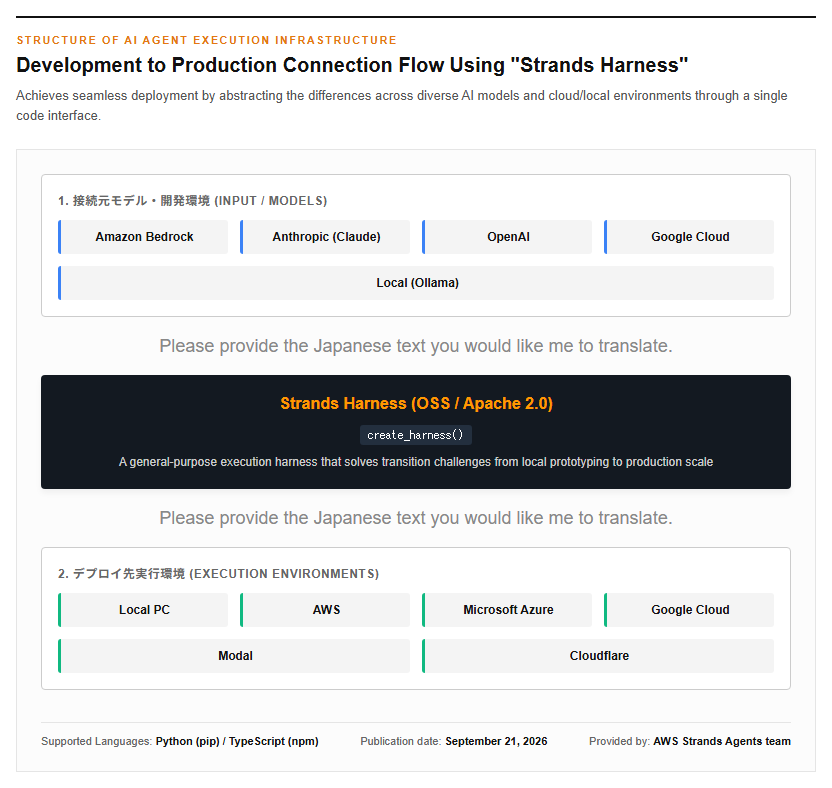
On September 21, 2026 (local time), Amazon Web Services (AWS) released “Strands Harness,” a general-purpose AI agent harness that operates with the same configuration from local environments to diverse cloud environments. This software is provided under the Apache 2.0 license and supports Python (pip install strands-harness) and TypeScript (npm install @strands-agents/harness). Previously, developers prototyped agents locally using Anthropic’s Claude Code or OpenAI’s Codex, but they faced issues such as environmental differences and increased costs when migrating and scaling them to the production cloud. Strands Harness can be launched with a single code create_harness(), and is capable of connecting to a wide range of models, from cloud models by Amazon Bedrock, Anthropic, OpenAI, and Google to local Ollama models. Regarding the execution environment, in addition to local PCs, it features the flexibility to be deployed as-is to container environments such as AWS, Microsoft Azure, Google Cloud, Modal, and Cloudflare. Please refer to the figure below.
Why “Harnessing” Outside the Model is Gaining Importance Now
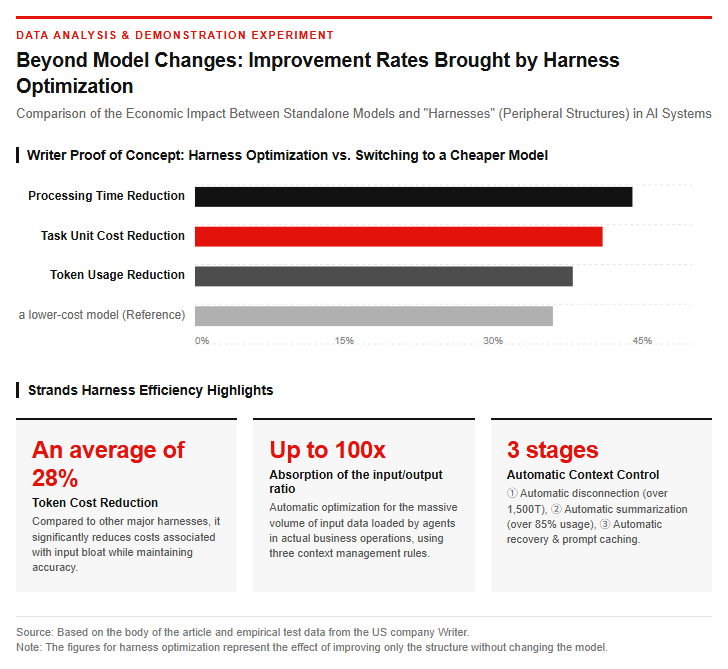
In the AI industry, the commoditization of standalone AI models is accelerating due to the rise of open-weight models. Along with this, the focus of market value is shifting from the “model itself” to the “harness,” which safely and efficiently connects models to business operations. Harnesses are classified into a “narrow harness” that handles the control of tools and data given to the model, processing loops, and evaluation mechanisms, and a “broad harness” that encompasses long-term memory, access permissions, audit logs, error control, and human-in-the-loop decision handoff. Even when using the same AI model, response quality, processing speed, operational costs, and safety vary significantly depending on the harness design. An empirical experiment by US-based Writer reported that simply optimizing the harness structure without changing the model reduced the cost per task by 41%, processing time by 44%, and token consumption by 38%. This is a result that exceeds the cost reduction rate (approximately 36%) achieved by changing the model itself to a cheaper one, and harness optimization has become the greatest factor in determining system economics.
Technical Mechanisms and Performance: The Secret Behind the 28% Token Cost Reduction
Context management feature that reduces costs while maintaining accuracy
The main factor driving up the operational costs of AI agents is the surge in the amount of input tokens during task processing. In actual business operations, the amount of input data read by an agent can reach up to about 100 times the amount of output data. Strands Harness has successfully reduced token costs by an average of 28% compared to other major harnesses while maintaining model accuracy. What supports this high efficiency are three built-in context management rules. First, bloated tool execution results exceeding 1,500 tokens are automatically truncated and offloaded to a separate file. Second, automatic compaction of the conversation history is executed once the context window usage rate exceeds 85%. Third, when the window overflows, in-loop recovery works within the processing loop to leverage prompt caching for duplicate request sections. Please refer to the figure below.
Measured data in benchmark comparisons such as Terminal-Bench 2.1
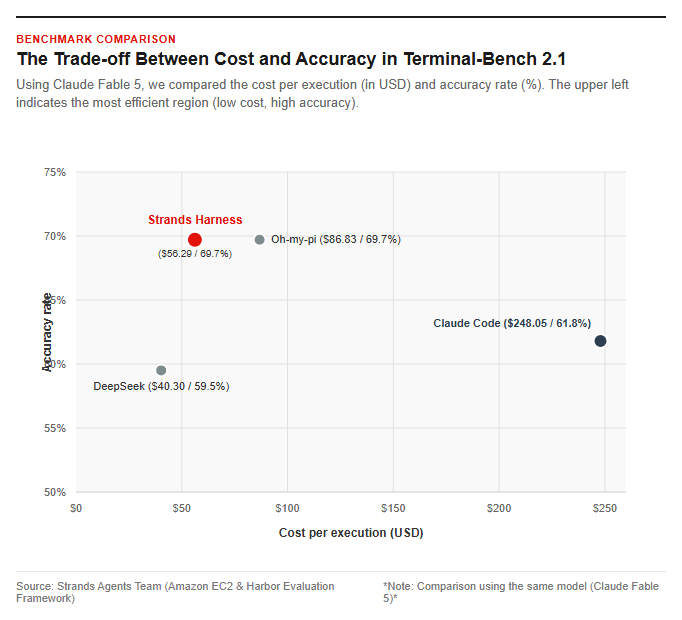
The Strands Agents team conducted distributed benchmarking on Amazon EC2 using the evaluation framework “Harbor”. A total of six metrics were used for the evaluation: ALFWorld, ContextBench, GAIA, WebShop, τ²-bench, and Terminal-Bench 2.1. In a direct comparison using the same model, Claude Fable 5, with 89 trials each on Terminal-Bench 2.1, an extremely clear difference was demonstrated. While Anthropic’s native Claude Code had an average cost per execution of $248.05 and an accuracy rate of 61.8%, Strands Harness recorded $56.29 per execution and an accuracy rate of 69.7%. As a result, Strands Harness achieved a 77% reduction in cost compared to Claude Code while outperforming it in accuracy by 7.9 percentage points. In addition, the rival configuration Oh-my-pi matched the accuracy rate at 69.7%, but its execution cost was $86.83, making it 54% higher. The lowest-priced DeepSeek Harness (costing $40.30) remained at an accuracy rate of 59.5%, demonstrating that Strands Harness holds the most advantageous position in terms of the balance between accuracy and cost performance.
Operational and Security Challenges and Future Outlook: The Path to Production Deployment
Security Vulnerabilities and Defense Architecture Surrounding Tool Calling
As agent execution infrastructures expand, security vulnerabilities lurking in the harness layer are also becoming apparent. The “CoreBreak” attack pattern (such as CVE-2026-18830) published by security researchers pointed out a structural flaw that directly induces tool calls without executing the model’s inference processing. In the open-source Python code of Strands, there is also a shortcut process that skips model calls and executes directly when a tool use block is included at the end of the message history, and risks in cases where appropriate input validation is not performed are being discussed. AWS has added and supplemented input validation on the managed service side while releasing the “Trusted Message History” guidelines for standalone environments, calling for externally manipulable input data not to be included in the history as-is. In addition to instruction control via system prompts, defense-in-depth design at the execution layer based on SQL parsing middleware, personally identifiable information (PII) detection filters, and the principle of least privilege (IAM) has become essential. Please refer to the figure below.
The Future of AI Agent Infrastructure in the Multi-Cloud Era
The emergence of Strands Harness is fundamentally transforming the workflow from prototyping to production operations in AI development. By using the “Strands CLI” provided as a development support tool, developers can prototype agents incorporating tools and prompts simply through natural language instructions, and instantly output production code in Python or TypeScript by executing the /export command. Code generated in this manner can be verified in a local environment and then safely deployed with the exact same configuration to cloud environments such as Modal, Cloudflare Containers, and Amazon Bedrock AgentCore. Moving forward, the competition will shift from simply selecting high-accuracy models to a comprehensive operational performance competition that includes context compression efficiency, infrastructure startup speed, execution cost, and auditability (such as OpenTelemetry integration). Broadly defined harness design for safely integrating autonomous agents into business processes while protecting a company’s intellectual assets will become the core of future AI social implementation.
Reference page
- [Strands Agents Official Documentation & GitHub Repository] https://github.com/strands-agents/harness-sdk
- [PyPI strands-harness package] https://pypi.org/project/strands-harness/
- [AWS Security Information (AWS Security Bulletins)] https://aws.amazon.com/security/security-bulletins/2026-073-aws/
【#AWS #AIAgents #StrandsHarness #OpenSource #GenerativeAI #MultiCloud】
コメント