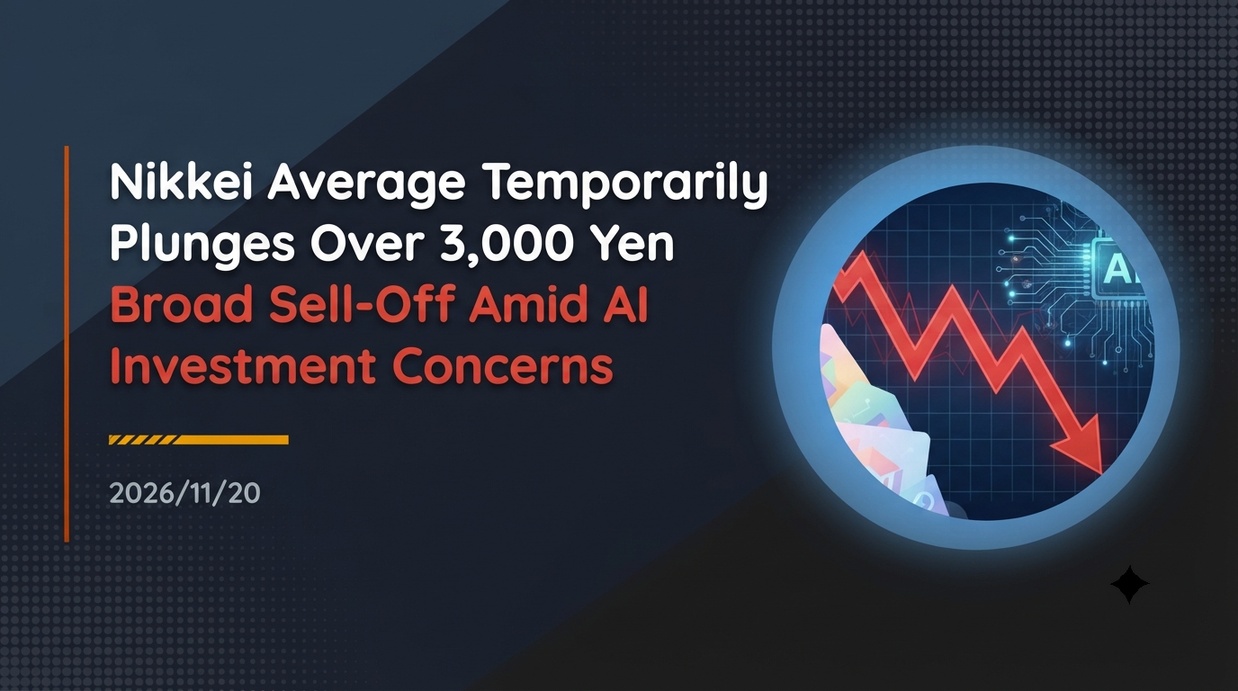
On the Tokyo Stock Exchange on November 20, 2026, the Nikkei Stock Average plummeted, dropping 3,007.56 yen from the previous day to close at 56,436.65 yen, falling below the 57,000-yen mark for the first time in about seven months. The backdrop includes credit anxiety surrounding U.S. AI-related companies, concerns over the profitability of capital investments, and a growing risk-off sentiment accompanying management changes at major high-tech firms.
- Market Crash on November 20, 2026 and the Movement of Major Stocks
- The Chain Reaction of AI Bubble Concerns and Credit Anxiety in the US Market
- Neo-Cloud Funding Difficulties and Hyperscaler Capital Expenditure Burdens
- Cascade Risks Caused by Circular Transactions Among AI Companies
- Japanese Banks’ Lending to Overseas Non-Banks and Its Spillover Effects on the Real Economy
- Stock Market Outlook and Key Warning Indicators Investors Should Watch Closely
Market Crash on November 20, 2026 and the Movement of Major Stocks
On November 20, 2026, the Tokyo stock market saw a broad-based sell-off from the opening bell, with sell orders flooding a wide range of stocks. The Nikkei Stock Average plummeted, closing down 3,007.56 yen (5.06%) from the previous day at 56,436.65 yen, falling below the milestone 57,000 yen mark on a closing basis for the first time in about seven months. The Tokyo Stock Price Index (TOPIX) also ended trading down 148.25 points (3.88%) at 3,674.22. This sharp decline was driven by semiconductor- and AI-related stocks, which had strongly led the stock market’s rise up to this point. In particular, major semiconductor test equipment manufacturer Advantest, which has a large impact on the Nikkei average, and SoftBank Group, which is promoting large-scale AI investments, were heavily sold, serving as the main catalysts for the market-wide plunge. Additionally, a global chain reaction of declines was triggered across major Asian markets, particularly those with a high concentration of semiconductor-related stocks, such as South Korea’s KOSPI index dropping 7.56% and Taiwan’s Weighted Index falling 3.40%. Please refer to the figure below.
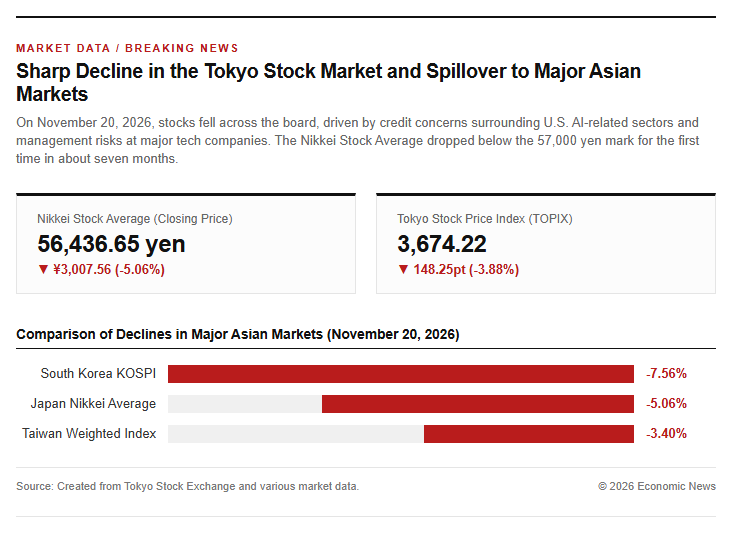
The sharp plunge in Tokyo stocks is not merely a temporary profit-taking sell-off, but rather the result of uncertainty surrounding profitability and funding conditions in AI-related sectors, which has rapidly cooled investor sentiment.
The Chain Reaction of AI Bubble Concerns and Credit Anxiety in the US Market
What triggered the sharp plunge in the Tokyo market was the significant decline in major indexes, such as the Dow Jones Industrial Average, in the U.S. stock market on the previous day, the 19th. In the U.S. market, credit anxiety surrounding AI-related companies rapidly surfaced, triggered by the sharp drop on October 14 in the prices of corporate bonds issued by CoreWeave, an emerging cloud provider for data centers. Because the company relied on the corporate bond market to procure massive data center development costs while receiving investments from U.S. semiconductor giant NVIDIA and others, the widening of corporate bond spreads directly led to a rise in funding costs. Furthermore, in NVIDIA’s third-quarter earnings for the fiscal year ending January 2027 announced on November 17, although revenue increased 103% year-on-year to $115.8 billion, beating market expectations, Colette Kress—who assumed the role of interim CEO following the departure of CEO Jensen Huang—indicated a policy to strictly evaluate future investments and debt guarantees for AI companies. This heightened caution that the conventional structure of excessive financial support would shift, resulting in even stronger selling pressure on AI stocks as a whole.
Structural Risks of AI Investment and Circular Transactions Among Companies
Neo-Cloud Funding Difficulties and Hyperscaler Capital Expenditure Burdens
With the rapid expansion of AI demand, massive capital expenditures have continued in the market by emerging cloud providers known as neo-clouds and major hyperscalers such as Alphabet, Amazon, and Microsoft. The value of uncommenced lease agreements for the top five hyperscalers reached approximately $1.1 trillion as of the April–June 2026 quarter. Backed by long-term lease agreements with hyperscalers, these operators have raised massive construction funds from non-bank financial intermediaries (NBFIs) such as bank loans and private funds. The total financing amount for U.S. data center projects announced between January 2023 and August 2026 reached approximately $1.6 trillion, with about $1.4 trillion of that currently in the planning stage. However, it has been pointed out that if usage fees for AI computing services decline or the pace of demand growth slows down, the recovery of returns on massive capital expenditures will be delayed, posing risks of profit compression and cash flow deterioration. Please refer to the figure below.
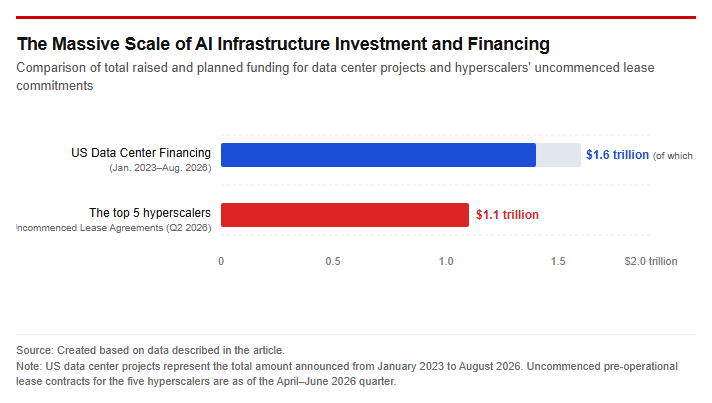
The payment obligations of off-balance-sheet long-term lease contracts will become a serious factor that directly pressures corporate financial foundations if AI demand slows down.
Cascade Risks Caused by Circular Transactions Among AI Companies
Market participants and international organizations are growing increasingly on guard against the circular transaction structures taking place among AI-related companies. This is a transaction scheme in which major tech companies invest in or lend to emerging AI companies with relatively weak financial bases, and the funded startups promise to purchase semiconductors and cloud services from their investors in the future. According to the Global Financial Stability Report (GFSR) published by the International Monetary Fund (IMF) in October 2026, in 14 deals confirmed since 2023, approximately $300 billion in investments and about $650 billion in debt financing were found to be strongly tied to promises of approximately $1.4 trillion in future sales. If the funded emerging AI companies fail to sustain their businesses, the major tech companies that provided the investments and loans will suffer a double blow: the impairment of their investment value alongside the loss of anticipated future revenues. The IMF refers to this phenomenon as “wrong-way risk” and strongly warns of the danger that, should business conditions deteriorate, losses will cascade across related corporate groups and ripple through the entire market.
Transmission Channels to the Japanese Economy and Financial System, and Future Points of Focus
Japanese Banks’ Lending to Overseas Non-Banks and Its Spillover Effects on the Real Economy
Concerns exist that a slowdown in US AI-related investments and credit uncertainty could spill over into Japan’s financial markets and real economy through multiple channels. In its financial system report compiled in October 2026, the Bank of Japan outlines three spillover channels: bank lending, financial markets, and the real economy. Japanese banks’ investment and loan balances to overseas non-bank financial intermediaries (NBFIs) have rapidly expanded from 8 trillion yen at the end of March 2008 to 126 trillion yen at the end of June 2026, significantly strengthening the ties among financial institutions through increased lending to overseas funds and data center operators. In addition, because overseas funds’ holdings of Japanese equities have reached a scale of 355 trillion yen, hedge fund deleveraging triggered by a downturn in AI stocks could cause a decline in liquidity in the Japanese stock and government bond markets. Furthermore, a slowdown in AI-related investments could lead to an economic slowdown in Asia—where related industries have a high weight (projecting a maximum downward deviation of about 7% in real GDP)—creating a structural dynamic that results in deteriorating earnings and increased credit costs for Japanese electrical machinery and electronic component manufacturers.
Stock Market Outlook and Key Warning Indicators Investors Should Watch Closely
In the market following the sharp drop in stock prices, the focus has shifted to a phase of calmly assessing whether AI-related investments can generate sustainable profits. In the short term, high volatility is expected to continue, with the VIX index—an indicator of market anxiety—rising into the 28 range and the Nikkei Stock Average Volatility Index (Nikkei VI) temporarily exceeding 41. Additionally, the hawkish stance of Federal Reserve Board (FRB) officials against the backdrop of inflation concerns, as well as discussions surrounding data center construction regulations following the U.S. midterm elections, will act as factors capping stock price gains. According to analyses by major securities analysts, while the main scenario for the Nikkei Stock Average projects it to trade around 63,000 yen by the end of 2026, caution remains regarding a short-term phase of searching for lower bottoms. Toward a future market recovery, it will be extremely crucial to closely monitor the balance between capital expenditures and free cash flow in the earnings reports of major tech giants such as Alphabet, Microsoft, and Amazon, the fundraising trends of startups, and real economy data indicating the broadening scope of AI demand.
Reference page
- [Outlook and Commentary on the Nikkei Stock Average – Nomura Securities] https://www.nomura.co.jp/wealthstyle/article/0724/
[#NikkeiAverage #AIInvestment #StockMarket #Semiconductors #FinancialRisk #USStocks #JapaneseEconomy]

コメント