In a nationwide survey on aging sewer pipes conducted by the Ministry of Land, Infrastructure, Transport and Tourism (MLIT), a total of 807 kilometers of pipelines were judged to “require countermeasures” due to severe corrosion or damage. Launched in the wake of a tragic road cave-in in Yashio City, Saitama Prefecture, in January 2025, the large-scale survey highlights the dual challenges of ensuring safety and maintaining infrastructure sustainability for financially strained local governments.
- Key Takeaways: Nationwide 5,209-km survey highlights pipelines requiring countermeasures
- Reason for investigation: The large-scale cave-in accident in Yashio City, Saitama Prefecture, and the swift response by the national government.
- The Threat of Road Cave-ins: Massive Underground Voids Triggering 10,000 Collapses Annually
- Local Governments’ Dual Hardship: Severe Operating Deficits and a Rapid Shortage of Technical Staff
- Pros and Cons of Public-Private Partnerships: Strong Local Opposition to Mandatory Water PPP
- Future Outlook and Key Points: Revision of the Sewerage Act and Transition to Johkasou (Decentralized Treatment)
Key Takeaways: Nationwide 5,209-km survey highlights pipelines requiring countermeasures
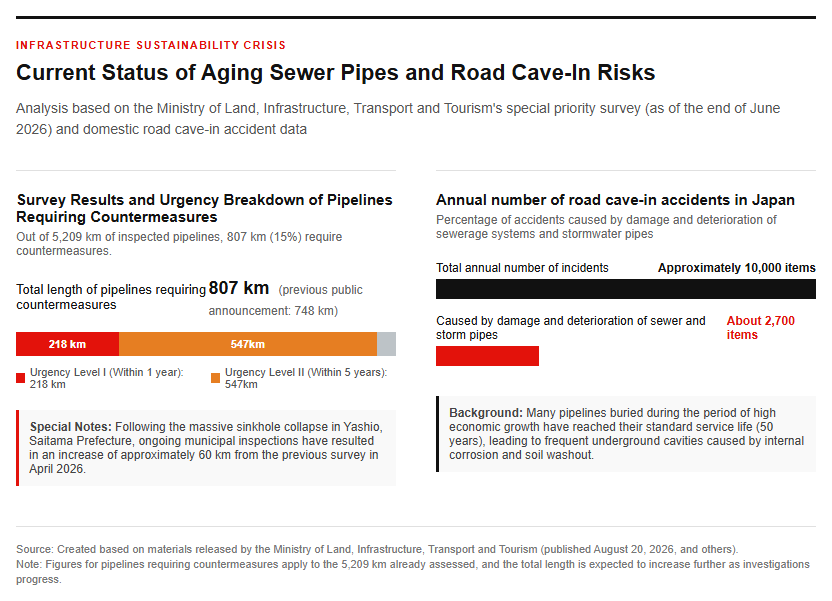
On August 20, 2026, the Ministry of Land, Infrastructure, Transport and Tourism announced that severely corroded or damaged sewer pipes requiring measures such as repair or replacement totaled 807 kilometers nationwide as of the end of June 2026. This represents an alarming 15% of the 5,209 kilometers of sewer pipes assessed. As local governments advance their inspections, the figure has increased by about 60 kilometers from the previous announcement in April 2026 (748 kilometers), continually exposing a brewing infrastructure crisis.
The specific status and breakdown of the judgment results are as follows.
-
Pipelines requiring countermeasures: 807 km total (15% of assessed pipelines)
-
Urgency Level I requiring prompt measures within 1 year: 218 km
-
Urgency Level II, requiring countermeasures within 5 years after emergency measures: 547 km (as of the April announcement)
-
Municipalities newly announced as requiring countermeasures: Saitama Prefecture, Chiba Prefecture, Osaka City, etc.
Sewer pipe collapses can suddenly cause road cave-ins, posing a critical risk to urban safety. As local assessments are still underway and updates will be requested on an ongoing basis, the total length of pipes requiring countermeasures is expected to increase further.
Reason for investigation: The large-scale cave-in accident in Yashio City, Saitama Prefecture, and the swift response by the national government.
The direct catalyst for this nationwide special priority sewer inspection was a massive road cave-in that occurred in Yashio City, Saitama Prefecture, in January 2025. Caused by the failure of an aging sewer pipe, the cave-in initially measured about 5 meters in diameter and 10 meters in depth before ultimately expanding to over 40 meters across. It resulted in the tragic fatality of a driver whose 2-ton truck plunged into the ground.
Taking the accident seriously, the Ministry of Land, Infrastructure, Transport and Tourism (MLIT) acted on a countermeasures review committee’s recommendations to request that local governments conduct a special prioritized survey of sewer pipelines on March 18, 2025. The targets were particularly high-risk, large-scale sewer pipelines with diameters of 2 meters or more that have been in service for over 30 years. Through thorough inspections involving personnel entering the pipes for visual checks and deploying underground TV cameras, critical damage lurking deep beneath the surface across Japan has been successively brought to light.
Social Infrastructure Dysfunction Caused by Aging and Structural Challenges
The Threat of Road Cave-ins: Massive Underground Voids Triggering 10,000 Collapses Annually
In Japan, approximately 10,000 road cave-in accidents of all sizes occur annually. Among them, approximately 2,700 cases per year are directly caused by damaged or deteriorated sewage and stormwater pipes, making it an extremely frequent occurrence. Many sewage pipes that were laid simultaneously during the post-war high-growth period are now reaching their standard service life of 50 years one after another [129, 176, Image 2].
Aging sewer pipes corrode from the inside, leading to cracks and joint displacement. Sewage leaks from these breaches, gradually washing away the surrounding soil underground. This creates hidden cavities beneath the road pavement. When the ground can no longer support its own weight or the load of heavy traffic, it results in sudden, unexpected sinkhole collapses.
Please refer to the figure below for the risks of such underground cavities, the service life of water and sewage pipes, and the nationwide status of seismic retrofitting.
Because inspection delays directly lead to serious accidents, the adoption of preventive maintenance measures—such as subsurface cavity surveys to detect underground voids early—is being accelerated across various regions.
Local Governments’ Dual Hardship: Severe Operating Deficits and a Rapid Shortage of Technical Staff
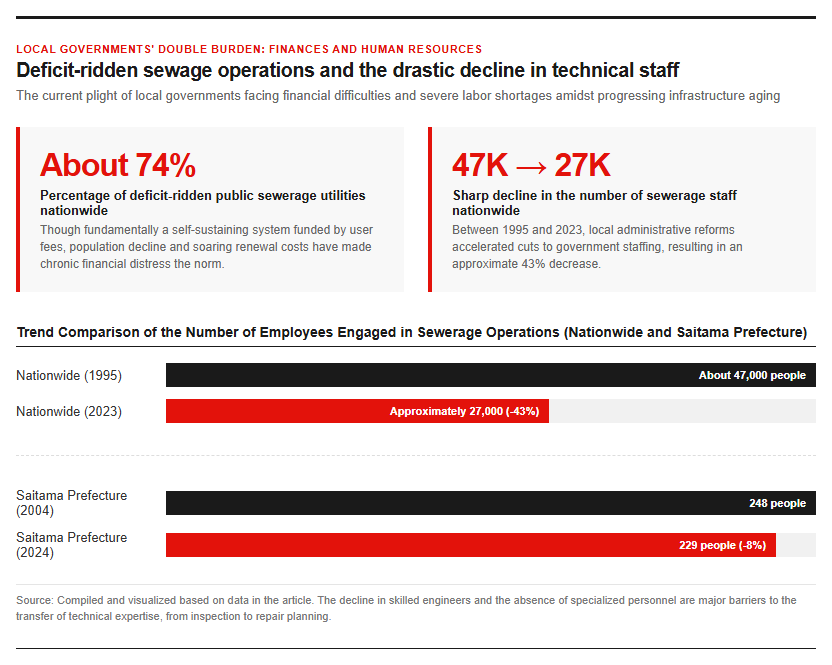
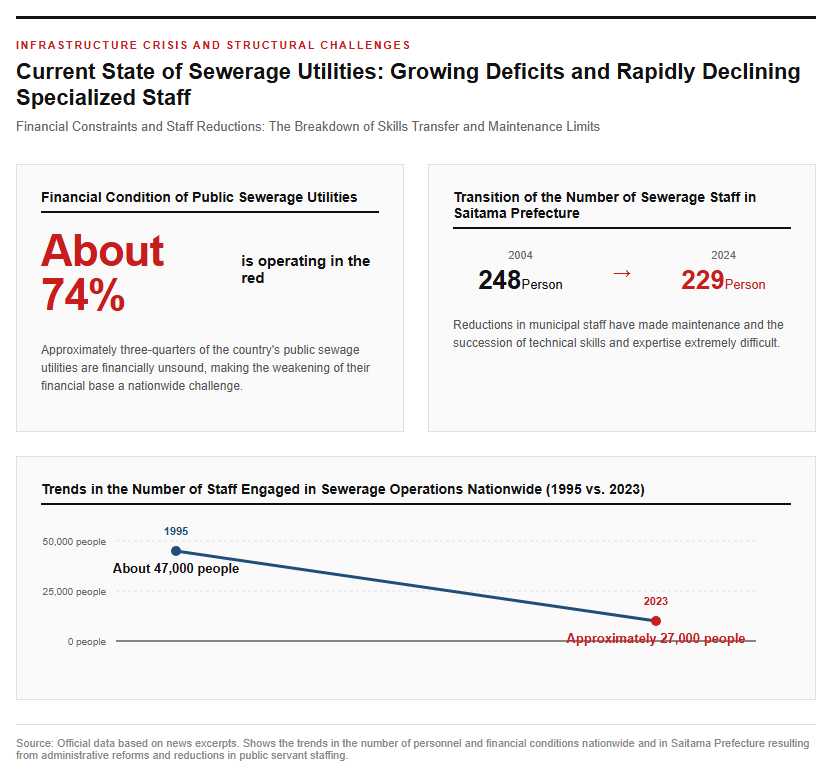
While calls grow for action against aging infrastructure, the local governments responsible for managing and repairing it face severe financial and staffing crises. Sewerage systems are fundamentally self-funding through user fees, but due to soaring upgrade costs driven by population decline and aging facilities, about 74% of public sewerage utilities nationwide are operating in the red.
In addition to deteriorating financial conditions, staffing cuts driven by national guidelines for local administrative reform have further exacerbated the situation. The number of personnel working in sewerage utilities nationwide plummeted from approximately 47,000 in 1995 to about 27,000 in 2023. Furthermore, in Saitama Prefecture, staff numbers decreased from 248 in 2004 to 229 in 2024, making maintenance and the transfer of technical expertise extremely difficult.
The departure of the skilled engineers who were present when the infrastructure was built, combined with the lack of dedicated maintenance personnel, has become a major barrier to the process from inspection to repair planning.
Institutional Reforms for Sustainable Cities and the Future of Infrastructure
Pros and Cons of Public-Private Partnerships: Strong Local Opposition to Mandatory Water PPP
The Ministry of Land, Infrastructure, Transport and Tourism is strongly promoting the introduction of “Water PPP,” a public-private partnership model that outsources infrastructure maintenance to private companies on a long-term and comprehensive basis, as a measure to make up for declining local government staff and tight budgets with private-sector capabilities. The central government has outlined a policy to make the pre-determined introduction of Water PPP a requirement (obligation) for receiving grants when utilizing disaster prevention and safety grants and other funds for sewer pipe renovations from fiscal 2027 (Reiwa 9) onward.
However, this national stance has met with strong opposition from some local governments, including Saitama Prefecture. In a request submitted to the central government, Saitama Prefecture strongly urged a redesign of the policy so that Water PPP is not made a prerequisite for financial support. The key concerns raised by local authorities are as follows:
-
The risk that the pursuit of profit by private companies will lead to cuts in costs for safety management and disaster response.
-
the breakdown of knowledge transfer, where local governments no longer accumulate technical expertise and know-how regarding infrastructure management and emergency response
-
The rollback of information disclosure due to outsourcing to the private sector, and the accompanying decline in resident oversight.
Future Outlook and Key Points: Revision of the Sewerage Act and Transition to Johkasou (Decentralized Treatment)
In Japan’s depopulating future, it is financially uneconomical to continually restore and maintain all vast sewer pipelines to their original state, prompting strategic policy shifts such as infrastructure downsizing and the transition to decentralized treatment (Johkasou).
In July 2026, the Act for Partial Amendment of the Sewerage Act and Other Acts (Act No. 65 of 2026) was enacted, establishing statutory standards for reliable aging assessments while clarifying procedures for abolishing or downsizing sewerage planning areas in consideration of population decline and natural conditions. Consequently, in areas where the abolition of a sewerage system is publicly notified, the obligation to connect is lifted, allowing individual households to switch to Johkasou septic tanks.
Please refer to the figure below for specific review procedures associated with the legal amendments and examples of local governments with a need for transition.
As a leading example, Minamiizu Town in Shizuoka Prefecture abolished a fishing community wastewater facility whose utilization rate had plummeted due to population decline and tourism decay, converting all 68 households to individual septic tanks over a two-year period using fully town-funded subsidies. This initiative has eliminated the massive fiscal expenditures required to maintain an oversized collective treatment facility, successfully reducing the long-term financial burden on residents.
Selecting the “best mix” for designing future maintenance and sludge treatment without interrupting local sewage treatment systems is a critical issue for future urban development.
Please refer to the figure below for the involvement of local stakeholders in post-conversion maintenance and construction.
In areas with rapidly declining populations, local governments are now required to restructure their infrastructure, prioritizing economic efficiency while balancing safety and operational sustainability.
Reference page
- 【Ministry of Land, Infrastructure, Transport and Tourism: “Water and Sewerage DX Technology Catalog”】https://www.mlit.go.jp/mizukokudo/watersupply_sewerage/jyouge_dx/index.html
[#Sewerage #AgingInfrastructure #RoadCaveIns #LocalGovernment #MinistryOfLandInfrastructureTransportAndTourism #SepticTanks #SewerageActAmendment]


コメント