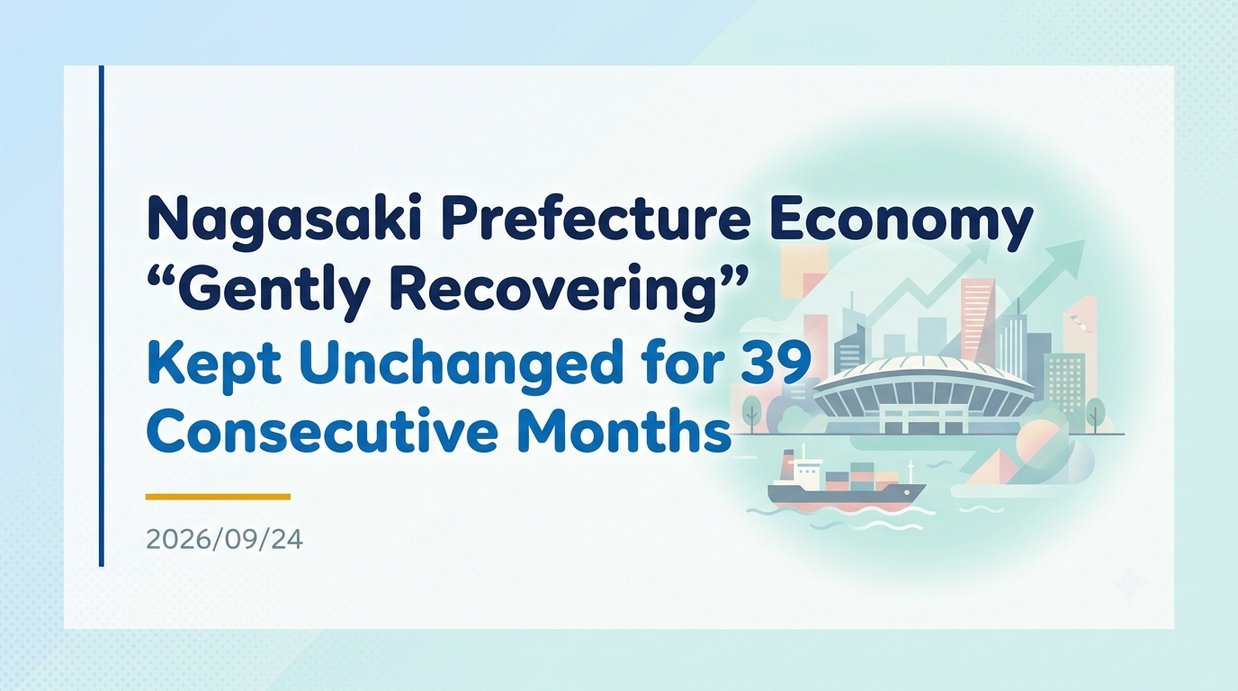
The Bank of Japan’s Nagasaki Branch maintained its economic assessment for Nagasaki Prefecture at “recovering moderately,” keeping the evaluation unchanged for the 39th consecutive month. While urban redevelopment projects, notably Nagasaki Stadium City, alongside a booming shipbuilding and defense sector, continue to drive momentum, rising raw material costs and severe labor shortages pose persistent challenges to corporate management.
- Assessment Unchanged for 39 Consecutive Months and Overall Economic Trends
- Major Regional Projects Supporting Personal Consumption and Tourism Demand
- Buoyant Production Activity Across Shipbuilding, Defense, and Semiconductor Sectors
- Escalating Labor Shortages and High Corporate Insolvency Rates
- Inflation and Cost Pass-Through Challenges in Corporate Management
- Medium- and Long-Term Growth Strategies and Key Risk Factors
Assessment Unchanged for 39 Consecutive Months and Overall Economic Trends
In its Financial and Economic Overview published in September 2026, the Bank of Japan’s Nagasaki Branch reported that Nagasaki Prefecture’s economy continues to recover moderately, maintaining this assessment for 39 consecutive months. The prefectural economy is bolstered by the opening of the Nishi-Kyushu Shinkansen line, a once-in-a-century urban redevelopment project around Nagasaki Station, and increased production in core industries such as shipbuilding and electronic components. At the Monetary Policy Meeting held on September 18, 2026, the Bank of Japan raised its target for the uncollateralized overnight call rate to around 1.25 percent, yet financial conditions supporting regional economies remain accommodating. In the 142nd Prefectural Corporate Business Conditions Survey conducted by the Nagasaki Economic Research Institute in November 2025, the Business Conditions BSI across all industries showed signs of pickup, driven by expectations of increased tourist traffic from major events such as the Nagasaki Peace Cultural Festival 2025. However, experts, including the Manager of the BOJ Nagasaki Branch, point out that while the recovery trend is intact, corporate profitability remains under pressure due to elevated energy costs and rising labor expenses.
Major Regional Projects Supporting Personal Consumption and Tourism Demand
Nagasaki Stadium City, which opened in Nagasaki City on October 14, 2024, is a major commercial and sports complex constructed on approximately 7.5 hectares of a former shipyard site with a total investment of 100 billion yen. Featuring Peace Stadium, Happiness Arena, the Nagasaki Marriott Hotel (opened in January 2024), and Amu Plaza Nagasaki New Building (opened in November 2023), the complex is projected to attract around 8.5 million visitors annually and generate an estimated economic impact of 96.3 billion yen in its first year. The promotion of professional soccer club V-Varen Nagasaki to the J1 League, the impressive performance of professional basketball team Nagasaki Velca, and the launch of a regular flight route connecting Nagasaki and Busan in January 2026 have all significantly expanded visitor flow from both domestic and international markets. According to data from Nagasaki Airport Building and travel industry sources, increased port calls by international cruise ships and a rebound in school trip demand have pushed up per-capita spending in hospitality, dining, and souvenir retail. The following image illustrates the bustling downtown Nagasaki area and sports hubs transformed by redevelopment.
Sectoral Performance and Structural Challenges
Buoyant Production Activity Across Shipbuilding, Defense, and Semiconductor Sectors
In Nagasaki’s manufacturing sector, production activity in core industries—namely shipbuilding, naval defense, and electronic devices—remains robust. Backed by expanding defense budgets and improving global maritime market conditions, Mitsubishi Heavy Industries’ Nagasaki Shipyard & Machinery Works has secured more than three years’ worth of order backlog. In particular, following the April 2026 contract signing for the construction of the initial three Mogami-class multi-role frigates (FFM) out of an 11-ship export deal for the Royal Australian Navy, high-level shipyard operations in Nagasaki are effectively locked in for the next decade. Driven by rising demand for AI applications, data centers, and smartphones, production among electronic components and device manufacturers, such as Isahaya Electronics, is also on an upward trajectory. Furthermore, public-private initiatives in offshore wind power and expanding investments in renewable energy infrastructure are providing local manufacturers with new contracts and opportunities for technological innovation.
Escalating Labor Shortages and High Corporate Insolvency Rates
Beneath active corporate operations, acute labor shortages and supply constraints have emerged as critical bottlenecks for the regional economy. Nagasaki City’s population dropped below 400,000 in July 2022 and is projected to decline further to approximately 280,000 by 2050, reflecting an accelerating shrinkage of the working-age population. According to research by the BOJ Nagasaki Branch, while the active job openings-to-applicants ratio remains high, net outward migration among younger demographics and an aging workforce have created chronic hiring difficulties, particularly in construction, transportation, and service sectors. The 2025 Nagasaki Prefecture Corporate Insolvency Survey by Teikoku Databank’s Nagasaki Branch reported a prefectural insolvency rate of 0.31 percent, remaining in the elevated 0.3 percent range for two consecutive years. The manufacturing sector was hit particularly hard, with its insolvency rate surging by 0.20 percentage points year-on-year to 0.84 percent, highlighting the severe operational risks faced by small and medium-sized enterprises (SMEs) unable to pass rising raw material and labor costs onto sales prices. The following graphic summarizes job mismatch trends and corporate insolvency dynamics.
Medium- to Long-Term Regional Economic Outlook and Key Drivers of Sustainable Growth
Inflation and Cost Pass-Through Challenges in Corporate Management
In a 2026 economic outlook survey of 107 local businesses conducted by the Nagasaki Economic Research Institute, labor shortages and workforce aging (72.0 percent) and rising procurement and raw material costs (70.1 percent) were cited as the top management challenges. In response, businesses are adopting digital transformation (DX) and artificial intelligence (AI) to automate and streamline operations, recruiting mid-career and foreign talent, and strategically adjusting product prices to protect profit margins. However, compared to large enterprises, regional SMEs possess weaker bargaining power, making it difficult to fully pass on rising wage expenses—amplified by the significant minimum wage increase decided in December 2025—to customers. Building a solid financial base capable of boosting corporate earning power and implementing sustained wage increases remains an urgent priority.
Medium- and Long-Term Growth Strategies and Key Risk Factors
To maintain a sustainable economic recovery trajectory over the medium to long term, Nagasaki Prefecture must go beyond capturing tourism demand by transforming its industrial structure toward higher-value local industries and retaining younger workers. Regional business leaders are strongly advocating for the cultivation of advanced industry clusters, such as semiconductors and marine energy, promoting U-turn and I-turn employment, and strengthening support for local enterprises. Key focal points and potential risk factors moving forward include the impact of US Trump administration tariff policies and international geopolitical shifts on export firms, elevated energy prices driven by Middle Eastern instability, risks of inbound travel restrictions stemming from diplomatic tensions, and rising financing costs associated with potential additional policy rate hikes by the Bank of Japan. Overcoming labor constraints and high costs while strategically allocating capital to growth sectors like defense, renewable energy, and tourism will determine Nagasaki’s capacity for sustainable long-term economic growth.
Reference Pages
-
[Bank of Japan Nagasaki Branch “Financial and Economic Overview of Nagasaki Prefecture”] https://www3.boj.or.jp/nagasaki/kouhyo/gaikyo.html
-
[Teikoku Databank, Ltd. “Nagasaki Prefecture Corporate Insolvency Survey (2025)”] https://www.tdb.co.jp/report/economic/20260402-incidencerate-nagasaki/
-
[Nagasaki Economic Research Institute “Nagasaki Keizai Web”] https://nagasaki-keizai.jp
[#NagasakiEconomy #EconomicRecovery #BOJNagasakiBranch #NagasakiStadiumCity #LaborShortage #InsolvencyRate #MitsubishiHeavyIndustries]


コメント