Amid growing expectations for further interest rate hikes by the Bank of Japan, the yield on newly issued 5-year bonds hit a record high in the bond market. As the ultimate destination for interest rates targeted by the BOJ remains unclear, upward pressure on yields is intensifying, particularly for medium-term bonds.
- Growing Expectations for Early Rate Hikes in Financial Markets and 5-Year Yields Reaching Record Highs
- The Policy Stance of the BOJ and the Market Perception Gap Behind the Stalling Peak Interest Rates
- An Unusual Interest Rate Decision Mechanism Driven by Stock Prices and Exchange Rates
- The Bank of Japan’s Negative Spread and Earnings Deterioration Risks Caused by Policy Rate Hikes
- Increase in Interest Payments Due to Rising Borrowing Rates and Pressure on Corporate Earnings
- Future Monetary Policy Developments and Key Points of Focus for the Japanese Economy
Growing Expectations for Early Rate Hikes in Financial Markets and 5-Year Yields Reaching Record Highs
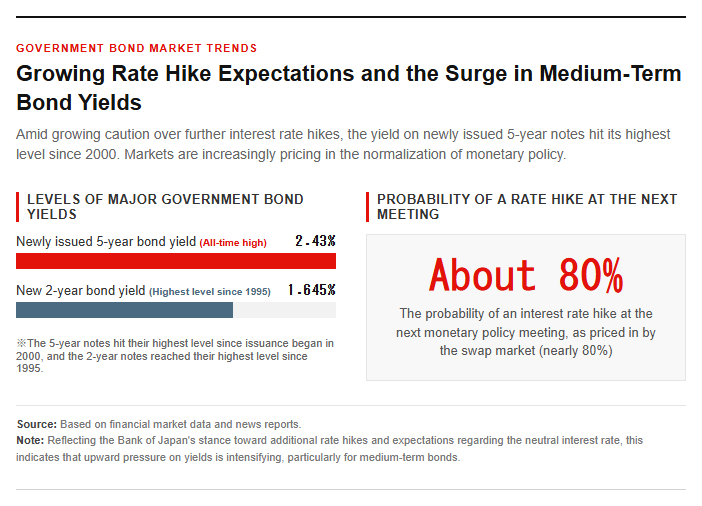
In Japan’s bond market, the yields on medium-term bonds, which are sensitive to monetary policy, continue to surge rapidly. The yield on newly issued 5-year government bonds rose to 2.43%, updating the record high since issuance began in 2000. Additionally, the yield on newly issued 2-year bonds reached 1.645%, marking its highest level since 1995. The background behind the rapid rise in market expectations for an early interest rate hike by the Bank of Japan (BOJ) includes reports that BOJ Governor Kazuo Ueda hinted at a rate hike behind the scenes of joint yen-buying intervention by the Japanese and U.S. governments, as well as a strengthening stance toward additional rate hikes aimed at the neutral interest rate. In the swap market, the probability of an interest rate hike at the next meeting has been priced in at close to 80%. Along with the rise in interest rates, while the TOPIX updated its record closing high in the stock market, centered on bank stocks, investors holding foreign bonds and medium-term government bonds are showing a move to refrain from buying. Although the interest rate levels themselves are increasing investment attractiveness, many investors are struggling to gauge the timing for purchases amid an inability to foresee the future pace of rate hikes. Please refer to the figure below.
The Policy Stance of the BOJ and the Market Perception Gap Behind the Stalling Peak Interest Rates
The fundamental factor exerting strong upward pressure on medium-term yields in the bond market is that the market has lost sight of the “terminal rate” for the policy interest rate aimed at by the Bank of Japan (BOJ). In its Outlook for Economic Activity and Prices report, the BOJ maintains a bullish main scenario that income spillovers from the corporate sector to the household sector and an upward trend in prices will continue. However, actual current economic data show that the growth of real wages and private consumption is lagging behind robust corporate earnings, highlighting a growth structure dependent on external demand. According to estimates by private-sector think tanks such as Nomura Securities, a risk scenario has also emerged in which the BOJ’s policy rate could eventually be hiked from 1.25% to 1.75% or even 2.00%. While the BOJ emphasizes the risk of upward pressure on prices and shows an active stance toward an early rate hike, market participants remain cautious about the economic slowdown in the U.S. and weak domestic consumption, widening the gap in economic perceptions between the two parties. This discrepancy in perception is resulting in a further amplification of expectations for higher interest rates in the market.
Monetary Policy’s Deepening Dependence on Asset Markets and the Bank of Japan’s Financial Risks
An Unusual Interest Rate Decision Mechanism Driven by Stock Prices and Exchange Rates
Governor Ueda expressed his stance on evaluating the financial environment by comprehensively assessing it through three axes: not only traditional interest rates and bank lending, but also the “asset market.” As a result, a structure is becoming established in which the Bank of Japan’s judgment criteria regarding the pace and timing of interest rate hikes are effectively heavily influenced by trends in stock prices and foreign exchange markets. As a result of years of ultra-large-scale monetary easing, while the wealth effect from higher stock prices supports consumption and economic activity, a paradoxical phenomenon has emerged in which the central bank itself is at the mercy of fluctuations in stock prices and exchange rates. In phases where the US dollar-yen exchange rate depreciates from the 158 yen range to around 160 yen per dollar, the risk of overshooting the inflation target increases through the resurgence of import prices, creating pressure that forces the BOJ into an early additional rate hike. Conversely, if rapid rate hikes trigger a crash in the stock and real estate markets, it harbors the dual danger of instead inflicting a major downward shock on the economy as a whole. The asset market, which should have been a mirror of the economy, is now acting as a major variable that determines the policy path itself.
The Bank of Japan’s Negative Spread and Earnings Deterioration Risks Caused by Policy Rate Hikes
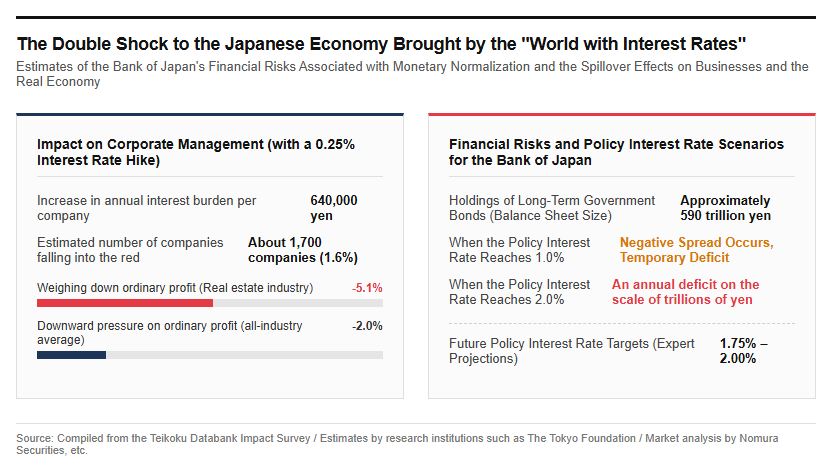
As the Bank of Japan (BOJ) raises its policy interest rate and proceeds with the normalization of monetary policy, a financial risk that the BOJ itself cannot avoid is its own fiscal vulnerability. The BOJ’s balance sheet records approximately 590 trillion yen worth of long-term government bonds as assets, and the interest income generated from these remains fixed at past low levels. On the other hand, accompanying the hike in the policy interest rate, the interest payment burden of “interest on excess reserves”—which are paid on current account deposits (excess reserves) held by private financial institutions at the BOJ—will rapidly expand. According to estimates by research institutions such as the Tokyo Foundation, if the policy interest rate is raised to around 1.0%, an “inverse margin” (negative spread) where interest payments exceed interest income will occur, and the BOJ’s profits and losses are highly likely to temporarily plunge into the red. Furthermore, if the policy interest rate reaches 2.0%, it is projected that deficits on the scale of several trillion yen per year will occur. Even if a central bank falls into a deficit or technical insolvency, its operations will not immediately cease; however, if market confidence in the central bank’s financial soundness and its ability to stabilize prices is shaken, it will pose a serious risk that could trigger a surge in government bond yields and excessive currency depreciation.
Impact on Corporate Management and Ripple Effects on the Real Economy
Increase in Interest Payments Due to Rising Borrowing Rates and Pressure on Corporate Earnings
The full-scale transition to a “world with interest rates” is having a direct impact on the finances and business environments of Japanese companies. According to an impact survey conducted by Teikoku Databank targeting approximately 100,000 companies nationwide, the average borrowing interest rate on interest-bearing debt held by companies has risen to the 1% range for the first time in four years. Estimates show that if corporate borrowing rates were to rise by 0.25% from their current levels, it would generate an average of 640,000 yen in new annual interest burdens per company, pushing down ordinary profit by an average of 2.0%. This interest rate hike is estimated to cause approximately 1,700 companies nationwide (1.6%) to fall from profitability into an ordinary loss. By industry, the negative impact is expected to be greatest in the real estate sector, which has a high dependence on borrowing and faces concerns over deteriorating investment yields, with ordinary profit projected to decline by an average of 5.1%. For small and medium-sized enterprises (SMEs) that have maintained their cash flow under the past ultra-low interest rate environment, the increase in interest payments accompanying the rise in the short-term prime rate is a life-or-death issue, and they will be strongly required to drastically review their business structures moving forward in order to improve profitability through price pass-through and secure resources for loan repayment.
Future Monetary Policy Developments and Key Points of Focus for the Japanese Economy
The single most important point in forecasting the future Japanese economy is the pace at which the Bank of Japan (BOJ) will proceed with interest rate hikes while confirming a virtuous cycle of sustainable wage increases and price stability. According to expert analyses, including calculations by Kyohei Morita of Nomura Securities, a leading scenario is that the BOJ will implement phased additional rate hikes every few months, ultimately aiming for a policy rate of around 1.75% to 2.00%. However, uncertainties surrounding monetary policy are extremely high, including trends among major overseas central banks, fluctuations in crude oil prices due to the situation in the Middle East, and domestic policy changes as well as debates over tax cuts. If rate hikes are pushed through with insufficient communication between the market and the BOJ, there are concerns that this could trigger a further sharp rise in medium-term bond yields and turmoil in financial markets. For corporations and households, a major challenge going forward will be preparing for the increased interest burden caused by rising interest rates while also being able to enjoy the positive effects of a stable exchange rate and the expansion of the real economy through the escape from deflation. Market fluctuations are as shown in the graph below.
Reference page
- [Tokyo Foundation Research Program] https://www.tkfd.or.jp/research/detail.php?id=4669
- [Teikoku Databank] https://www.tdb.co.jp/report/economic/20260122-interestrates/
[#BOJRateHike #MediumTermYields #MonetaryPolicy #JapaneseEconomy #RisingInterestRates #TeikokuDatabank]

コメント