Hitachi, Ltd. has developed a training technology for large language models (LLMs) that generates diverse and promising candidates by considering multiple conflicting KPIs. This development comes against the backdrop of a current demand in social infrastructure and industrial sectors for advanced decision-making that simultaneously satisfies trade-off conditions, such as cost reduction and efficiency improvement.
- Overview of the Presentation and the Importance of AI-Driven Decision Making
- Challenges of Multiple KPIs Faced in Social Infrastructure and Industrial Settings
- Iterative Learning Techniques to Enhance Performance and Diversity of Candidate Pools
- GRPO Reinforcement Learning Using Hypervolume Contribution
- 13.3% Improvement in Logic Circuit Design Tasks and Verification Results
- Integration with the IWIM Platform, Future Developments, and Key Highlights
Overview of the Presentation and the Importance of AI-Driven Decision Making
On October 6, 2026, Hitachi, Ltd. announced that it has developed a training technology for Large Language Models (LLMs) that considers multiple conflicting Key Performance Indicators (KPIs) and outputs diverse and promising candidate options, aimed at optimizing operation and management in social infrastructure and industrial fields. This research was conducted in collaboration with the Okazaki Laboratory of Institute of Science Tokyo, and the results are scheduled to be presented at the international conference “COLM 2026” held in San Francisco, USA, from October 6 to 8, 2026. The key points of this technology are as follows.
- Supporting flexible decision-making without retraining the AI when on-site conditions change
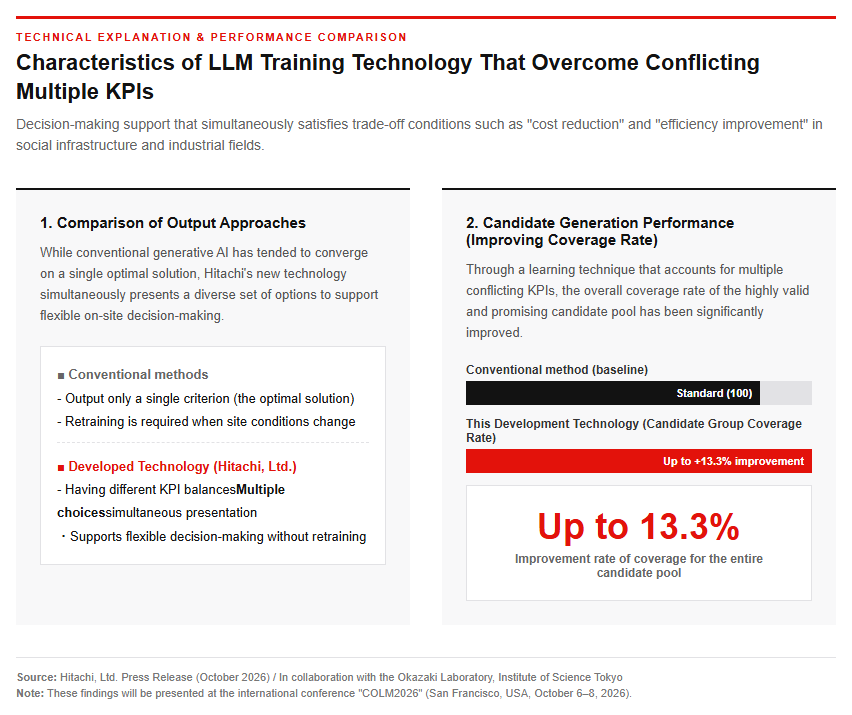
- Achieving superior candidate generation performance that improves overall candidate coverage by up to 13.3%
Conventional generative AI and optimization methods have tended to produce outputs based on a single criterion in operational environments with complex constraints, but this technology strongly supports flexible decision-making in operations. Please refer to the figure below.
Challenges of Multiple KPIs Faced in Social Infrastructure and Industrial Settings
In recent years, social challenges such as advancing decarbonization, volatile energy prices, and addressing labor shortages have become increasingly severe. Consequently, the mobility sector—including railways and automobiles—and logistics operations are increasingly required to develop operational plans that simultaneously satisfy multiple, conflicting objectives. For instance, in mobility operations, improving operational efficiency and reducing power consumption are in a trade-off relationship, while logistics delivery requires simultaneously achieving shorter transit times and lower electricity costs. With conventional reinforcement learning methods for LLMs, it has been common to convert multiple KPIs into a single overall score for training. This approach tends to bias the search toward a specific numerical balance that maximizes the overall score, making it difficult for users to compare and evaluate multiple alternatives. Furthermore, changing KPI priorities in response to shifting on-site conditions requires retraining the AI, which has been a major barrier to flexible responsiveness in infrastructure operations where agility is essential.
The Mechanism of the New Technology and Two Core Approaches
Iterative Learning Techniques to Enhance Performance and Diversity of Candidate Pools
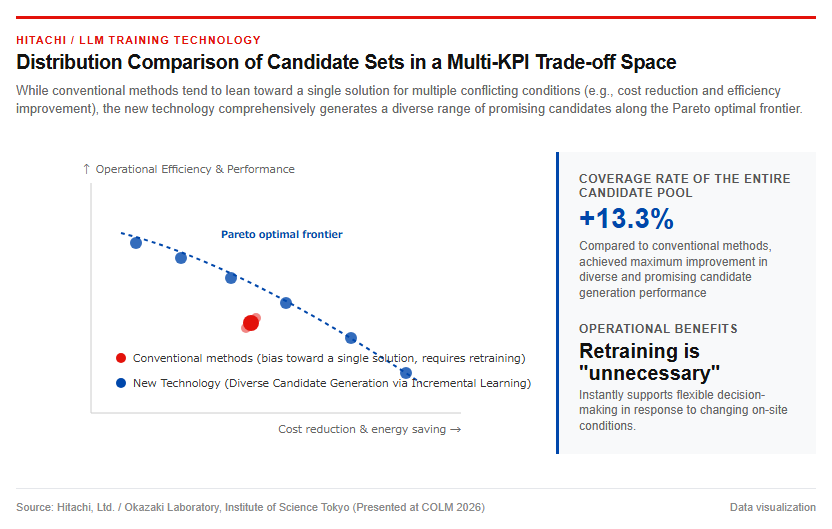
The first pillar of the new technology developed by Hitachi is a sequential learning technology that improves the performance and diversity of the entire generated candidate group. When attempting to have an LLM output a large number of candidate proposals at once, there has been a challenge in that the output text becomes long and learning efficiency drops significantly. Therefore, this technology adopts an approach that generates the next candidate while taking into account the contents of the candidate group generated in past trials. A mechanism has been built to proceed with learning step-by-step while evaluating how much newly generated candidates contribute to improving the performance and diversity of the entire candidate group as a whole. This makes it possible to acquire diverse options without compromising learning efficiency, while leveraging the strengths of conventional reinforcement learning algorithms targeting a single candidate. By suppressing the processing load of long-form text output by generative AI while deriving high-precision proposals, it functions as a learning infrastructure robust enough to withstand operational deployment. Please refer to the figure below.
GRPO Reinforcement Learning Using Hypervolume Contribution
The second pillar is an algorithm that incorporates “hypervolume contribution” into GRPO (Group Relative Policy Optimization), a reinforcement learning method for LLMs. Hypervolume contribution is an index that quantifies how much a specific candidate contributes to expanding the overall performance and diversity of a group in an evaluation space with multiple metrics. By applying this evaluation metric to GRPO, training is guided to avoid the redundant generation of similar candidates and instead produce a group of promising candidates with distinct characteristics. As a result, variation-rich solutions can be efficiently extracted even in situations where the number of evaluations is limited. For example, in the field of logic circuit design, it becomes possible to generate options with the following diverse characteristics for the same basic specification:
- A high-speed-oriented approach that prioritizes maximizing processing speed
- A low-power-focused approach that minimizes power consumption to the absolute limit
- A miniaturization-focused approach with minimized mounting area
Results of the Demonstration Experiment and Future Social Implementation Scenarios
13.3% Improvement in Logic Circuit Design Tasks and Verification Results
To verify the effectiveness of the developed LLM training technology, empirical experiments were conducted using circuit generation tasks in the field of logic circuit design, which allow for objective and automated performance evaluation. In the experiments, the “coverage rate” was used as a metric to measure how comprehensively the candidate circuits generated by the AI for the required specifications covered conflicting metrics such as power consumption, processing speed, and circuit scale. As a result of the evaluation, it was confirmed that the model trained using this technology improved the coverage rate of the candidate group by up to 13.3% compared to the model before training. This achievement overcomes the limitations of conventional technology, which could only provide solutions biased toward specific conditions, and demonstrates the practicality of enabling designers to compare multiple candidate designs with different characteristics according to product requirements and operating environments to select the optimal one.
Integration with the IWIM Platform, Future Developments, and Key Highlights
Hitachi positions this technology as an advanced decision-making technology that supports its proprietary social infrastructure intelligence foundation model, the “Integrated World Infrastructure Model (IWIM).” Going forward, the company plans to further deepen the verification of the technology while expanding its application to a wide range of industrial fields. Specific target areas for application include the following.
- Formulating optimal mobility operation plans for railways, automobiles, and other transportation modes
- Building a Smart Logistics System that Optimizes Power Costs and Delivery Times
- Watt-Bit Cooperative Control Linking Power Status with Computational Processing
- Logic circuit design support for advanced semiconductors and electronic devices
As a technology that achieves both stable infrastructure operations and energy savings and productivity improvements through advanced decision-making support considering multiple KPIs, its future implementation in society is attracting significant attention.
Reference page
- [Hitachi, Ltd.] Developed LLM Training Technology that Generates Diverse and Promising Candidates by Considering Multiple Conflicting KPIs for Optimizing Operation and Management of Social Infrastructure and Other Systems https://prtimes.jp/main/html/rd/p/000000082.000152541.html
[#Hitachi #GenerativeAI #LLM #ReinforcementLearning #SocialInfrastructure #AITech]


コメント