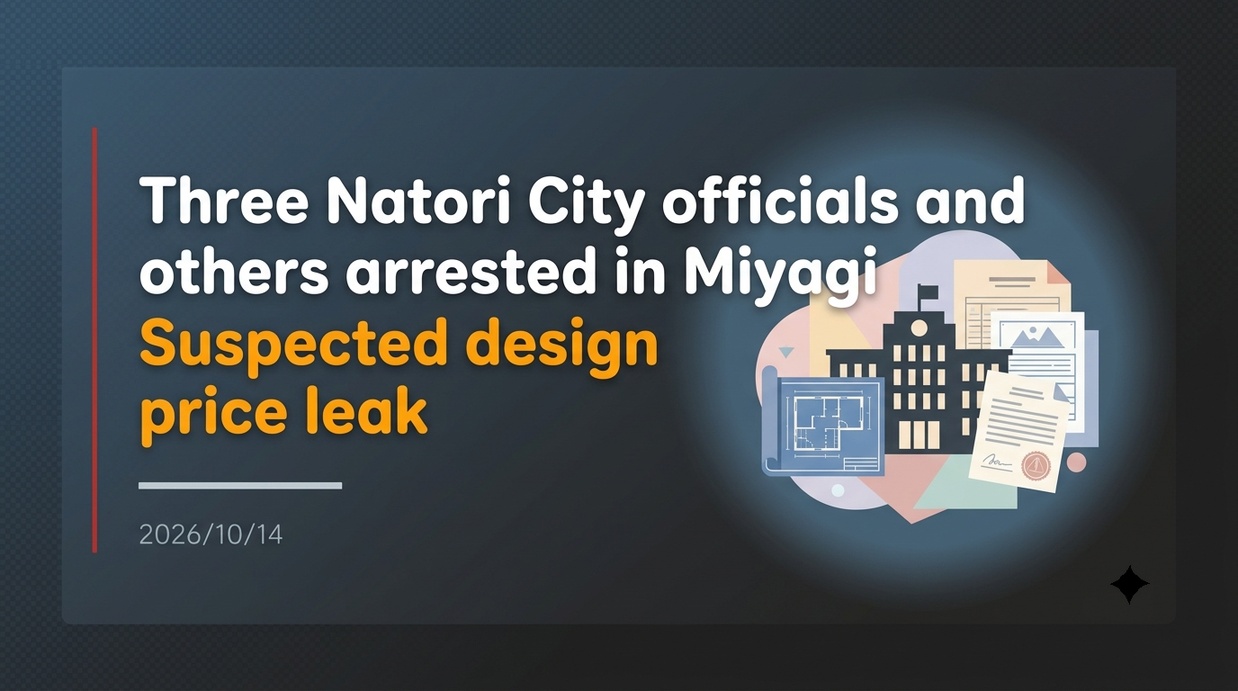
Regarding the restricted general competitive bidding for a retarding basin construction project ordered by Natori City, Miyagi Prefecture, three individuals, including a city official, were arrested on suspicion of violating the Anti-Bid Rigging Act for allegedly leaking the confidential design price to contractors. Behind this incident lie issues such as the hollowed-out state of information management by public works cost-estimation personnel and challenges in the internal controls of local governments.
- Arrest Charges and Background of Three Individuals, Including a Natori City Official and Construction Company Personnel
- The two laws applied to the arrest charges and their respective penalty provisions
- The Impact of Non-Public Information Leaks on Public Works Bidding
- Challenges in Local Government Internal Control Systems and Information Management
- Strengthening Recurrence Prevention Measures and Governance at Procuring Organizations
- Focus of Future Investigations and Outlook for the Public Procurement System
Arrest Charges and Background of Three Individuals, Including a Natori City Official and Construction Company Personnel
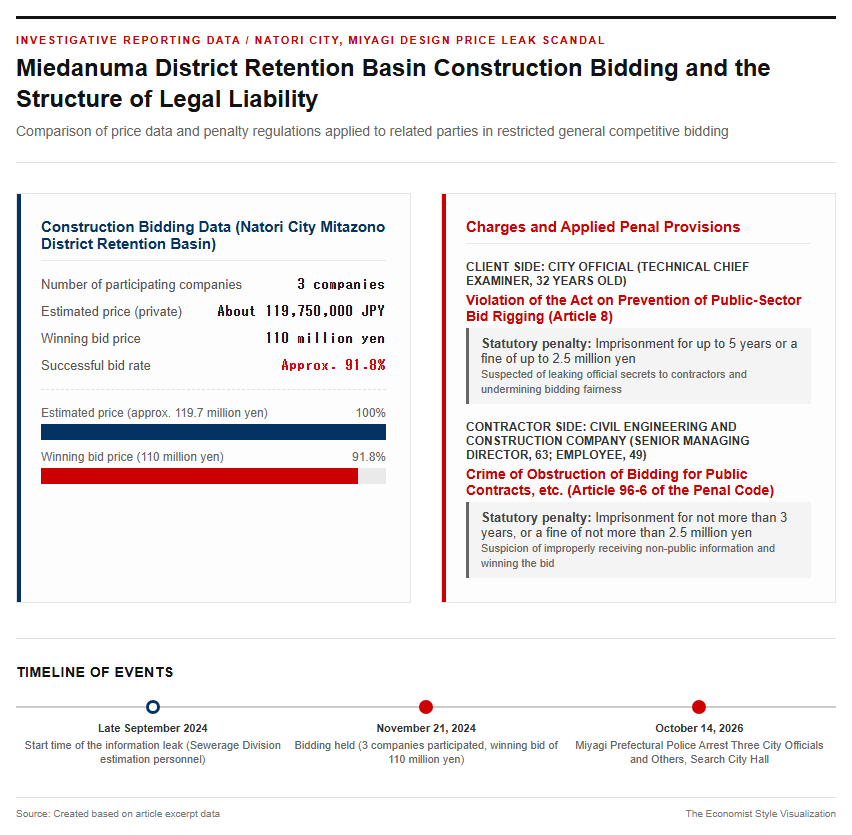
On October 14, 2026, the Second Investigation Division of the Miyagi Prefectural Police arrested Gensuke Sato (32), a technical chief in the Urban Planning Division of Natori City, on suspicion of violating the Act on Prevention of Public-Pertaining Bid Rigging (obstruction of bids by public officials) for allegedly leaking confidential design prices in a restricted general competitive bidding process for a public works project commissioned by the city. Simultaneously, the police arrested a 63-year-old executive managing director and a 49-year-old employee of a civil engineering and construction company based in Natori City on suspicion of bid obstruction related to public contracts, after they allegedly won the tender with the benefit of the leaked design prices.
The incident centers around the bidding for a retention basin construction project carried out in the Mitazono district of Natori City. The leaks are believed to have taken place between around late September 2024 and November 21 of the same year, the day of the bidding. The municipal official, who was serving as a technical chief in the Sewerage Division at the time and was in charge of estimating and designing the project, allegedly leaked non-public information obtained through his official duties to the contractor side.
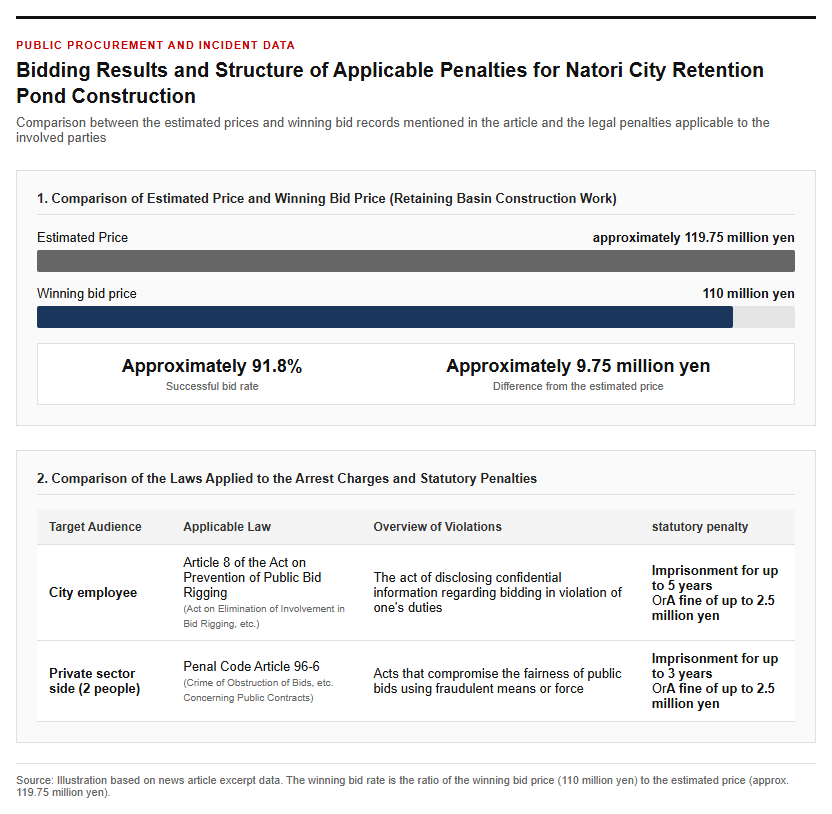
Three companies participated in the bidding, with the aforementioned civil engineering and construction company winning the contract with a bid of 110 million yen. Given that the estimated price was approximately 119.75 million yen, the successful bid rate reached approximately 91.8 percent. On the evening of October 14, the day of the arrests, the Miyagi Prefectural Police conducted a raid on the Natori City Hall, and Natori Mayor Shiro Yamada issued an apology statement to the citizens as the head of the municipal administration.
The two laws applied to the arrest charges and their respective penalty provisions
A legal feature of this incident is that different penal provisions under separate laws were applied to the city employee, who is a public official, and the two individuals on the side of the private contractor. Article 8 of the Act on Prevention of Public-Private Bid Rigging (official title: Act on Elimination and Prevention of Involvement in Bid Rigging, etc. by Public Officials and Punishment of Acts by Officials that Harm the Fairness of Bids, etc.), which was applied to the city employee, directly penalizes acts such as national or local government employees revealing bidding-related secrets in violation of their duties. The statutory penalty is imprisonment for up to 5 years or a fine of up to 2.5 million yen. On the other hand, the crime applied to the two individuals from the contractor side who received the information and won the bid is the crime of obstruction of public auctions, etc. relating to public contracts stipulated in Article 96-6 of the Penal Code. This penalizes acts that undermine the fairness of public bids by means of fraudulent devices or force, with a statutory penalty of imprisonment for up to 3 years or a fine of up to 2.5 million yen. To ensure fair competition in public procurement, high professional ethics and legal responsibilities are imposed on public officials on the ordering side, while at the same time establishing a framework in which heavy criminal responsibility is also pursued against contractors who improperly obtain non-public information and participate in bids.
Risks and Structural Background of Government-Led Bid-Rigging in Public Procurement
The Impact of Non-Public Information Leaks on Public Works Bidding
In public works procurement procedures, estimation information such as expected prices and design prices is kept undisclosed in advance so that participating bidders can submit appropriate prices based on their respective technical capabilities and management efforts, thereby ensuring fair price competition. If a specific contractor obtains undisclosed design prices in advance in a restricted general competitive bidding process, it becomes possible for them to set their bid amount from a decisively advantageous position over other companies. This hinders the proper expenditure of public funds that should otherwise be achieved through free competition, creating the risk that winning bid prices will remain unjustifiably high. Particularly in large-scale projects with an estimated price of approximately 119.75 million yen, such as the retention basin construction work in this case, a price difference of just a few percentage points directly impacts local government finances and the burden on residents. Bid-rigging orchestrated by officials due to information leaks not only distorts bidding results but also constitutes a major scandal that fundamentally shatters public trust in municipal administration. To maintain fairness and transparency in public procurement, strict measures to prevent the leakage of design prices and estimation information are indispensable.
Challenges in Local Government Internal Control Systems and Information Management
In the public works procurement processes of local governments, various fraud prevention measures have been introduced based on the internal control guidelines of the Ministry of Internal Affairs and Communications and findings by the Board of Audit. However, when information concentrates on individual estimators in actual operations and checking mechanisms become a mere formality, it remains difficult to completely eliminate the risk of government-led bid rigging. In the recent case in Natori City, the suspect official was in charge of estimation and design in the Sewerage Division at the time of the leak, placing them in a position to easily access non-public information within the department. As follow-up investigations into past projects handled by the official were also conducted after their transfer to the Urban Planning Division, it has highlighted the limitations of a management system that relies solely on the ethical standards of individual employees. From the perspective of internal control, alongside strengthening electronic bidding system security and regularly auditing access logs, there is a need to establish effective organizational checks and balances, such as requiring multiple personnel to verify estimation information and setting restrictions on information handling.
Future Discussion Points and Preventive Measures for Restoring Trust in Public Works
Strengthening Recurrence Prevention Measures and Governance at Procuring Organizations
In the wake of this incident, re-examining governance and compliance in procurement operations has become an urgent issue for local governments nationwide. In precedent cases from other municipalities that have established third-party investigation committees or reviewed their existing bidding systems, measures implemented include reconsidering the timing for publishing estimated prices, randomizing the calculation rates for minimum price limits, and strictly operating bidding monitoring committees comprised of external experts. In Natori City as well, alongside full cooperation with the investigation, it is necessary to improve the accessibility of the whistleblowing system in construction procurement procedures and to formulate a code of conduct to prevent inappropriate contact between procurement staff and contractors. Furthermore, it is essential to build an organizational culture capable of preventing and early detecting misconduct through continuous ethics training for employees and regular random audits by the internal audit department.
Focus of Future Investigations and Outlook for the Public Procurement System
In future judicial investigations, through house searches of related locations by the police and the analysis of seized materials, it is expected that the specific methods of the leak, the presence or absence of financial or entertainment-related benefits behind it, and the existence of organizational involvement will be clarified. In addition, the scope of application for civil and administrative penalties—such as suspension from bidding imposed by the local government on the civil engineering and construction company that won the bid, and claims for contractual penalties—will also be a focus. At the national level, efforts are underway through revisions to the Act on Promotion of Quality Assurance in Public Works (Hinkakuhō) and the Guidelines for Ordering-Related Administrative Operations to balance anti-dumping measures, fair price formation, and the assurance of transparency. In order to wipe out the distrust of citizens and local residents toward public works, both the ordering local governments and the awarded construction industry are strongly required to thoroughly comply with laws and regulations and rebuild a sound competitive environment.
Reference Page
- 【Act on Elimination and Prevention of Involvement in Bid Rigging, etc. and Punishment of Acts by Officials that Harm the Fairness of Bids, etc.】https://laws.e-gov.go.jp/law/414AC1000000101
[#Natoricity #OfficialBidRigging #BiddingInterferenceinPublicContracts #RestrictedGeneralCompetitiveBidding #InternalControl]

コメント