The projected public works procurement outlook for fiscal 2026 has been released, revealing the details of business plans by national agencies, expressway companies, and others. This is driven by the need to ensure the quality of public works projects, improve the transparency of bidding and contracting, and further improve the working environment and ensure sustainability in the construction industry.
- Key Points of the Events and Overview of the Ordering Schedule
- Ministry of Land, Infrastructure, Transport and Tourism Budget and Measures to Secure Public Works Expenditures
- Mandatory Submission of Construction Cost Breakdown Statements and Securing Labor Costs
- How the Revised Construction Business Act Drives Work Style Reform and Productivity Improvement
- Thorough Prevention of Fraud and Ensuring Fair Transactions
- Future Developments and Key Points
Key Points of the Events and Overview of the Ordering Schedule
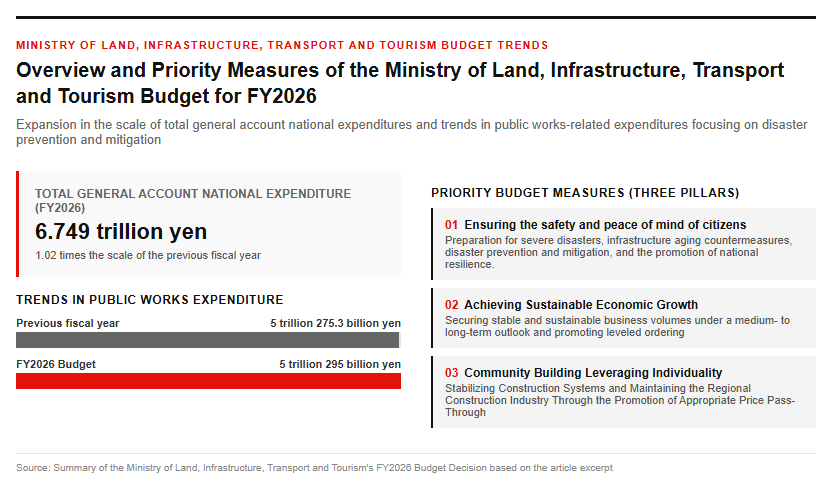
East Nippon Expressway Company Limited (NEXCO East) has announced its procurement outlook for construction and other projects for fiscal 2026, in accordance with the Act on Promotion of Proper Tendering and Contracting for Public Works. This announcement is current as of October 1, 2026, and covers construction works with a contract limit price of 4 million yen or more, as well as investigation and other services via competitive contracts with a contract limit price of 10 million yen or more, which are scheduled to be ordered during the one-year period from October 2026 to September 2027. All civil engineering construction management services are included in the announcement without any monetary limits.
In addition, the House of Councillors Administrative Department released its procurement forecasts for public works and other projects for fiscal 2026, outlining various construction types and scheduled bidding periods for Diet-related facilities in Nagata-cho, such as the renovation of the main building’s internal telephone exchange equipment, private power generation facilities, and television relay equipment. The publication of these procurement forecasts aims to ensure public trust in public works and to enable construction contractors, who are the receiving parties, to formulate construction plans and personnel allocations with ample time. Contractors will be able to proceed with appropriate preparations after reviewing the pre-disclosed information.
Ministry of Land, Infrastructure, Transport and Tourism Budget and Measures to Secure Public Works Expenditures
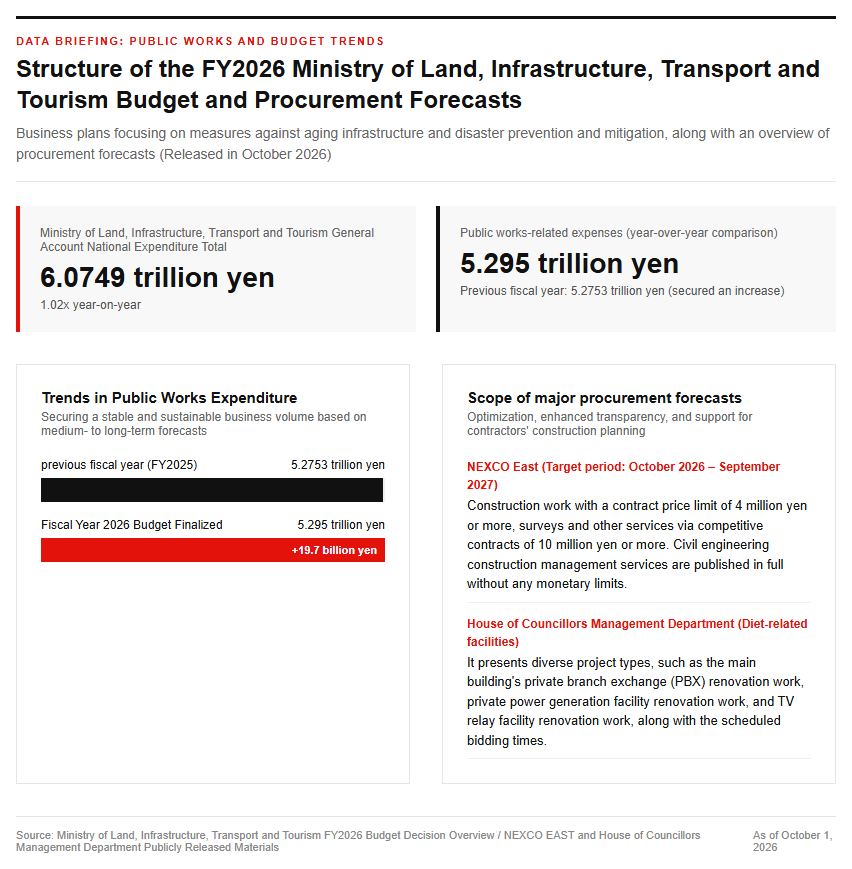
According to the FY2026 budget decision outline compiled by the Ministry of Land, Infrastructure, Transport and Tourism, a total of 6.0749 trillion yen in general account national funds has been allocated, representing a scale 1.02 times that of the previous fiscal year. Of this amount, public works-related expenses stand at 5.295 trillion yen, an increase from 5.2753 trillion yen in the previous year. As priority measures for the budget, three pillars were presented: ensuring the safety and security of citizens, achieving sustainable economic growth, and creating communities that leverage their unique characteristics.
In particular, a strong emphasis is placed on disaster prevention, mitigation, and the promotion of national resilience, focusing primarily on preparations for increasingly severe and frequent disasters in recent years and measures against aging infrastructure. Toward the appropriate promotion of public works, a policy has been set forth to secure stable and sustainable project volumes under a medium- to long-term outlook, while taking into account soaring material prices and the necessity of securing labor costs. As shown in the figure below, the aim is to stabilize construction systems and maintain the regional construction industry by promoting leveled ordering and facilitating appropriate price pass-throughs.
The presentation of planned procurement forecasts linked with these budgetary measures is positioned as an important measure to enhance the predictability of the construction market as a whole.
System Design for Optimizing Bidding and Contracting and Improving the Working Environment
Mandatory Submission of Construction Cost Breakdown Statements and Securing Labor Costs
In public works bidding and contracting procedures, efforts to improve transparency and prevent dumping practices are rapidly being strengthened. West Nippon Expressway Company Limited (NEXCO West) has revised its cost breakdown submission rules for all construction projects publicly announced or notified to designated bidders on or after October 1, 2026, in accordance with the revised Construction Business Act and the Act on Promotion of Proper Tendering and Contracting for Public Works. In addition to conventional estimates, the company now newly requires the submission of specified itemized cost statements.
This initiative requires the clear specification of concrete figures for items such as material costs, labor costs, contributions to the Construction Industry Retirement Benefits system, and health and safety expenses, and bids with missing submissions or blank amounts will be treated as invalid. Furthermore, to encourage appropriate wage returns to workers, investigations based on the Ministry of Land, Infrastructure, Transport and Tourism’s “Guidelines for Public Procurers to Prevent Labor Cost Dumping” will be conducted, and a system has also been established to report malicious cases to the Construction G-men. The aim is to block unjustified cost reductions and the shifting of burdens onto subcontractors by having the ordering party strictly verify the basis of estimation.
How the Revised Construction Business Act Drives Work Style Reform and Productivity Improvement
In the construction industry, low wage levels and long working hours compared to other industries have made the shortage of future workers a serious issue. To address this, the revised Construction Business Act and the revised Public Works Bidding and Contracting Act are being implemented sequentially, and efforts to improve the treatment of on-site workers and reform work styles are gaining full momentum. In addition to the establishment of a recommendation system for “standard labor costs” formulated by the Central Construction Industry Council, submitting estimates or requesting changes that significantly fall below normally required labor costs has been prohibited.
In addition, as a response to the upper limits on overtime work backed by penalties, contracts with exceptionally short construction periods (construction period dumping) have also been prohibited for both contractors and clients. At the same time, as a measure to complement improvements in the working environment, productivity enhancement through the use of ICT and digital technologies (i-Construction 2.0) is being promoted.
Efforts are underway to create an environment where safe and high-quality construction management can be carried out even with limited personnel, through the streamlining of the obligation to assign dedicated on-site engineers using remote communication and the promotion of data sharing between prime and subcontractors.
Addressing Challenges in Public Works and Future Outlook
Thorough Prevention of Fraud and Ensuring Fair Transactions
In public works and social infrastructure development, maintaining a fair and free competitive environment is essential. In past large-scale bid-rigging cases involving condominium major repair work, disciplinary actions were taken by the Fair Trade Commission, revealing the reality of opaque back-margins and estimate adjustments between design consultants and construction companies. The prior leakage of internal information, such as planned project budgets and selection criteria, acts as a factor that severely distorts competition.
In public works, the strict management and public disclosure of procurement information are mandated to prevent similar fraudulent practices. Based on the principles of the Act for Ensuring Quality of Public Works (Hinkaku Act) and the Act on Promotion of Proper Tendering and Contracting for Public Works, the application of comprehensive evaluation methods is expanding, going beyond mere price competition to incorporate assessments of technical capabilities and safety measures. Early publication of procurement forecasts eliminates opportunities for prior negotiations and bid-rigging, while maintaining vigilant oversight by the Japan Fair Trade Commission and relevant ministries and agencies is required to uphold a high level of market soundness and transparency.
Future Developments and Key Points
Moving forward, in the execution of public works, flexible adaptation to surging material costs and inflation, as well as the effectiveness of leveled procurement orders, will be the primary points of focus. In the event of rapid price fluctuations, the legal obligations for contractors to notify clients of “potential risk information” and to engage in good-faith consultations regarding contract price changes have been clearly established. This is expected to ensure a fair sharing of risks post-contract and facilitate smooth contract modifications.
On the other hand, the projected figures published by each ordering organization are merely plans as of the time of publication, and are subject to change depending on future social conditions and the status of budget execution. For contractors, it is essential to continuously monitor procurement forecasts and strengthen their corporate structures through digital transformation (DX), the adoption of ICT technologies, and the utilization of initiatives such as the Construction Career Up System (CCUS). There is a growing interest in ensuring that both clients and contractors build fair and appropriate business relationships to support sustainable infrastructure development and regional safety and security.
Reference page
- [East Nippon Expressway Company Limited (NEXCO EAST): “Revisions to the FY2026 Order Forecast”] https://www.e-nexco.co.jp/bids/prospection/r08_prospection/index1001.html
- 【West Nippon Expressway Company Limited (NEXCO West) “Regarding the Submission of Construction Cost Breakdowns Based on the Act on Promoting Proper Tendering and Contracting for Public Works”】https://corp.w-nexco.co.jp/newly/release/2026/10/post_8.html
- [Ministry of Land, Infrastructure, Transport and Tourism: “FY2026 Budget Decision Overview”] [suspicious link removed]
- 【e-Gov Law Search: “Act on Promotion of Proper Tenders and Contracts for Public Works”】[suspicious link removed]
【#PublicWorks #ProcurementForecast #PublicWorksBiddingAct #MLIT #ConstructionDX #QualityAssurance #BidRiggingPrevention】

コメント