The Atami Public Works Office of Shizuoka Prefecture and other organizations conducted a joint safety patrol at construction sites to inspect safety management systems in the work environment and the status of regulatory compliance. This comes amid a strong demand to raise awareness for the prevention of occupational accidents in the construction industry, as well as to strengthen infrastructure development and disaster prevention measures in the Izu region.
- Purpose and Inspection Details of the Joint Patrol by the Atami Public Works Office
- Key Points for Safety Checks and Guidance Examples at Construction Sites
- 5S Activities to Prevent Occupational Accidents and Eliminate Hazards On-Site
- Challenges in Report Creation and Photo Sharing, and the Utilization of DX Technology
- Lessons from the Sediment Disaster in Atami City and Strengthening of Embankment and Disaster Prevention Measures
- Preventive Maintenance for Aging Infrastructure and Construction Management Systems Supporting Local Communities
Purpose and Inspection Details of the Joint Patrol by the Atami Public Works Office
On October 22, 2026, the Atami Public Works Office of Shizuoka Prefecture and other organizations conducted a joint safety patrol at construction sites within their jurisdiction. The main purpose of this patrol is to detect potential hazards in on-site operations at an early stage and prevent the occurrence of occupational accidents. On the day of the patrol, government officials, specialists from related organizations, and representatives of construction industry associations visited the sites to conduct detailed inspections of compliance with work procedures and the establishment of safety and health management systems. Especially at sites involving large-scale civil engineering work or work at heights, a moment of carelessness carries a high risk of leading to a serious accident, which is why direct guidance and safety verification through patrols are treated with the utmost importance. Please refer to the following photos for scenes from the patrol.
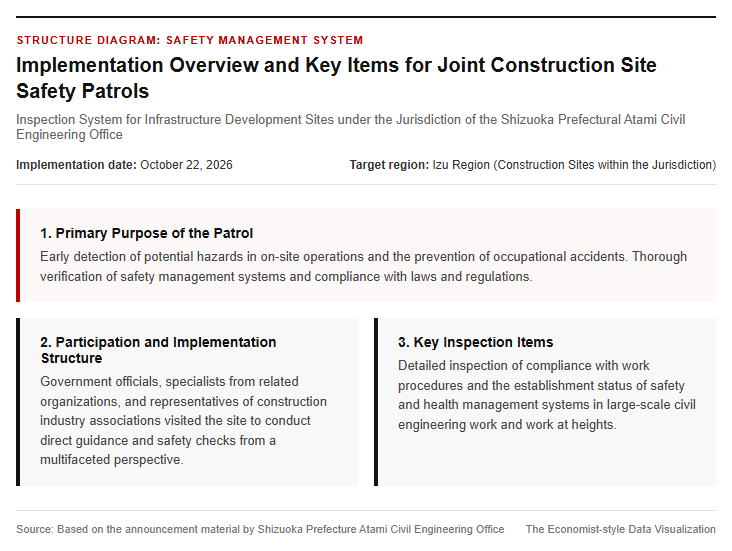
On-site patrols not only provide an opportunity to remind contractors of the “safety first” principle, but they are also an essential process for protecting the living environment of local residents and the safety of passersby. The patrol team thoroughly inspected every corner of the site based on a checklist and strongly urged the early correction of hazardous areas. Through such regular patrols and close cooperation with related organizations, efforts are underway to achieve the goal of zero accidents at construction sites throughout the region.
Key Points for Safety Checks and Guidance Examples at Construction Sites
During patrols, the key points inspected focus on a wide range of areas, such as the state of organization and tidiness within the site, the installation status of safety equipment, and the thorough use of protective gear by workers. Specifically, strict inspections were conducted on the securing of dedicated safety passageways that allow workers and delivery vehicles to pass safely, as well as safety measures to prevent falls at steps or gaps between scaffolding and building structures. In addition, important items listed included the prevention of electric shock accidents caused by the inappropriate use of cord reels and various power tools on-site, as well as thorough guidance on the “5S” activities, which stand for sorting, setting in order, shining, standardizing, and sustaining. Past construction accident reports highlighted issues such as insufficient coordination between signal persons and operators during heavy machinery work, and accidents involving damage to underground buried pipes and cables during excavation. Based on these specific examples, the thorough implementation of pre-work KY (hazard prediction) activities was instructed for each site. For deficiencies and points noted during the inspections, prompt responses are thoroughly enforced based on checklists, such as giving clear improvement instructions to the construction manager on the spot and requiring the submission of a corrective action report.
The Importance of Safety Patrols in the Construction Industry and Challenges in Site Management
5S Activities to Prevent Occupational Accidents and Eliminate Hazards On-Site
Safety patrols at construction sites are extremely important initiatives that not only prevent accidents but also directly link to construction quality control and the improvement of overall work efficiency on-site. To achieve “Safety First,” which is widely displayed as an on-site slogan, it is essential to establish a safety culture in which not only specific auditors, but all workers on-site, proactively detect and improve hazards. In particular, thorough implementation of 5S activities serves as the foundation for preventing slips, trips, and falls, as well as material collapse accidents caused by cluttered workspaces. Additionally, an important role of the inspectors is to confirm that instructions given during pre-work morning assemblies and health and safety meetings are correctly communicated to the lowest levels of the site and observed by the actual workers. Furthermore, at large-scale sites where the workplace regularly employs 50 or more workers, the establishment of a health and safety committee and other similar bodies is legally mandated, requiring the operation of an organizational and systematic safety management system. The accumulation of steadily eliminating hazard factors one by one through patrols leads to the prevention of occupational accidents and the securing of social trust as a company.
Challenges in Report Creation and Photo Sharing, and the Utilization of DX Technology
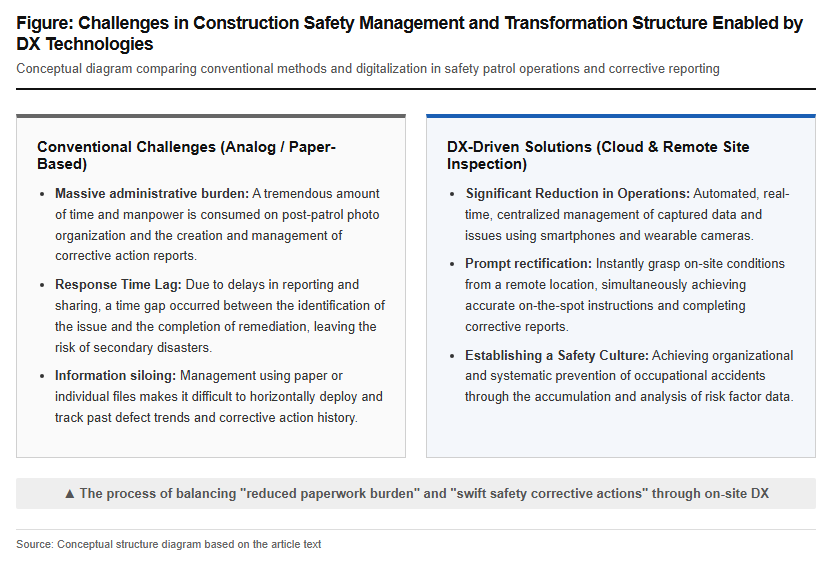
In conducting safety patrols, a significant burden placed on site managers and personnel is the creation and management of corrective action reports for identified issues. A tremendous amount of time and human labor is spent accurately recording problems discovered on-site during patrols, organizing photos from before and after corrections, and compiling them into reports. If the creation and sharing of reports are delayed, the risk that a new accident may occur before the correction of the identified issues is completed cannot be ruled out. To resolve these operational challenges on-site, the digital transformation (DX) of safety management utilizing cloud systems and remote inspection technology has been rapidly advancing in recent years. There is an increasing number of implementation cases involving dedicated solutions that use smartphones and wearable cameras to check on-site conditions in real-time from remote locations and automatically centralize captured data and identified issues. As shown in the conceptual diagram below, introducing digital technology into site management makes it possible to simultaneously achieve a drastic reduction in paperwork and the prompt execution of on-site corrections and safety measures.
Improving Infrastructure Reliability and the Future of Safety Measures Through Public-Private Partnerships
Lessons from the Sediment Disaster in Atami City and Strengthening of Embankment and Disaster Prevention Measures
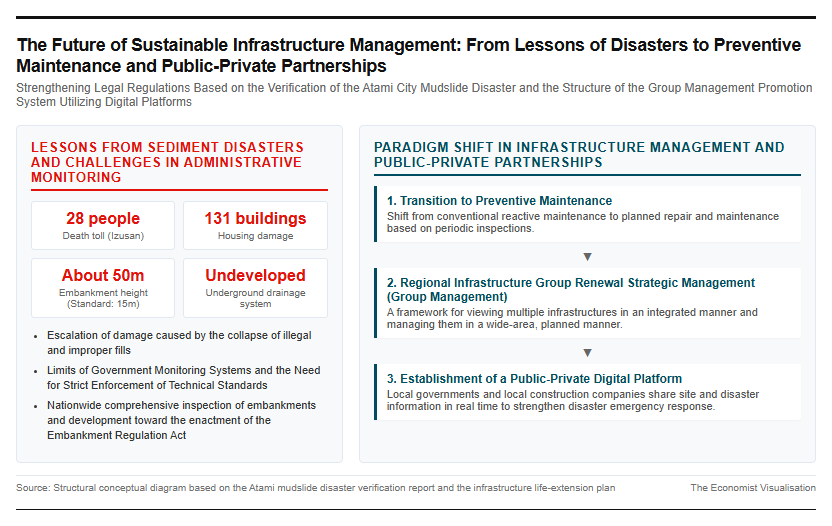
In Atami City, the Atami City Izusan debris flow disaster that occurred in the Aizome River basin on July 3, 2021, caused extremely serious damage, resulting in 28 fatalities and damage to 131 homes. In this disaster, it became clear that the collapse of illegal and inappropriate fill created in the upper reaches of the mountainous area significantly increased the scale of the sediment and greatly exacerbated the damage. Prompted by this incident, the national and local governments proceeded with a drastic strengthening of fill regulations, which developed into nationwide comprehensive inspections of fills and the enactment of the Fill Regulation Act. Strong awareness was also raised regarding challenges in the administrative monitoring system, such as the height of the fill reaching approximately 50 meters—far exceeding the statutory standard of 15 meters—and the absence of necessary subsurface drainage facilities. Building upon these painful lessons, monitoring over various construction projects and development work involving earth and sand transportation has been significantly strengthened within the jurisdiction of the Atami Public Works Office. To proactively prevent the risks of landslides and ground failures at construction sites, thorough compliance with laws and regulations and adherence to technical standards are being enforced through patrols. Toward ensuring regional safety and promoting sustainable urban development, the establishment of a public-private disaster prevention framework continues to be pursued.
Preventive Maintenance for Aging Infrastructure and Construction Management Systems Supporting Local Communities
Social infrastructure in Japan, such as roads, bridges, and tunnels, is aging rapidly, and there is a strong demand for a complete transition from conventional reactive maintenance, which addresses damage after it occurs, to preventive maintenance, which involves carrying out proactive repairs based on regular inspections. However, the decline in civil engineering technical staff in local governments and prolonged financial constraints have made the vulnerability of the systems required to sustainably maintain and manage infrastructure a major concern. Under such circumstances, the role played by local construction companies—which are deeply rooted in their communities and handle construction work and emergency disaster response for infrastructure—is becoming extremely significant. Initiatives are underway to promote Regional Infrastructure Group Regeneration Strategic Management (“Group Management”), which comprehensively views multiple pieces of infrastructure for wide-area and planned management, and to build digital platforms that enable the public and private sectors to share on-site and disaster information in real time. As shown in the conceptual diagram below, establishing close cooperation between the public and private sectors and an appropriate evaluation system for engineers is essential to maintaining a reliable infrastructure foundation well into the future.
Thorough on-site safety management through safety patrols has become a crucial pillar in maintaining local infrastructure and protecting the safe and secure daily lives of residents.
Reference page
- [Confirming On-Site Safety: Atami Public Works Joint Patrol – Izu Shimbun Digital] https://digital.izu-np.co.jp/news/society/113925
[#AtamiCity #ConstructionIndustry #SafetyPatrol #OccupationalAccidentPrevention #DisasterPreventionMeasures #InfrastructureMaintenance]

コメント