A serious vulnerability has been discovered in the programming language “PHP”, leading governments and top leaders to issue rare emergency warnings. Prompted by cutting-edge AI accelerating the discovery of flaws and the speed of attacks, both the public and private sectors are increasingly implementing preventive service suspensions and rebuilding their security frameworks.
- The Full Story of the Decade-Old Fatal Flaw “php2shell”
- An unprecedented emergency warning that even prompted the Prime Minister to act
- The Night of Turmoil When Over 200 Organizations Suspended Their Services
- Concentration of Funds in Cybersecurity-Related Stocks
- The Serious Risks Facing Unsupported Old Versions
- A New Security Initiative Against AI-Driven Attacks
The Full Story of the Decade-Old Fatal Flaw “php2shell”
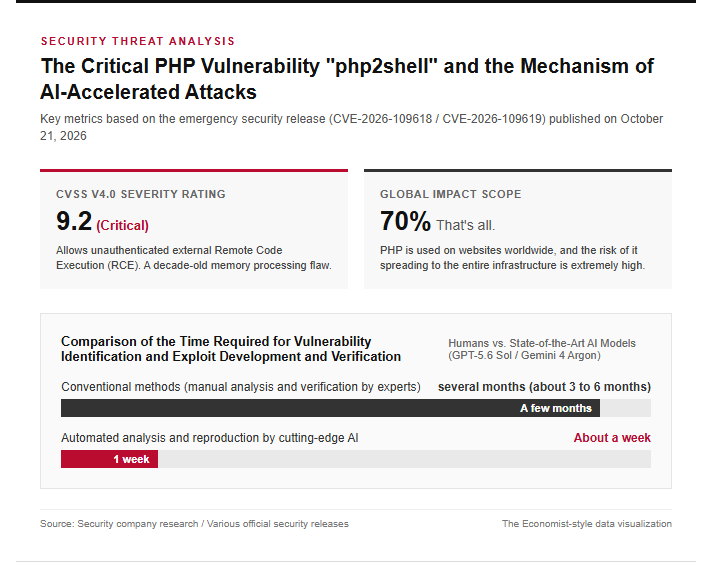
In the programming language PHP, which has been widely used in web development for many years, two critical vulnerabilities (CVE-2026-109618 and CVE-2026-109619) that threaten the core of the system were discovered, and an emergency security release was published on October 21, 2026. Commonly referred to as “php2shell,” these vulnerabilities have been rated at the highest level of “Critical” (severity 9.2) on the Common Vulnerability Scoring System (CVSS v4.0), and possess the extremely dangerous capability of allowing remote code execution (RCE) from an external source without authentication. Given that PHP is adopted in approximately 70% or more of websites worldwide, the scope of the impact in the event of exploitation is immeasurable.
What is particularly noteworthy is that cutting-edge artificial intelligence (AI) models were utilized to discover this vulnerability. In a security firm’s investigation, advanced AI models such as OpenAI’s “GPT-5.6 Sol” and Google’s “Gemini 4 Argon” were deployed for code analysis, identifying a memory-processing flaw that had been hidden for nearly 10 years in an extremely short period of time. It has been reported that the development and verification of exploit code, which typically takes experts several months, could be replicated in just about a week, highlighting the reality that the evolution of AI is driving not only defensive capabilities but also the sophistication and acceleration of attack methods.
Please refer to the figure below.
An unprecedented emergency warning that even prompted the Prime Minister to act
What was most unusual in this situation was the swift and direct communication by top government leadership and administrative agencies. Following alerts issued on the night of October 21, 2026, by the Information-technology Promotion Agency (IPA) and the National Cyber Directorate, Prime Minister Sanae Takaichi posted on her official X account at 9:55 p.m. that same day, titled “A most urgent request for everyone to address tonight.” It is extremely rare for the Prime Minister to personally call on the public and businesses late at night to address a programming language vulnerability, and she strongly urged the prompt application of security patches as well as the temporary suspension of websites if taking action is difficult. Prime Minister Takaichi’s own website was also taken offline as a countermeasure.
Behind the government’s show of such a strong sense of crisis is the immediacy of AI-driven cyberattacks. If attackers were to identify vulnerabilities before well-intentioned security researchers, there was an imminent risk that “catastrophic damage could be inflicted on web infrastructure across Japan overnight.” This issue was reportedly taken up even at a four-minister meeting of the National Security Council (NSC), and a nationwide emergency alert system was established in cooperation with the U.S. National Security Agency (NSA) and cyber authorities in various European countries.
Expanding Social Ripples and Impact on the Stock Market
The Night of Turmoil When Over 200 Organizations Suspended Their Services
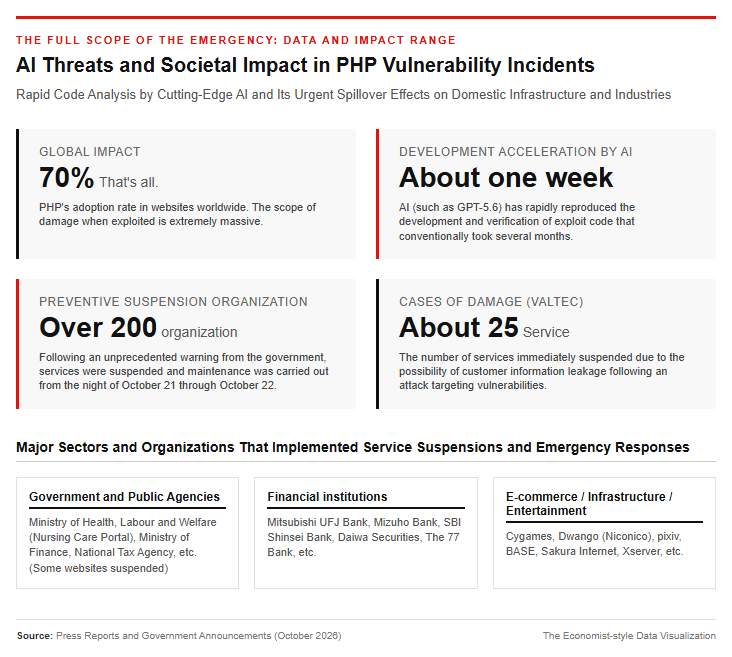
Following an unprecedented call by the government, a wide range of domestic industries and public institutions moved in unison to take precautionary measures. From the afternoon of October 21 to October 22, 2026, the number of organizations implementing temporary service suspensions or emergency maintenance reached over 200. Among government agencies, the Ministry of Health, Labour and Welfare’s nursing care portal and parts of the Ministry of Finance and National Tax Agency websites were temporarily taken offline, while financial institutions such as MUFG Bank, Mizuho Bank, SBI Shinsei Bank, Daiwa Securities, and The 77 Bank temporarily suspended online functions including internet banking and account opening forms.
The impact also expanded into the e-commerce (EC) and entertainment sectors. Major game titles from Cygames, certain features of Dwango’s Niconico Doga, the illustration posting site pixiv, the EC platform BASE, and even rental server providers such as Sakura Internet and Xserver all entered maintenance mode simultaneously. While many organizations voluntarily suspended their services as a proactive defense measure prior to patch application, cases of social disruption also spread—such as VALTEC, a provider of POS systems and other services, which suspended about 25 services after a potential customer data leak arose from an attack targeting the PHP vulnerability.
Please refer to the figure below.
Concentration of Funds in Cybersecurity-Related Stocks
Amid the social disruption, the stock market saw strong buybacks and investment funds pouring into cybersecurity-related companies in response to the situation. On the Tokyo stock market on October 22, 2026, as threats to global web infrastructure were exposed, views rapidly gained momentum that reinvesting in and reinforcing security measures would be indispensable for corporations and government agencies. As a result, major security provider Trend Micro led the way with a substantial consecutive surge in its share price, capturing significant market attention.
In the market, buy orders also flooded into related stocks such as GMO GlobalSign, Segue Group, Soliton Systems, Secureveil, and Ubiquitous, driving an upward trend in pursuit of higher prices. This situation demonstrates that cyber threats in the AI era are spreading across all industries at a pace exceeding previous expectations. Market participants are viewing this not merely as a temporary, one-off emergency response, but as a turning point that will structurally elevate the priority of security measures within corporate IT infrastructure budgets.
The Limitations of Legacy Systems and Defense Strategies in the AI Era
The Serious Risks Facing Unsupported Old Versions
The recent “php2shell” incident has highlighted the fundamental issue of legacy system vulnerabilities that remain deeply rooted in the global web environment. Although the PHP development team quickly released patched versions (8.2.35, 8.3.36, 8.4.27, and 8.5.12) for each of the currently supported 8.2, 8.3, 8.4, and 8.5 series, the problem lies in systems that continue to use older versions prior to PHP 8.1, which no longer receive official support. According to investigations by security organizations, it is estimated that out of approximately 2.6 million PHP servers operating worldwide, about 1.5 million are running on older versions for which no official patches will be provided.
Although the developer made an exception by providing minimal source code backports for older versions, websites running on legacy environments face the risk that upgrading their PHP version will cause existing programs and CMSs to malfunction. In fact, some operators have chosen to permanently shut down their services, giving up on maintaining older environments in the wake of this issue. The depth of system dependencies—which cannot be resolved simply by applying a patch—has become a major barrier hindering prompt recovery.
A New Security Initiative Against AI-Driven Attacks
Looking ahead, it can be said that cybersecurity battles have entered a new dimension: “AI-powered attacks” versus “AI-powered defenses.” The risk is becoming a reality that the speed at which attackers use AI to discover unknown vulnerabilities (zero-days) and generate automated attack tools outpaces the speed at which defenders detect vulnerabilities and distribute patches. As the government moves forward with the full-scale implementation of active cyber defense, an urgent priority going forward will be to establish infrastructure for the real-time sharing of unknown threat information between the public and private sectors, alongside instant detection and automated response systems leveraging AI technology.
At the same time, all companies and businesses are required to thoroughly inventory the software configurations in their internal systems and manage their supply chains as a whole. It is especially important to build support systems for small and medium-sized enterprises (SMEs), which face a shortage of specialized talent, and to establish structures for rapid risk judgment based on primary information. In cyber defense of the AI era, rather than stopping at technical patching, establishing operational governance that enables prompt decision-making in emergencies is the key that will determine an organization’s medium-to-long-term resilience.
Reference page
- [IPA] Regarding PHP Vulnerability Countermeasures (CVE-2026-109618, CVE-2026-109619: PHP2shell)
 PHPの脆弱性対策について(CVE-2026-109618、CVE-2026-109619:PHP2shell) | 情報セキュリティ | IPA 独立行政法人 情報処理推進機構情報処理推進機構(IPA)の「PHPの脆弱性対策について(CVE-2026-109618、CVE-2026-109619:PHP2shell)」に関する情報です。www.ipa.go.jp
- 【The PHP Group】Security advisory: Critical remote code execution vulnerabilities, update now
 PHP: News Archive - 2026PHP is a popular general-purpose scripting language that powers everything from your blog to the most popular websites i...www.php.net
- [JPCERT/CC] Security Advisory: Multiple Vulnerabilities in PHP (CVE-2026-109618, CVE-2026-109619)
 PHPにおける複数の脆弱性(CVE-2026-109618、CVE-2026-109619)に関する注意喚起www.jpcert.or.jp
- 【GitHub Security Advisory】RCE via OOM corruption (GHSA-w8hw-w9fx-j79w)
[suspicious link removed]
【#PHPVulnerability #Cybersecurity #PrimeMinisterTakaichi #SecurityRelatedStocks #php2shell #InformationSecurity #ITInfrastructure】
コメント