On October 23, 2026, Prime Minister Sanae Takaichi announced that she had instructed the Minister of Economy, Trade and Industry to consider a phased review and an exit strategy for fuel oil subsidies, such as gasoline. In light of concerns from both the ruling and opposition parties over the growing fiscal burden and trends in crude oil prices, discussions on shifting away from the long-standing price-suppression measures are gaining serious momentum.
- Key Points of the Event and Prime Minister Takaichi’s Instruction for Consideration
- Cumulative financial burden exceeding 9 trillion yen and the risk of budget depletion
- Impairment of Market Functions and a Setback for Decarbonization
- The Vicious Cycle of Fiscal Deterioration and Inflation Caused by Continuing Subsidies
- Estimation of Phased Reduction and Specific Review Process
- Future Outlook and Key Points
Key Points of the Event and Prime Minister Takaichi’s Instruction for Consideration
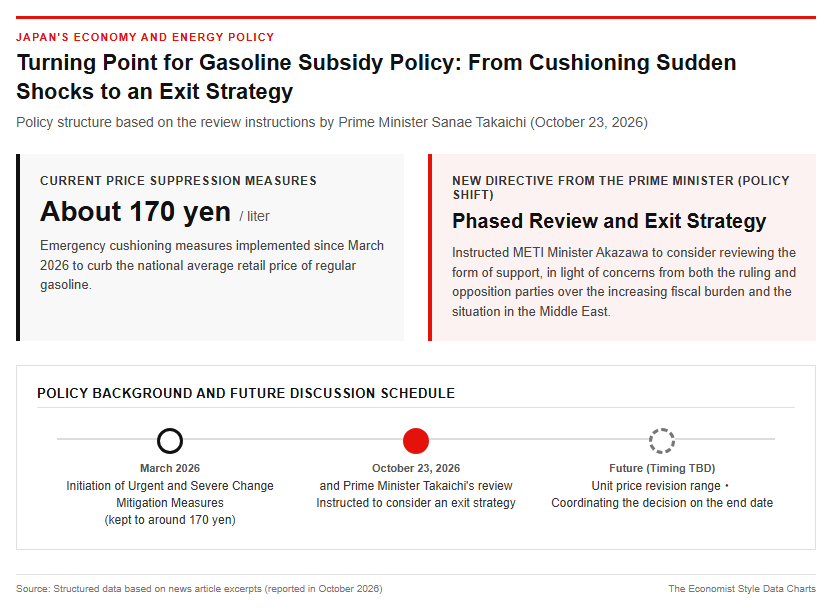
On October 23, 2026, Prime Minister Sanae Takaichi revealed to reporters at the Prime Minister’s Office that she had instructed Minister of Economy, Trade and Industry Ryosei Akazawa to examine future forms of support regarding fuel oil subsidies for gasoline and other fuels in light of the situation in the Middle East. Since March 2026, the government has implemented emergency sudden-change mitigation measures to keep the national average retail price of regular gasoline at around 170 yen per liter. However, Prime Minister Takaichi emphasized that fuel oil support is inherently a temporary measure solely for mitigating drastic changes, citing the fact that concerns over the fiscal burden, calls for a phased review, and demands for a clear exit strategy have been successively raised by both the ruling and opposition parties. Regarding the specific review, while having coordination proceed between Finance Minister Satsuki Katayama and the Minister of Economy, Trade and Industry to secure the scale of the fund necessary for immediate support, the policy is to closely monitor the impact of the Middle East situation and price trends on the economy. Although the scope of the unit price revision and the specific end timing remain undecided, she indicated her intention to advance discussions at an early stage, meaning that the large-scale gasoline price subsidy policy implemented for a long period is now reaching a major turning point.
Cumulative financial burden exceeding 9 trillion yen and the risk of budget depletion
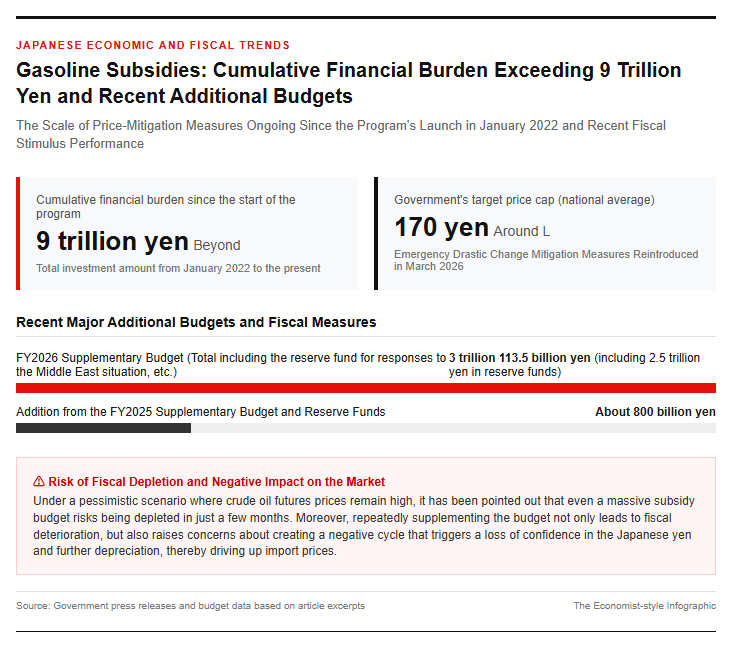
Japan’s gasoline subsidy program has been extended and scaled up repeatedly since it started in January 2022 as a drastic mitigation measure to cope with high crude oil prices. The cumulative budget injected since the program’s inception has exceeded 9 trillion yen, with massive amounts of public funds being spent to directly suppress prices. Even in the drastic mitigation measures reintroduced in March 2026, large amounts of national funds are being poured in, including the drawdown of the fuel oil price drastic mitigation fund and the addition of approximately 800 billion yen from the fiscal 2025 supplementary budget and reserve funds. In June 2026, to address soaring energy prices driven by the situation in the Middle East, a fiscal 2026 supplementary budget on the scale of 3.1135 trillion yen was enacted, of which 2.5 trillion yen was allocated as a reserve fund for responses to the Middle East situation and other developments. However, under a pessimistic scenario where crude oil futures prices remain at high levels, experts have pointed out the risk of budget depletion, where even a massive subsidy budget would be exhausted in just a few months. There are growing concerns that repeated budget augmentations not only lead to a deterioration of the nation’s finances, but also induce a decline in confidence in the Japanese yen in the market and cause depreciation, resulting in a negative cycle that pushes up import prices.
The Structural Challenges of Gasoline Subsidies and Their Impact on the Market
Impairment of Market Functions and a Setback for Decarbonization
Methods where the government directly controls retail prices, such as gasoline subsidies, pose an economic challenge in that they hinder the supply-and-demand adjustment function of free market mechanisms. Normally, when supply decreases due to international crude oil shortages or geopolitical risks, rising market prices curb non-essential gasoline usage and fuel consumption, thereby restoring supply-and-demand equilibrium. However, when subsidies artificially suppress price increases, this demand-suppression effect fails to materialize, leaving the imbalance in energy consumption unaddressed. Moreover, measures to keep prices low over an extended period weaken incentives for structural transitions, such as the electrification of vehicles or upgrading to energy-saving equipment. Amid the global push toward decarbonization, policies that effectively continue to subsidize fossil fuel consumption carry the side effect of delaying medium- to long-term climate change countermeasures and industrial restructuring.
The Vicious Cycle of Fiscal Deterioration and Inflation Caused by Continuing Subsidies
Continuing the gasoline subsidies carries the risk of significantly undermining the nation’s fiscal discipline. Japan’s government debt-to-GDP ratio exceeds 200 percent, the worst level among major economies, and amid rising long-term interest rates, increasing future interest payments will pose a serious challenge. It has been pointed out that the structure of continuously relying on deficit-financing bonds and reserve funds to fund these subsidies risks eroding market confidence in Japan’s fiscal health, potentially triggering further depreciation of the yen. Furthermore, critics note that gasoline subsidies offer little support to households that do not own private cars, making the benefits uneven. As price hikes across daily necessities, including food, strain household budgets, growing doubts are being raised—even from the perspective of policy cost-effectiveness—regarding the continued allocation of massive public funds to a single specific energy source.
Future Exit Strategies and the Outlook for the Japanese Economy
Estimation of Phased Reduction and Specific Review Process
Concrete discussions are underway within the government and ruling parties toward the phased reduction of gasoline subsidies. Under the draft plan currently being considered, discussions are moving toward lowering the subsidy unit price for fuel distributors in stages, gradually allowing the nationwide average retail price of regular gasoline to rise to about 175 yen per liter in December, and to around 180 yen by January 2027. Because completely abolishing the subsidies all at once would have a massive impact on everyday life and the logistics industry, a soft landing that gradually brings prices closer to market rates is being explored. Experts, including Hideo Kumano from the Dai-ichi Life Research Institute, have also proposed that highly transparent policy rules should be re-established to adjust subsidy amounts based on crude oil price levels, avoiding an unprincipled and indefinite continuation. The transition to direct support measures that narrow the target of assistance down to low-income households genuinely in need is also a key point of discussion.
Future Outlook and Key Points
The key point to watch moving forward is the impact that the reduction of gasoline subsidies will have on price trends, people’s livelihoods, and overall economic growth. If the subsidies are reduced or phased out, the Consumer Price Index, which has been suppressed up to now, could rise and put pressure on household purchasing power. In forums such as the National Council on Social Security, the government is advancing discussions on comprehensive livelihood support measures that integrate the tax system and social security, such as the introduction of refundable tax credits and the ideal approach to the tax burden on food. It is necessary to break away from the approach of continuing to rely on short-term price suppression measures, and instead strive to diversify the energy supply system—including the use of renewable energy and nuclear power—promote investment in energy conservation, and establish sustainable fiscal management. The question is whether a smooth exit strategy from the drastic change mitigation measures can be drawn up to transform the economy into one that is resilient to shocks.
Reference Page
- 【House of Councillors Research Office: “FY2025 Supplementary Budget, FY2026 Initial and Supplementary Budget Review”】https://www.sangiin.go.jp/japanese/annai/chousa/rip/pou_chousa/backnumber/20260713.html
[#GasolineSubsidy #TakaichiAdministration #ExitStrategy #FiscalRisk #InflationCountermeasures #EnergyPolicy #EconomicNews]

コメント