Following the decline in international crude oil prices, selling became dominant in the stock market, focusing primarily on mining and resource-related stocks such as INPEX and Petroleum Resources Development. In the background are concerns over oversupply, driven by the International Energy Agency’s (IEA) outlook suggesting an easing of supply and demand, as well as expectations that geopolitical risks surrounding the Middle East will subside.
- Resource stocks face selling pressure amid oversupply concerns
- International Energy Agency’s Forecast Revision and Easing of Supply and Demand
- Crude Oil Price Sensitivity and Impact on Corporate Earnings
- Examining the “Quality of Earnings” in Petroleum Resource Development and INPEX
- The Ripple Effects of Falling Crude Oil Prices on the Japanese Economy and Industry as a Whole
- Key Points for the Market to Watch Going Forward and Scenario Analysis
Resource stocks face selling pressure amid oversupply concerns
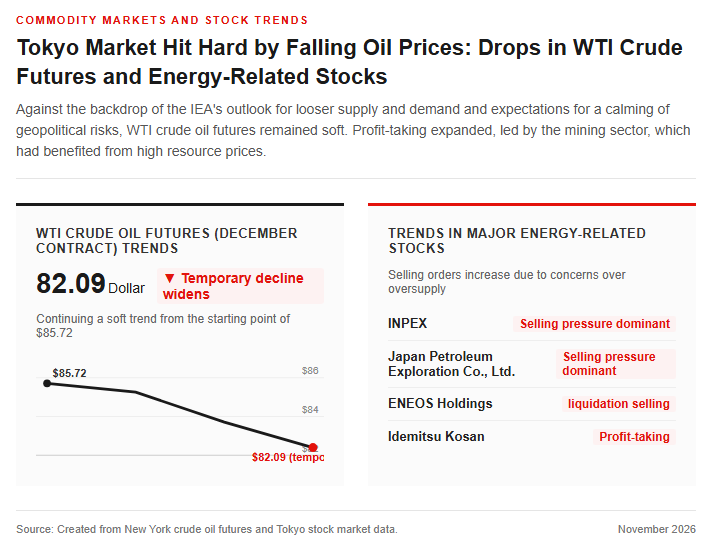
In November 2026, on the Tokyo Stock Exchange, sell orders surged for energy-related stocks such as major oil and natural gas developer INPEX and Petroleum Resources Development, as well as ENEOS Holdings and Idemitsu Kosan. The direct trigger was that December WTI crude oil futures fell to $85.72 per barrel in the New York crude oil futures market, and subsequently extended their decline to briefly reach $82.09 per barrel. Reflecting the sluggish trend in crude oil prices, profit-taking and liquidation sales have been spreading, centered mainly on the mining sector, which had previously benefited from high resource prices. Please refer to the figure below.
International Energy Agency’s Forecast Revision and Easing of Supply and Demand
The primary cause of the recent drop in crude oil prices is the downward revision of the global oil market outlook for the fourth quarter (October–December) of 2026, released by the International Energy Agency (IEA). Reversing its previous forecast of a supply deficit, the IEA presented an analysis indicating that the market will fall into a supply glut of approximately 1.7 million barrels per day. Market sentiment was also boosted by expectations of progress in conflict-resolution talks between the U.S. and Iran, as well as the recovery of tanker traffic through the Strait of Hormuz to pre-conflict levels. Furthermore, the stronger U.S. dollar—driven by expectations of interest rate hikes by the Federal Reserve (FRB)—along with increases in U.S. crude oil inventories by 3.4 million barrels and gasoline inventories by 5 million barrels, have served as downward pressure on crude oil prices.
Energy Company Revenue Structures and Their Impact on Financial Performance
Crude Oil Price Sensitivity and Impact on Corporate Earnings
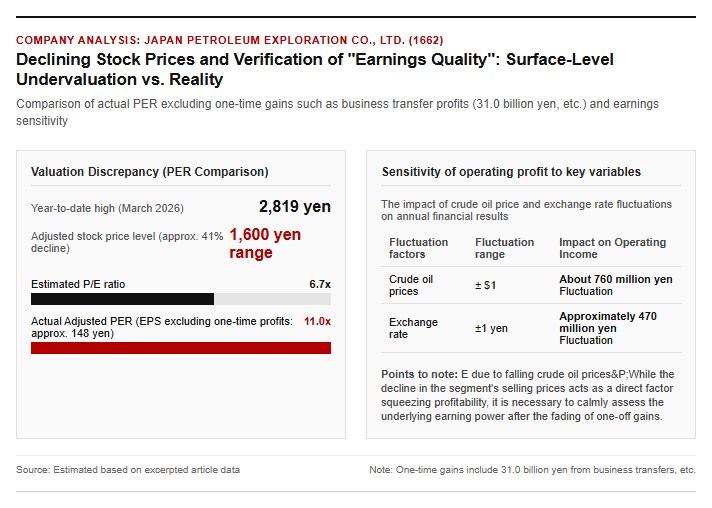
The decline in crude oil prices delivers a direct blow to the financial performance of energy companies engaged in oil and gas exploration, development, and production (E&P). For example, in the case of Japan Petroleum Exploration (1662), the company’s earnings sensitivity is structured such that a $1 per barrel fluctuation in crude oil prices impacts annual operating income by approximately 760 million yen, while a 1-yen fluctuation in the exchange rate has an impact of about 470 million yen. When crude oil prices fall, the selling price in the E&P segment drops, which pushes down both net sales and operating income. On the other hand, in the infrastructure and utility businesses responsible for domestic natural gas and power generation, the drop in LNG procurement costs—which serve as procurement costs—can act as a positive factor in some scenarios, resulting in profit and loss changes that depend on the business portfolio.
Examining the “Quality of Earnings” in Petroleum Resource Development and INPEX
A close examination of valuations in the stock market calls for a cautious approach that looks beyond superficial cheapness. Petroleum Resources Development’s stock price has fallen by approximately 41% from its year-to-date high of 2,819 yen (March 2026), correcting to the 1,600-yen range. While the apparent forecast P/E ratio for the current fiscal year appears undervalued compared to the market average at 6.7x, this includes one-time gains such as a 31 billion yen business transfer profit and gains on the sale of investment securities. Calculated using the underlying adjusted EPS (approximately 148 yen) excluding these one-time gains, the actual P/E ratio is about 11x, significantly diminishing the sense of undervaluation. While plans to double production through the acquisition of U.S. tight oil assets are underway, we have reached a phase where we must carefully assess changes in the quality of earnings. Please refer to the figure below.
Spillover Effects on the Macroeconomy and Future Market Outlook
The Ripple Effects of Falling Crude Oil Prices on the Japanese Economy and Industry as a Whole
While low crude oil prices are a headwind for resource development companies, they act as a cost-reduction tailwind for the Japanese economy as a whole and the manufacturing sector. According to estimates by Nomura Securities, if crude oil prices rise by 20%, Japan’s annual fuel costs will increase by 4 to 5 trillion yen, having the impact of lowering corporate ordinary profits by 2 to 2.5%. Conversely, a drop in crude oil prices has the effect of curbing raw material and logistics costs—centering on energy-intensive industries such as chemicals, steel, and transportation—thereby improving corporate earnings. An analysis by the Daiwa Institute of Research also estimates that if crude oil prices fall by 50%, operating surpluses will be boosted by +4.6% for all industries and by +9.8% for the manufacturing sector, which is expected to improve real GDP through enhanced household purchasing power.
Key Points for the Market to Watch Going Forward and Scenario Analysis
In the future stock market, the timing of the bottoming out of crude oil prices and trends in geopolitical risk will be the primary points of focus. According to scenario analysis by Sumitomo Mitsui DS Asset Management, in an “optimistic scenario” where WTI crude oil prices settle around $75, the negative impact on TOPIX earnings per share (EPS) will be kept to a minimum, and the stock market is projected to head toward a recovery. However, in a “risk scenario” where high prices remain prolonged at $100 to $120, or a “tail-risk scenario” where prices spike to $150 to $200, concerns remain that stock prices could explore a double bottom due to worsening global demand and caution regarding tightening by the Fed. Investors are required to adopt investment strategies that carefully assess the business structures and true earnings potential of individual companies.
Reference Page
- 【Scenario Analysis of Japanese Stocks Based on Crude Oil Prices】https://www.smd-am.co.jp/market/macroview/2026/mvreport20260318/
【#JapanPetroleumExploration #INPEX #CrudeOilPrices #StockInvesting #WTICrudeOil】


コメント