The European Central Bank (ECB) has begun considering raising the minimum reserve ratio required for commercial banks from the current 1% to 2%. The background to this includes excess liquidity associated with large-scale quantitative easing, the elimination of the central bank’s negative spread caused by interest rate hikes, and the aim of reducing its interest payment burden by approximately 4.4 billion euros annually.
- Proposal to double the reserve requirement to 2% to ease interest payment burdens
- A historic policy shift, the first since the 2012 European debt crisis
- The Aftermath of Quantitative Easing and the “Negative Spread” Risk Hitting Central Banks
- The reality of interest payment distribution and fiscal transfers among member states
- “De Facto Tax Increase” and Deteriorating Earnings Warned by the Association of German Banks
- Upcoming Decision Schedule and Central Bank Balance Sheet Outlook
Proposal to double the reserve requirement to 2% to ease interest payment burdens
Policymakers at the European Central Bank (ECB) are expected to discuss a proposal to raise the minimum reserve ratio mandated for commercial banks in the eurozone from the current 1% to 2% at the Governing Council meeting on November 25, 2026. While a final decision may be carried over to the monetary policy meeting on December 17, 2026, if implemented, commercial banks would be required to deposit a greater amount of funds corresponding to short-term liabilities such as deposits into zero-interest accounts at the ECB. The primary aim of this measure is to reduce the massive interest payment costs incurred by the ECB and the national central banks of the 21 eurozone countries. Calculated at the current deposit facility rate level of 2.5%, doubling the minimum reserve ratio is estimated to save the central banks as a whole at least about €4.4 billion (approximately 770 billion yen) in annual interest expenses. Furthermore, if deposit rates are raised to 3.0% to 3.25% over the next year as market expectations suggest, the interest reduction effect is projected to expand even further. Please refer to the figure below.
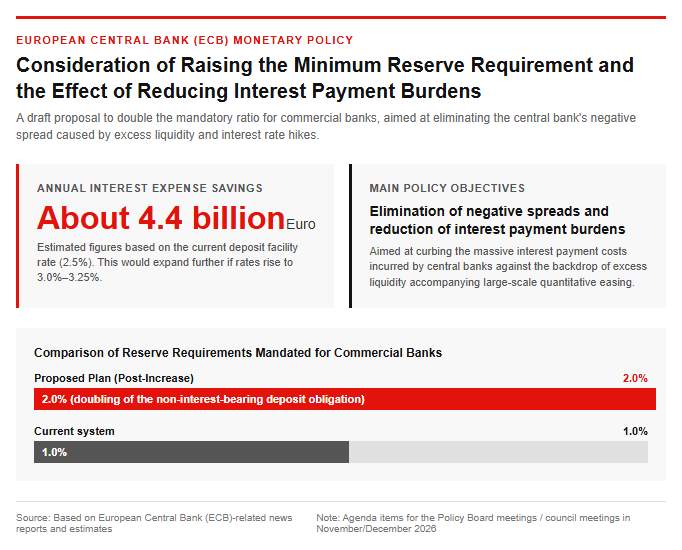
. The institutional change is directly linked to improving the central bank’s finances, while also being expected to have the monetary policy effect of directly absorbing excess liquidity lingering in the market.
A historic policy shift, the first since the 2012 European debt crisis
For the ECB to set the minimum reserve ratio at 2% would mark the first time since 2012. Looking back at history, the ECB lowered the reserve ratio from 2% to 1% during the 2012 European debt crisis with the objective of easing the burden on commercial banks struggling with cash flow, preventing a credit crunch, and promoting lending to the real economy. The current discussions on raising the ratio represent a historic turning point toward normalization and a complete departure from the exceptional monetary easing measures introduced as a crisis response. Although the idea of raising the reserve ratio was already floated as early as the summer of 2025, it was shelved at the time due to strong opposition from some influential policymakers, including Executive Board member Isabel Schnabel. Recently, however, a majority of Governing Council members—including Vice-President Boris Vujčić and Chief Economist Philip Lane—have shifted to supporting the hike, causing discussions to rapidly gain momentum. While a proposal has surfaced among some to postpone implementation until July 2027, when the terms of key high-ranking officials expire, it has failed to garner widespread support, and momentum for an early resolution is building.
The Central Bank Financial Deficit Problem and the Structure of Excess Liquidity
The Aftermath of Quantitative Easing and the “Negative Spread” Risk Hitting Central Banks
Behind the ECB’s move to double the reserve requirement lies the severe deterioration of central bank finances left in the wake of past quantitative easing (QE). Between 2015 and 2022, with the aim of averting deflation and stimulating economic growth, the ECB implemented large-scale Asset Purchase Programmes (APP) and Pandemic Emergency Purchase Programmes (PEPP), pumping vast amounts of liquidity into the market. As a result, an enormous amount of excess liquidity exceeding 2 trillion euros accumulated in the euro area banking system. Central banks in highly rated countries, led by the Deutsche Bundesbank, continue to hold massive amounts of ultra-low-yield government bonds acquired during the era of ultra-low and negative interest rates. Meanwhile, interest rate hikes to combat rapid inflation have forced central banks to pay a high interest rate of 2.5% on excess reserves held by commercial banks, plunging central bank finances into a “negative carry” state. Currently, the Eurosystem as a whole pays a staggering 52.2 billion euros (approximately 9.1 trillion yen) in annual interest to commercial banks, and the widening central bank deficits are igniting political flashpoints and fueling debates over recapitalization using public funds.
The reality of interest payment distribution and fiscal transfers among member states
As pointed out in academic research (such as the analysis by Professor Angelo Baglioni and others), the structure of interest payment burdens through the minimum reserve system generates large-scale redistribution effects among eurozone member countries. Under ECB regulations, central bank monetary income and interest payment burdens are designed to be redistributed among member states according to their capital share (capital key). However, the actual distribution of excess liquidity is heavily skewed among countries. For example, according to actual performance estimates for 2023, while the Deutsche Bundesbank received a net profit-like compensation of approximately €6.329 billion due to the concentration of excess liquidity, the central bank of Italy, which has a low ratio of deposits relative to its capital share, bore a negative impact of €12.67 billion, and the central bank of Spain bore €6.827 billion. Please refer to the figure below.
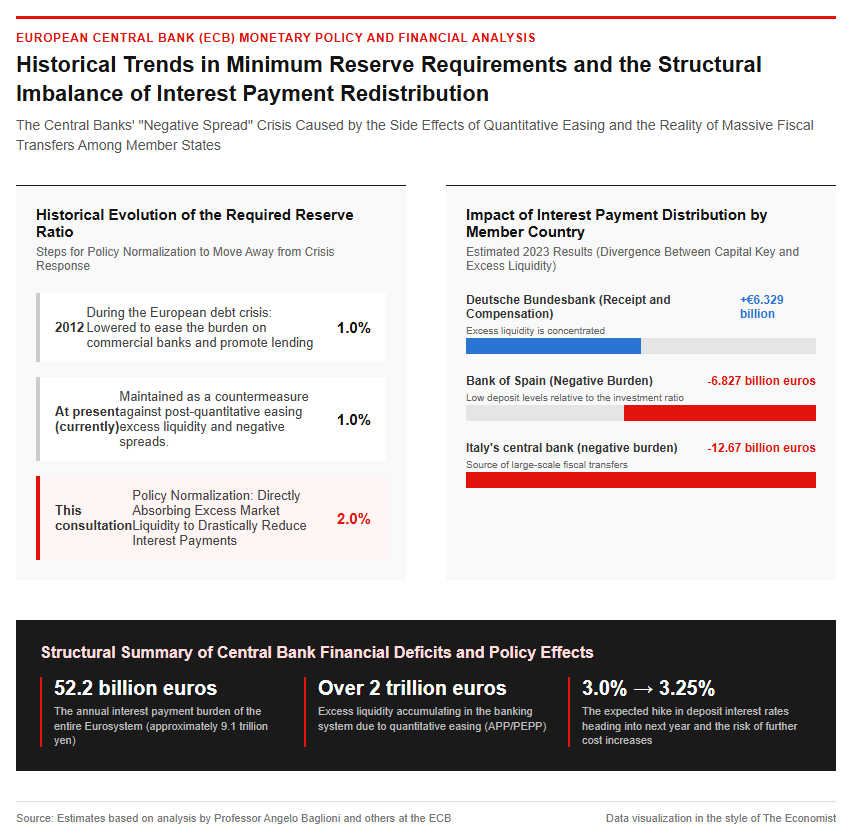
. By raising the minimum reserve requirement and increasing the amount of funds tied up without interest, the total interest payments across the central bank as a whole are suppressed, which is expected to have the effect of keeping the scale of such distorted fiscal transfers among member countries small.
Banking Industry Backlash and Future Impact on Financial Markets
“De Facto Tax Increase” and Deteriorating Earnings Warned by the Association of German Banks
There is fierce backlash from the eurozone banking sector against the ECB’s move to raise reserve requirements. In particular, Heiner Herkenhoff, Managing Director of the Association of German Banks (Bankenverband), issued an official statement strongly condemning the expansion of funds tied up in non-interest-bearing accounts as nothing less than a “de facto tax increase” on the banking industry. This is because doubling the non-interest-bearing statutory reserves will reduce excess reserves that would otherwise have earned deposit interest from the central bank, directly eroding banks’ net interest income. Herkenhoff warns that this measure will not only severely impair the profitability of financial institutions, but also squeeze their lending capacity directed toward corporate capital expenditures and mortgages. Comparing this with the United States, where the Federal Reserve (FRB) does not employ a minimum reserve requirement system and pays market interest on all bank reserves, there are growing concerns that imposing a unilateral burden solely on European banks will further exacerbate their disadvantage in international financial competition.
Upcoming Decision Schedule and Central Bank Balance Sheet Outlook
Discussions surrounding the hike in minimum reserve requirements are expected to be debated in earnest at the Governing Council meeting on November 25, 2026, with a final resolution expected to be reached as early as the policy-setting meeting on December 17, 2026. Financial markets and analysts are closely watching whether this hike in reserve requirements will do more than just serve as a self-congratulatory financial repair for the central bank, functioning instead as part of quantitative tightening (QT). Due to the introduction of post-Lehman international capital and liquidity regulations such as the Liquidity Coverage Ratio (LCR), the practical role that minimum reserves themselves play as a bank liquidity buffer has now diminished. As a result, there are persistent arguments from experts that, rather than relying solely on the micro-measure of raising reserve requirements, active QT is needed to further accelerate the sale and the suspension of reinvestments concerning the ECB’s roughly €5 trillion government bond portfolio. How the ECB proceeds with the normalization of its balance sheet while striking a balance between ensuring financial soundness, price stability, and economic growth will have a profound impact on the European economy.
Reference page
- [European Central Bank (ECB) Official Speech] https://www.ecb.europa.eu/press/key/date/2026/html/ecb.sp261116~db374b56ab.en.html
- 【SUERF (The European Money and Finance Forum) Policy Note】https://www.suerf.org/policynotes
- 【Bocconi Institute for European Policy (IEP@BU) Research Paper】[suspicious link removed]
【#ECB #MinimumReserves #EuropeanMonetaryPolicy #CentralBank #FinancialMarkets #NegativeSpread】


コメント