The Brazilian Ministry of Finance has revised down its gross domestic product growth forecast for 2027 to 1.8% and revised up its inflation forecast to 4.5%. The prolonged period of high benchmark interest rates, mounting public debt, and household debt default issues are weighing heavily on the economy.
- Key Points of the Ministry of Finance’s Economic Outlook Revision
- Gap Between Private Market Forecasts and Central Bank Views
- Persistence of High-Interest-Rate Environment and Impact on the Credit Market
- Public Debt Exceeding 82% of GDP and Rigid Expenditure Structure
- An 80-Million-Scale Credit Default and Debt Amnesty Program
- Key Points to Watch Regarding Congressional Relations and Tax Reform
Key Points of the Ministry of Finance’s Economic Outlook Revision
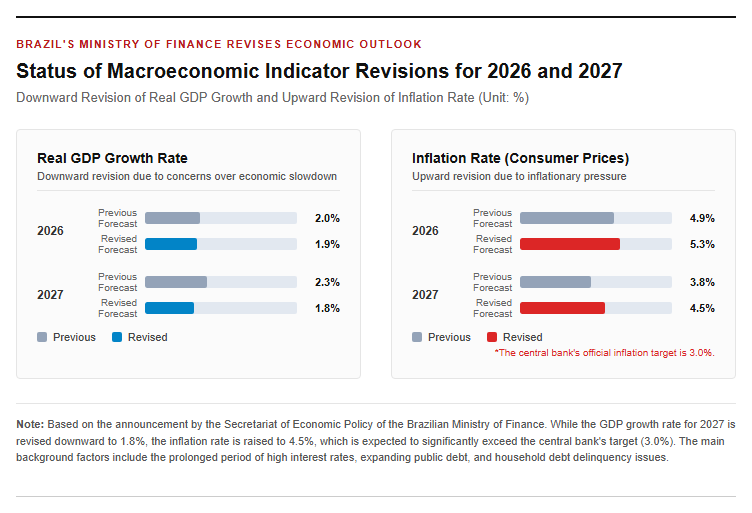
The Economic Policy Secretariat of the Brazilian Ministry of Finance has revised down its real gross domestic product (GDP) growth forecast for 2027 from the previous 2.3% to 1.8%. Additionally, it has raised its consumer price index inflation forecast for the same year from the previous 3.8% to 4.5%. This 4.5% level significantly exceeds the official inflation target of 3.0% set by the Central Bank of Brazil. The Ministry of Finance also slightly revised down its 2026 GDP growth forecast from 2.0% to 1.9% and adjusted its inflation forecast for that year from 4.9% to 5.3%, respectively. According to the Ministry’s explanation, the factors driving the growth slowdown in 2027 include persistently high interest rate policies and prolonged borrowing costs, a decline in the contribution of the key agricultural sector, and a reduction in the statistical carry-over effect from the previous year. This revised outlook is scheduled to be used as the basis for the government’s final revenue and expenditure report and budget amendment proposal for the current fiscal year. The following chart shows the trends in macroeconomic indicators in Brazil in recent years.
Gap Between Private Market Forecasts and Central Bank Views
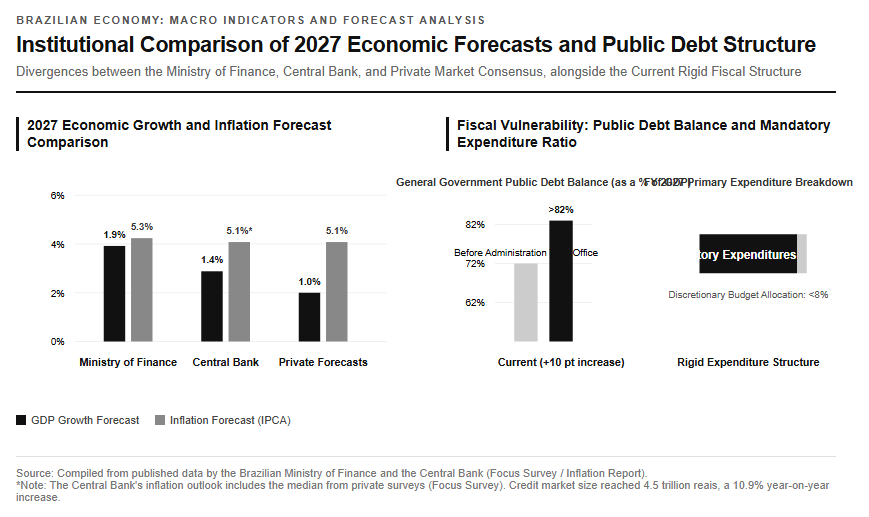
The growth forecast published by the Ministry of Finance remains relatively optimistic compared to the views of the private sector and the central bank. In a weekly survey of private analysts conducted by the Central Bank of Brazil (Focus Survey), the median GDP growth forecast for 2027 stands at just 1.0%, while the inflation forecast reaches 5.1%. In its quarterly monetary policy report, the central bank itself lowered its 2026 growth forecast from 2.0% to 1.8% and presented a cautious outlook that growth in 2027 will be 1.4%. The background behind the central bank presenting a more rigorous growth outlook than the government is a strong sense of caution regarding the fading effects of past economic stimulus measures and a significant increase in uncertainty in the external global environment. While the administration emphasizes its stance of balancing the expansion of social security with economic growth, uncertainty is spreading in the financial markets over whether the government can curb mandatory spending and stabilize public debt.
Monetary Tightening Policy and Expanding Fiscal Challenges
Persistence of High-Interest-Rate Environment and Impact on the Credit Market
Amid persistent inflationary pressures, Brazil’s policy interest rate (Selic) is expected to remain high. The policy rate has hovered at high levels ranging from 13.75% to 15.00%, and in terms of real interest rates as well, it stands at an exceptionally high level among emerging nations. Although the central bank maintains its monetary tightening stance with price stability as its top priority, this high-interest-rate environment directly hits the financing costs of businesses and households. Unsecured personal loan rates and credit card revolving interest rates remain high, drastically increasing the interest payment burden on households. Meanwhile, driven by high profit margins on loans and the entry of fintech companies, the scale of the credit market itself continues to expand, up 10.9% year-on-year to 4.5 trillion reals. This unbalanced structure, in which high interest rates and credit expansion progress simultaneously, is a factor causing sluggish domestic demand and the accumulation of credit risk.
Public Debt Exceeding 82% of GDP and Rigid Expenditure Structure
Emerging as the greatest vulnerability of the Brazilian economy is the rapid expansion of public debt and a rigid fiscal structure. Since the inauguration of the Lula administration, the general government public debt balance has increased by more than 10 percentage points of GDP, surpassing 82%. Looking at the federal government’s expenditure structure, mandatory expenditures mandated by law, such as pensions and personnel costs, account for the majority, with mandatory expenses accounting for 91.7% of primary expenditures in the 2027 budget proposal. The budget framework that the government can reduce at its discretion is extremely limited at less than 8% of the total. The debt-servicing burden on government bonds associated with high interest rates and an increase in payment obligations based on judicial rulings are also putting pressure on finances. Among investors, concerns over fiscal sustainability have intensified the demand for high yields, creating a vicious cycle in which rising government bond issuance costs make fiscal consolidation even more difficult. The following chart illustrates the trend of the public debt-to-GDP ratio.
Household Debt Issues and Future Economic Outlook
An 80-Million-Scale Credit Default and Debt Amnesty Program
The prolonged period of high prices and high interest rates is severely squeezing household cash flow. According to data compiled by the credit bureau Serasa, the number of adults with delayed debt repayments who have been negatively registered with credit bureaus has exceeded 81.7 million, meaning approximately half of the adult population is in a state of default. The average delinquent individual spends 70.5% of their income on debt servicing, making multiple-debt situations—where people cut living expenses just to make repayments—a regular occurrence. In response, President Lula issued “Desenrola Brasil 2.0,” a household debt restructuring program that establishes a government guarantee framework totaling 20 billion reals. This measure targets small-scale delinquent debts, offering up to a 90% discount on the principal and restructuring them into installment plans of up to five years, effectively acting as a debt jubilee to rescue households. However, concerns have also been raised that as long as the structural reliance on borrowing that outpaces income growth remains, such relief measures will amount to nothing more than a temporary palliative treatment.
Key Points to Watch Regarding Congressional Relations and Tax Reform
Political consensus and the feasibility of structural reforms will hold the key to restoring confidence in the Brazilian economy going forward. Following the recent elections, conservative forces—led by the opposition Liberal Party—have seized control of both the upper and lower houses of Congress, weakening the Lula administration’s political foundation for passing legislation and budgets. There is a high risk that discussions on fiscal consolidation bills, such as spending cuts and reviews of tax incentives, will face rough going in Congress. In addition, regarding the new value-added tax (consumption tax reform) scheduled for introduction next year, while the applicable rate is estimated to reach approximately 28%, detailed application rules and tax rates remain unpublished, creating uncertainty for the business environment of companies. To prevent the outflow of foreign assets and restore stability to the real and the stock market, it is essential for the next economic team to present concrete spending containment measures and establish a clear path toward fiscal discipline through cooperation with Congress.
Reference Pages
- [Brazil Ministry of Finance – Desenrola Brasil Official Portal] https://www.gov.br/fazenda/pt-br/assuntos/desenrola
- [IBGE (Brazilian Institute of Geography and Statistics) Official News] https://agenciadenoticias.ibge.gov.br/
- [World Bank – Brazil Macro Poverty Outlook] https://thedocs.worldbank.org/en/doc/e408a7e21ba62d843bdd90dc37e61b57-0500032021/related/mpo-bra.pdf
[#BrazilEconomy #InflationRate #PolicyInterestRate #FiscalDeficit #EmergingMarkets]


コメント