French pharmaceutical giant Sanofi has agreed to acquire U.S. biopharmaceutical company Insmed for approximately $41 billion in all cash. The backdrop involves a sense of urgency regarding revenue declines following the 2031 patent expiration of its blockbuster drug Dupixent, making this a strategic acquisition to capture product portfolios in the respiratory disease field and strengthen the foundation for medium-to-long-term growth.
- Overview of Sanofi’s Billion Acquisition Agreement
- Countermeasures for Dupixent’s Patent Expiration and Strategic Intent
- Revenue Base of Commercialized Respiratory Therapeutics
- Future Prospects of Pipeline New Drug Candidate TPIP Currently in Phase 3 Clinical Trials
- Surging Stock Prices and Market Evaluation by Analysts
- Rating changes due to doubling of debt and future schedule
Overview of Sanofi’s Billion Acquisition Agreement
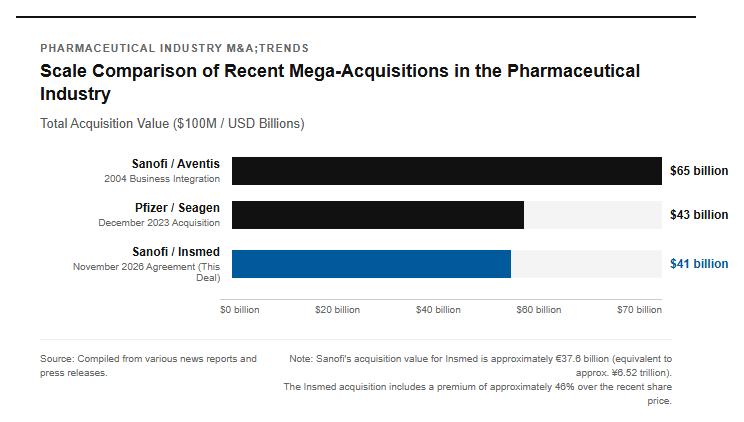
On November 24, 2026, French pharmaceutical giant Sanofi announced that it has agreed to acquire all shares of U.S. biopharmaceutical company Insmed at $175 per share in cash. The total transaction value amounts to approximately $41 billion (approx. €37.6 billion, or roughly 6.52 trillion Japanese yen). This acquisition price represents a premium of about 46% over the stock price of $119.80 on November 18, 2026, before acquisition rumors were reported. In terms of M&A in the pharmaceutical industry, this is the largest mega-deal in roughly three years, since Pfizer acquired Seagen for $43 billion in December 2023. It is also Sanofi’s largest acquisition since its $65 billion business integration with Aventis in 2004. The chart below shows a scale comparison of major pharmaceutical acquisitions in recent years.
This decision is attracting significant attention as the most important strategic turning point implemented under Belén Garijo, who assumed the position of CEO of Sanofi in April 2026.
Countermeasures for Dupixent’s Patent Expiration and Strategic Intent
The primary backdrop for Sanofi’s massive investment is the patent cliff facing its revenue pillar, the antibody drug Dupixent. Dupixent is a flagship product accounting for approximately 40% of Sanofi’s total sales, with third-quarter 2026 sales alone reaching €5.7 billion (approx. $6.2 billion), a roughly 35% increase year-over-year. However, the drug is scheduled to lose its U.S. market exclusivity in 2031, with revenue losses projected to reach approximately €8 billion between 2031 and 2035. By acquiring Insmed to capture commercialized products and development pipelines in the growing respiratory disease therapeutic area, Sanofi aims to offset the revenue decline accompanying Dupixent’s patent expiration and secure a foundation for sustainable performance growth toward the late 2030s. This is a strategic decision to complement delays in in-house research and development through large-scale M&A.
Insmed’s Drug Portfolio and Growth Potential
Revenue Base of Commercialized Respiratory Therapeutics
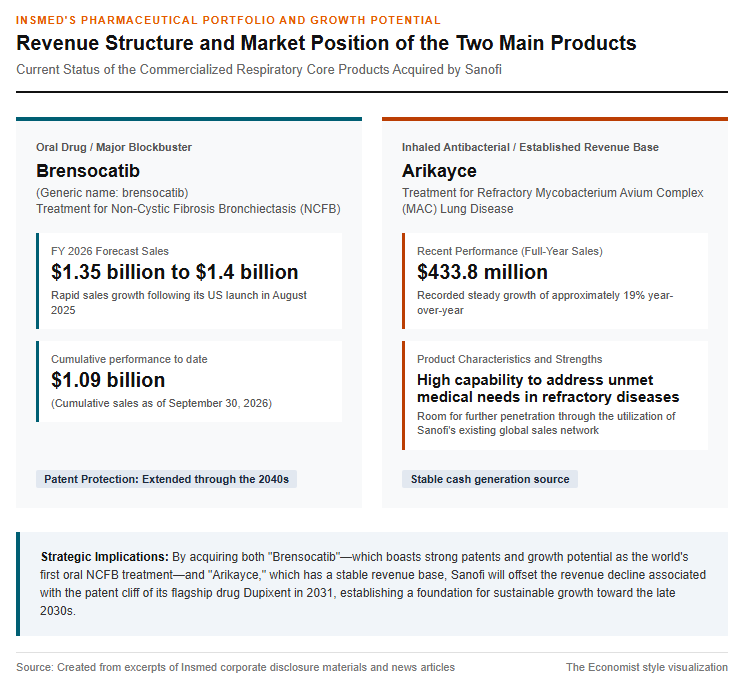
Through this acquisition, Sanofi will acquire two high-quality respiratory therapeutics that Insmed has already successfully commercialized. The first is Brensocatib (brand name: Brinspri), the world’s first approved oral medication for the treatment of non-cystic fibrosis bronchiectasis (NCFB). Since its launch in the United States in August 2025, cumulative sales through September 30, 2026, have reached $1.09 billion, rapidly growing into a major blockbuster drug. Full-year 2026 sales are expected to reach $1.35 billion to $1.4 billion, backed by strong patent protection extending into the 2040s. The second product is the inhaled antibacterial drug Arikayce, which recorded 2025 sales of $433.8 million—a 19% increase year-over-year—for the treatment of refractory Mycobacterium avium complex (MAC) lung disease. The conceptual diagram below illustrates the revenue structure of Insmed’s product lineup.
The strong cash flow generated by these existing products will support future debt repayments.
Future Prospects of Pipeline New Drug Candidate TPIP Currently in Phase 3 Clinical Trials
In addition to the current revenue base from existing products, Sanofi pins its hopes for a new growth driver beyond 2030 on the development-stage drug candidate TPIP (treprostinil palmitil inhalation powder). TPIP is a once-daily inhaled drug candidate, and Phase 3 clinical trials are progressing smoothly targeting pulmonary arterial hypertension (PAH), pulmonary hypertension associated with interstitial lung disease (PH-ILD), and progressive pulmonary fibrosis (PPF). Furthermore, Phase 3 trials targeting idiopathic pulmonary fibrosis (IPF) are scheduled to begin in the first half of 2027. Sanofi CEO Belén Garijo forecasts that the combined future peak sales of the three products—Brinspri, Arikayce, and TPIP—will exceed $10 billion, with some securities firms offering bullish estimates reaching the $15 billion scale. By acquiring these assets en bloc, including those in early clinical trial stages, the aim is to expand global dominance in rare respiratory diseases.
Market Response and Impact on Financials and Credit Ratings
Surging Stock Prices and Market Evaluation by Analysts
Following the announcement of the acquisition agreement, the stock market reacted favorably, with both companies’ share prices surging. On the day of the announcement, Sanofi’s stock price in the Paris market jumped 10.9% to 90.35 euros, marking its highest level in approximately one year. Meanwhile, the stock of the target company, Insmed, also spiked 14.13% to $170.15 in the U.S. market, closing at a level approaching the proposed acquisition price of $175. Securities analysts’ assessments are also generally positive. An analyst from Jefferies in the U.S. noted that the pro forma price-to-earnings (P/E) ratio is approximately 10x, which is below the sector average of 13x, suggesting that it is not an excessive overpayment, and evaluated that it will begin contributing to earnings by the end of 2028. While research firms such as Raymond James have downgraded their investment rating for Insmed to “Neutral,” this is viewed as a rational move reflecting the fact that the stock price has become fixed to the acquisition price.
Rating changes due to doubling of debt and future schedule
The large-scale debt financing required for this major acquisition will place a temporary strain on Sanofi’s financial balance sheet. While the rating agency Moody’s Ratings confirmed Sanofi’s long-term issuer rating of “Aa3,” it changed the rating outlook from “Stable” to “Negative.” As interest-bearing debt is expected to more than double upon completion of the acquisition, it is predicted that the adjusted interest-bearing debt/EBITDA ratio will deteriorate to 3.5x in 2027. However, by utilizing the robust free cash flow generated by Insmed’s products to proceed with deleveraging, the ratio is expected to improve to 2.6x in 2028, contributing to an increase in business-based earnings per share (EPS) by the end of 2028. The boards of directors of both companies have already approved the transaction. Moving forward, the companies aim to complete the acquisition in the first half of 2027, following approval from Insmed shareholders and antitrust reviews by regulatory authorities in Japan, the U.S., and Europe.
Reference Pages
- 【Sanofi Form 6-K (Q3 FY2026)】https://www.sec.gov/Archives/edgar/data/1121404/000112140426000009/pressreleaseq32026english.htm
- 【Insmed Form 8-K (Q3 FY2026)】https://www.sec.gov/Archives/edgar/data/1104506/000114036126041097/ef20084500_ex99-1.htm
- 【Sanofi Form 6-K (Q2 FY2026)】https://www.sec.gov/Archives/edgar/data/1121404/000162828026050803/sny-20260630_d2.htm
【#Sanofi #Insmed #PharmaMA #RespiratoryDiseases #Dupixent #PharmaIndustry #StockInvestment】


コメント