In the takeover battle for Kadoya Sesame Oil, a rival bidder has made a counterproposal to raise its purchase price to 3,200 yen per share. The situation is driven by the movements of major shareholders and a struggle over the company’s valuation.
- Overview and Details of the Rival’s Proposal to Raise the Price to 3,200 Yen
- A 78.2 Billion Yen Valuation and the Disparity with Integral’s Proposal
- Directors’ Duty of Care and the Possibility of the Board Revoking its Consent
- The Launch of the Privatization TOB by the Founding Family and Integral
- An Unprecedented Scenario: The Leading Shareholder Trading Consortium Draws in a Rival Bidder
- Impact of Surging Stock Prices and Increased TOB Prices on Shareholders and Business Operations
- Upcoming Deadlines and Key Points Regarding Fair Procedures in Japanese M&A
Overview and Details of the Rival’s Proposal to Raise the Price to 3,200 Yen
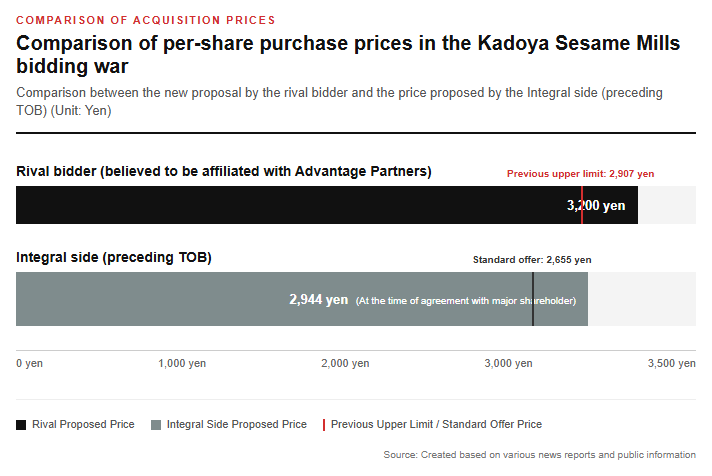
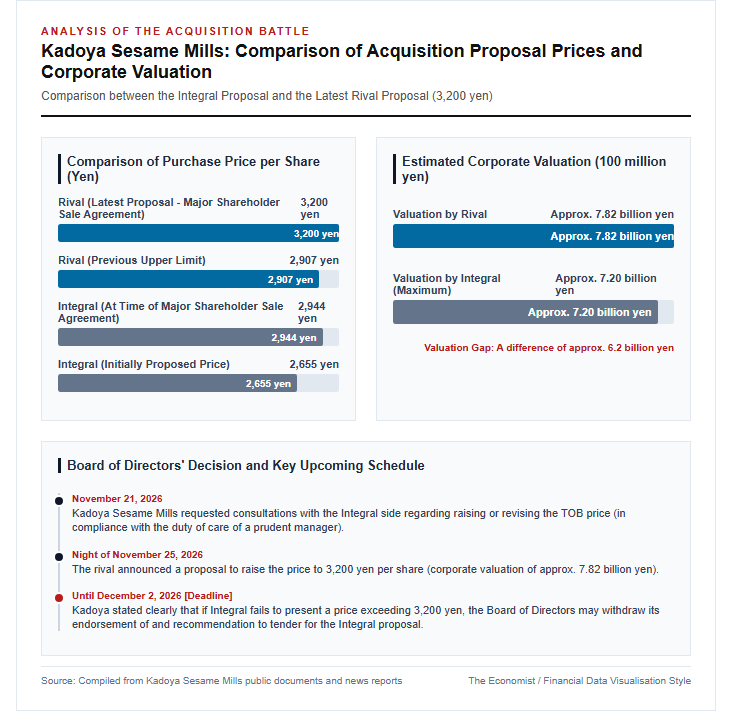
A significant development has occurred in the takeover battle surrounding Kadoya Sesame Oil, the leading sesame oil producer. On the night of November 25, 2026, in relation to the tender offer (TOB) announced in September by an Integral Group-affiliated fund, it was announced that another competing bidder (believed to be the investment fund Advantage Partners) had proposed an increase in the purchase price. Under the new proposal, the purchase price would be 3,200 yen per share, provided that all major shareholders, including the top shareholder Mitsubishi Corporation and the second-largest shareholder Mitsui & Co., agree to sell their shares. This represents a substantial increase from the rival side’s previous maximum purchase price of 2,907 yen. Meanwhile, the price offered by Integral, which is already conducting a TOB, remains at 2,655 yen per share (or 2,944 yen even if all major shareholders agree to sell), allowing the rival bidder to strongly assert its advantage in terms of price. Among market participants, expectations regarding the impact of this massive price hike on share supply and demand are intensifying.
A 78.2 Billion Yen Valuation and the Disparity with Integral’s Proposal
The rival bidder’s decision to raise the purchase price to 3,200 yen is more than just a mere price hike; it highlights a significant gap in the valuation of the target company’s asset value and future potential. According to Kadoya Sesame Oil’s announcement, the rival bidder has made its takeover proposal based on an estimated enterprise value of approximately 78.2 billion yen. In contrast, Integral’s prior valuation is calculated at a maximum of approximately 72 billion yen, resulting in a discrepancy of about 6.2 billion yen between the two valuations. Using this valuation gap as justification, the rival bidder argues that its takeover proposal is overwhelmingly superior in terms of the collective interest of the shareholders. Given the company’s high brand recognition and strong presence in the household sesame oil market, the underlying factor in the price calculation is which fund can more highly value the synergies gained through business growth and management improvements after the company goes private. For general shareholders, the focus remains on whether they will be provided with an opportunity to sell their shares at a price that more accurately reflects the company’s true value.
Directors’ Duty of Care and the Possibility of the Board Revoking its Consent
As the gap between the takeover proposals widens, Kadoya Sesame Oil’s management and Board of Directors are being forced to make a critical legal decision. Initially, the company supported Integral’s TOB, which is partnered with the founding family, and had expressed its intention to recommend the offer to shareholders. However, with the emergence of a higher-priced counterproposal, the company determined there is a concrete and reasonable risk that maintaining its support for the initial, lower-priced TOB could constitute a breach of the directors’ duty of care. Consequently, as of November 21, 2026, the company has requested Integral to enter into discussions regarding a price increase or revision of the TOB. Furthermore, the company stated clearly that if Integral does not present a price exceeding the 3,200 yen level offered by the rival bidder by December 2, 2026, it may revoke its consent to and recommendation of the Integral proposal. The Board of Directors is prepared to carefully compare and examine the terms and legal conditions of both proposals.
Background of the Unprecedented Battle and the Intentions of Major Shareholders
The Launch of the Privatization TOB by the Founding Family and Integral
The trigger for this unusual takeover battle is said to have been a takeover inquiry sent from a major food manufacturer to Kadoya Sesame Oil around September 2025. In response, the founding family, wishing to protect the company’s independence and business policies, began taking countermeasures. As the third-largest shareholder holding 15.87% of the shares through asset management companies and other entities as of the end of March 2026, the founding family teamed up with the investment fund Integral to launch their own TOB aimed at taking the company private. The initial purchase price was set at 1,514 yen per share, starting as a fund-led privatization project (similar to an MBO) that reflected the intentions of management. The primary goal for the founding family and Integral was reportedly to avoid the costs associated with maintaining a listing and short-term shareholder return requests from the market, while advancing business structural reforms from a medium-to-long-term perspective. However, the situation changed completely when outside major shareholders voiced their opposition to this privatization process.
An Unprecedented Scenario: The Leading Shareholder Trading Consortium Draws in a Rival Bidder
What makes the structure of this case extremely unusual is the behavior of the major shareholders, which are large general trading companies. Kadoya Oil’s shareholder composition includes Mitsubishi Corporation as the largest shareholder with a 26.3% stake and Mitsui & Co. as the second-largest shareholder with 21.4%. Combined with the founding family’s 15.87%, these top three entities account for over 60% of the total outstanding shares. Traditionally, major shareholders like trading companies have often functioned as defense mechanisms against takeovers or as stable shareholders; however, in this instance, both Mitsubishi Corporation and Mitsui & Co. expressed dissatisfaction with the initial tender offer price and requested the participation of another potential buyer. By inviting Advantage Partners to act as a rival bidder, the trading companies have triggered a TOB (takeover bid) battle between funds—not a race to drive prices down, but a race to drive them up. This method, where major shareholders themselves bring in a rival to maximize shareholder value, is attracting intense attention from market participants as an unprecedented case in conventional Japanese M&A practices and privatization processes.
Stock Market Reaction and Medium-to-Long-Term Outlook Regarding the Privatization Deal
Impact of Surging Stock Prices and Increased TOB Prices on Shareholders and Business Operations
The stock market reacted immediately when reports surfaced of a rival bidder’s proposal to raise the price to 3,200 yen. On the Tokyo Stock Exchange on November 26, 2026, Kadoya Oil’s stock price (TSE Standard, ticker code 2612) surged by more than 5% from the previous day to 3,270 yen, marking a new year-to-date high. The trend of rising tender offer prices brings the direct benefit of substantial premium returns to general investors and existing shareholders who choose to exit by selling their shares. On the other hand, for the acquirer who successfully completes the takeover and operates the company, it signifies a significant increase in acquisition costs. Risks have also been pointed out that if a fund pays a high acquisition price upfront, it may lead to excessive pressure for profit recovery or debt burdens during business operations after privatization. The question remains how to balance the maximization of shareholder returns with healthy business investment and product development schemes post-acquisition.
Upcoming Deadlines and Key Points Regarding Fair Procedures in Japanese M&A
The upcoming focus is narrowed down to whether Integral will initiate a further price hike to counter the rival’s 3,200 yen proposal by the set deadline of December 2, 2026, or whether they will withdraw or agree to modified terms. The success of the TOB and the final acquisition price will be determined by which proposal the major shareholders, who hold a majority of the voting rights (Mitsubishi Corporation, Mitsui & Co., and the founding family), ultimately select. This battle can be seen as a symbolic case of “bumpitrage” (demands for price increases after a TOB announcement) and counter-TOBs, which have been spreading across the Japanese market in recent years. Amid calls for the Tokyo Stock Exchange to ensure thorough fair procedures in MBOs (management buyouts) and privatizations by controlling shareholders—such as market checks and minority shareholder protection—this case presents a challenge of whether a true acquirer can be selected who not only drives up the price but also contributes to the long-term improvement of corporate value. Future developments will have a significant impact on governance practices for privatization M&A in Japanese companies.
Reference Pages
- [Japan Research Institute Research Report: “Activist Trends and the Response Required from Japanese Listed Companies”] https://www.jri.co.jp
[#KadoyaOil #TOB #TakeoverDefense #Integral #AdvantagePartners]


コメント