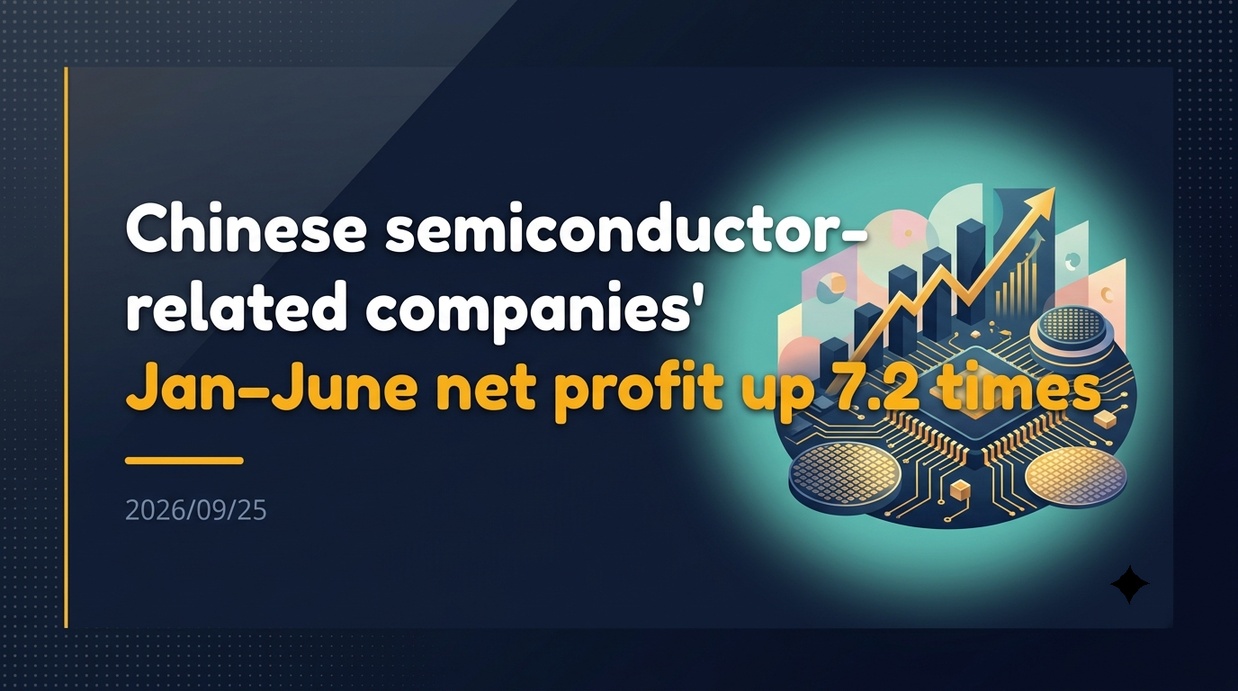
Combined net profits of semiconductor companies listed in mainland China surged 7.2-fold year-on-year in the first half of 2026. The dramatic surge was driven by expanding demand from rapid AI adoption alongside government-led localization initiatives designed to counter U.S. export controls.
- Key Highlights and Analysis of Financial Results
- The AI Surge and Bolstered Domestic Demand
- Massive Subsidies from the National Integrated Circuit Industry Investment Fund
- Escalating U.S. Export Controls and Supply Chain Restructuring
- Expanding Global Market Share in Legacy Nodes and Industry Impact
- Future Outlook and Key Watchpoints in the Global Semiconductor Market
Key Highlights and Analysis of Financial Results
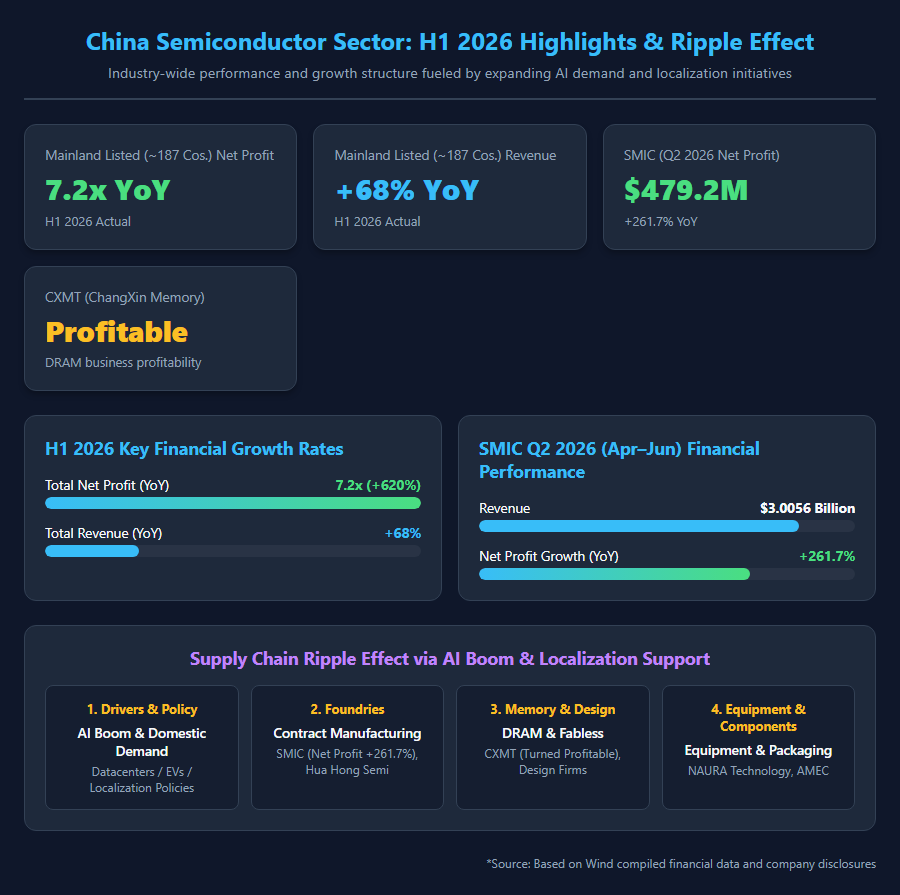
The financial recovery and growth among major semiconductor companies listed on mainland Chinese stock exchanges have reached dramatic proportions. According to financial data compiled by market intelligence firm Wind across approximately 187 listed semiconductor companies in mainland China, total net profits for the first half of 2026 soared 7.2-fold year-on-year. Over the same period, total revenues recorded impressive growth of 68% year-on-year. This wave of financial performance improvement was not confined to a few dominant players; it reverberated across the entire supply chain, encompassing pure-play foundries, memory manufacturers, fabless design firms, back-end packaging and testing providers, as well as equipment and materials suppliers. As a prominent example, Semiconductor Manufacturing International Corporation (SMIC), China’s leading contract chipmaker, reported second-quarter 2026 revenue of \$3.0056 billion, while net profit surged 261.7% year-on-year to \$479.2 million. Meanwhile, major DRAM producer ChangXin Memory Technologies (CXMT) achieved profitability after prolonged losses. Fundamental structural turnarounds at such flagship enterprises served as a primary catalyst lifting the broader industry metrics. The diagram below illustrates this ripple effect across the sector.
The AI Surge and Bolstered Domestic Demand
The primary macroeconomic catalyst behind this explosive profit growth was the rapid global proliferation of artificial intelligence technologies and the resulting surge in datacenter demand. Developing and operating generative AI models demands vast computing power, fueling global demand for advanced logic chips and high-capacity memory modules. Within China, tech giants and emerging startups alike have launched proprietary large language models (LLMs) and AI-driven services, sparking an influx of infrastructure investment. Furthermore, key domestic sectors including electric vehicles (EVs), smart home appliances, and industrial automation equipment have steadily increased their semiconductor content per unit, boosting demand across the product spectrum from commodity microcontrollers to high-value silicon. As U.S. export restrictions curbed access to foreign high-end semiconductors, domestic technology firms moved to mitigate supply chain risks by increasingly sourcing from local chipmakers. This structural shift toward domestic procurement created strong tailwinds for local semiconductor vendors, driving up both capacity utilization rates and average selling prices.
Massive State Funds and Import-Substitution Strategy Under U.S. Sanctions
Massive Subsidies from the National Integrated Circuit Industry Investment Fund
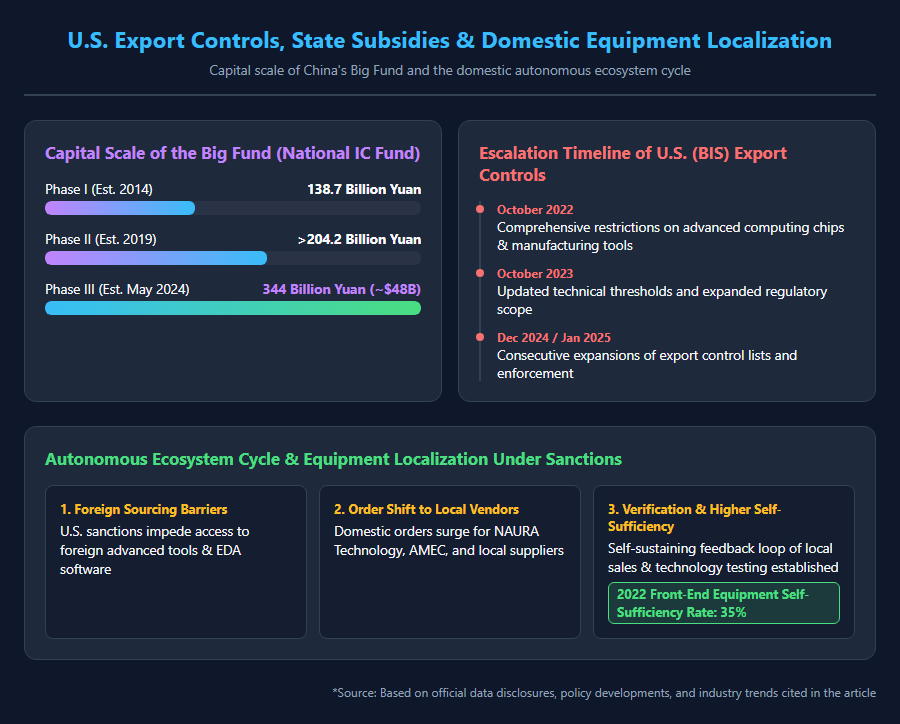
Underpinning the rapid expansion of China’s semiconductor sector is sustained, aggressive financial backing and industrial planning spearheaded by the central government. Under the “Made in China 2025” strategic framework introduced in 2015, Beijing established ambitious goals for semiconductor self-sufficiency and built a powerful financing framework. Central to this strategy is the National Integrated Circuit Industry Investment Fund, commonly known as the “Big Fund.” The Big Fund raised 138.7 billion yuan during Phase I in 2014 and over 204.2 billion yuan in Phase II in 2019, injecting direct capital into key players such as SMIC and Hua Hong Semiconductor. In May 2024, the fund established Phase III with a registered capital of 344 billion yuan (approximately \$48 billion). Beyond direct equity stakes, policy banks have extended low-interest credit while crowding in private capital, directing tens of trillions of yen into fabrication plant construction and capital equipment. On the policy front, generous tax incentives—including corporate income tax exemptions of up to 10 years for fabs operating 28-nanometer (nm) or mature processes for over 15 years, along with a 120% tax deduction on research and development expenses—have significantly alleviated capital burdens for domestic manufacturers.
Escalating U.S. Export Controls and Supply Chain Restructuring
While the tightening of U.S. export controls initially created supply chain disruptions, it ultimately accelerated China’s import-substitution agenda. Since the Bureau of Industry and Security (BIS) under the U.S. Department of Commerce sharply restricted exports of advanced computing chips and semiconductor manufacturing equipment in October 2022, Washington has progressively expanded its regulatory reach through additional controls in October 2023, December 2024, and January 2025. Facing severe barriers in procuring cutting-edge lithography systems and advanced EDA software, Chinese chipmakers prioritized eliminating foreign dependency. Orders placed with domestic equipment suppliers, such as Naura Technology Group (NAURA) and Advanced Micro-Fabrication Equipment Inc. (AMEC), surged dramatically, pushing the domestic sourcing rate for front-end equipment to 35% as early as 2022. Consequently, stringent U.S. restrictions paradoxically fostered a self-sustaining cycle of domestic procurement, field testing, and iteration, establishing a resilient local equipment ecosystem. The figure below illustrates the progression of equipment self-sufficiency.
The Rise of Mature Processes and Global Market Implications
Expanding Global Market Share in Legacy Nodes and Industry Impact
With access to leading-edge nodes severely constrained, Chinese foundries concentrated capital investments on mature processes (28nm and above), rapidly expanding their global manufacturing capacity share. Market research firm TrendForce projects that China’s share of global mature-node capacity will rise from 29% in 2023 to 33% by 2027. Massive production infrastructure for legacy chips—essential for automotive systems, industrial equipment, power electronics, and CMOS image sensors (CIS)—is coming online, enabling Chinese vendors to leverage vast economies of scale and state subsidies to offer aggressive price competitiveness. This rapid capacity expansion presents a formidable challenge to competing foundries in Taiwan, South Korea, Europe, and the United States, exerting downward pressure on legacy chip pricing and intensifying competition for market share. China’s growing dominance in mature nodes is reshaping the balance of power in the global semiconductor supply chain.
Future Outlook and Key Watchpoints in the Global Semiconductor Market
Looking forward, the critical questions surrounding China’s semiconductor trajectory focus on how domestic manufacturers will overcome technological bottlenecks in sub-7nm fabrication and navigate potential overcapacity risks. Led by SMIC, Chinese vendors continue to pursue process shrink technologies equivalent to 7nm and 5nm. However, operating without access to Extreme Ultraviolet (EUV) lithography tools poses formidable hurdles regarding manufacturing yield and cost sustainability. Simultaneously, aggressive capital expenditure raises concerns about potential supply gluts in mature nodes, leading analysts to project a temporary cooling in equipment purchasing starting after 2025. Nonetheless, supported by substantial state subsidies and a massive domestic technology market, China’s semiconductor ecosystem is poised to maintain a self-directed growth trajectory despite U.S. sanctions. As nations worldwide accelerate efforts to onshore chip manufacturing for national security reasons, the ongoing bifurcation and fragmentation of the global semiconductor market will remain a central defining dynamic.
Reference Pages
- [arXiv Publication Database] https://arxiv.org/
【#ChinaSemiconductors #AIDemand #ProfitSurge #ChipLocalization #TechEconomy #FinancialResults】


コメント